
We read your photo as:
How do I sew a sleeveless dress with belts for a 15-year-old girl, including pattern selection, fabric cutting, bodice and skirt construction, and finishing?
ScanSolve AI Answer
Answer
Step-by-step solution
3 stepshere's how to approach this tailoring business task:
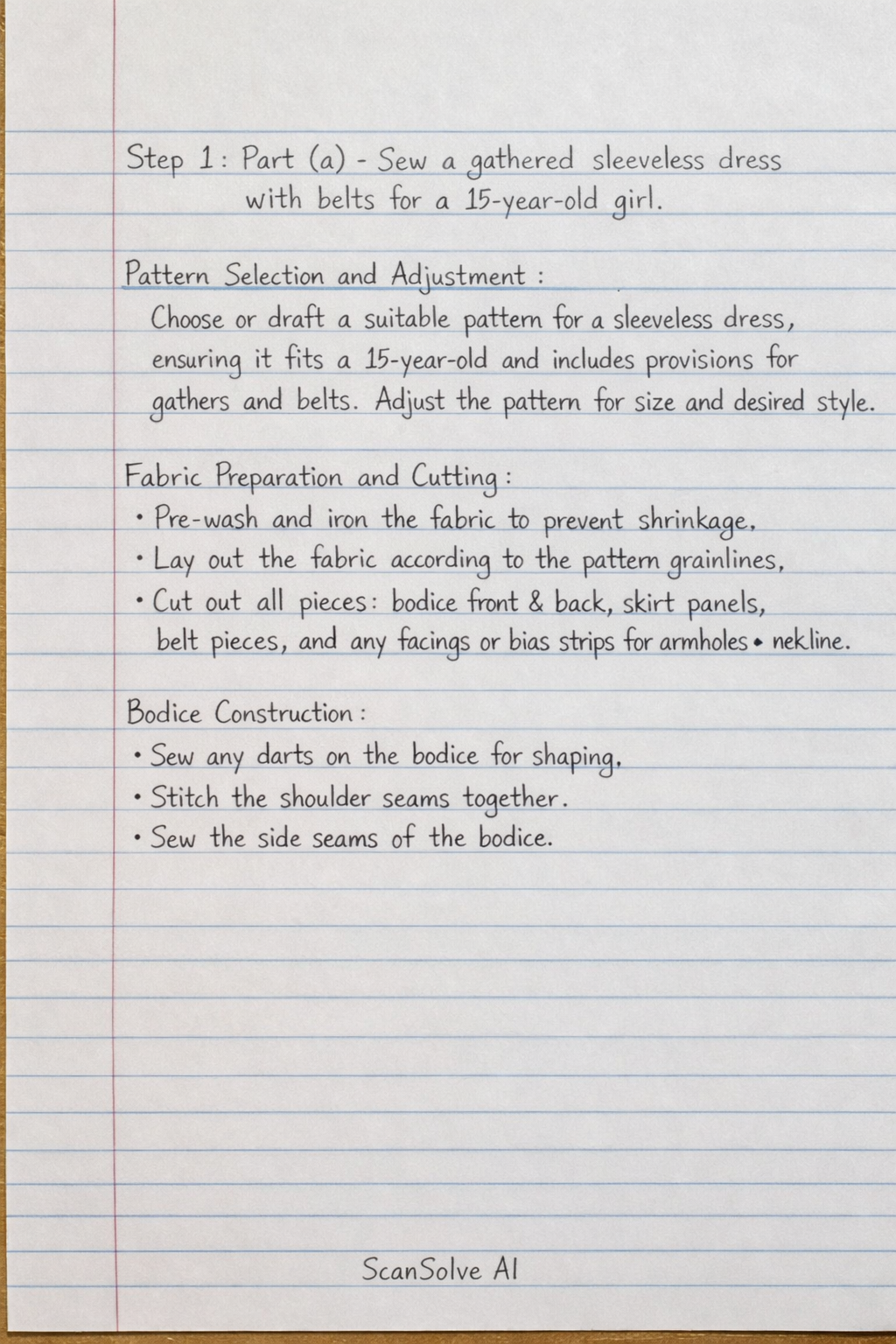
Part (a) - Sew a gathered sleeveless dress with belts for a 15-year-old girl.
To sew the dress, you would follow these needlework processes:
- Pattern Selection and Adjustment: Choose or draft a suitable pattern for a sleeveless dress, ensuring it fits a 15-year-old and includes provisions for gathers and belts. Adjust the pattern for size and desired style.
- Fabric Preparation and Cutting: Pre-wash and iron the fabric to prevent shrinkage. Lay out the fabric according to the pattern grainlines and accurately cut out all pieces: bodice front and back, skirt panels, belt pieces, and any facings or bias strips for armholes and neckline.
- Bodice Construction: Sew any darts on the bodice for shaping. Join the shoulder seams and side seams of the bodice.
- Skirt Construction and Gathering: Sew the side seams of the skirt panels. Create gathers along the top edge of the skirt by sewing two rows of long stitches and pulling the bobbin threads until the skirt matches the width of the bodice waistline.
- Joining Bodice and Skirt: Pin and stitch the gathered skirt to the bodice at the waistline, ensuring gathers are evenly distributed.
- Finishing Armholes and Neckline: Apply facings or bias binding to neatly finish the raw edges of the armholes and neckline.
- Belt Construction: Sew the belt pieces, turn them right side out, and press them flat. Attach the belts securely to the dress at the waistline, or create belt loops if they are detachable.
- Hemming: Finish the bottom edge of the dress with a neat hem, such as a double-fold hem or a blind hem.
- Final Pressing: Give the entire dress a final press to ensure a crisp, professional finish.
Part (b) - With the remaining fabric, make a fascinator for hair styling or an elastic hair band.
Assuming you choose to make an elastic hair band:
- Fabric and Elastic Cutting: Cut a rectangular strip of the remaining fabric (e.g., 50 cm long by 10 cm wide) and a piece of elastic (e.g., 20 cm long).
- Sewing the Fabric Tube: Fold the fabric strip lengthwise, right sides together, and sew along the long edge to create a tube. Turn the tube right side out.
- Inserting Elastic: Attach a safety pin to one end of the elastic and thread it through the fabric tube until it emerges from the other end.
- Securing Elastic: Overlap the ends of the elastic by about 1 cm and stitch them securely together.
- Finishing the Hair Band: Bring the raw ends of the fabric tube together, tucking one end into the other, and stitch them closed neatly to enclose the elastic and form a continuous loop.
Part (c) - In your portfolio, explain all the needlework processes clearly and calculate your expenditure and profit.
Explanation of Needlework Processes for a Portfolio:
A comprehensive portfolio would highlight key needlework techniques and their application. These include:- Pattern Interpretation and Layout: Understanding pattern markings, grainlines, and efficient fabric layout to minimize waste.
- Accurate Cutting: Precision in cutting fabric pieces to ensure garments fit correctly and hang well.
- Seaming Techniques: Mastery of various seams (e.g., plain seams for strength, French seams for a neat finish on delicate fabrics) and appropriate seam allowances.
- Shaping Techniques: Using darts, gathers, pleats, and tucks to create garment shape and fit the body contours.
- Edge Finishes: Applying facings, bias binding, or hemming techniques to create clean, durable edges on necklines, armholes, and garment hems.
- Fastenings and Openings: Skill in inserting zippers, creating buttonholes, and attaching buttons or other closures.
- Pressing: The critical role of pressing at each stage of construction to achieve a professional, crisp appearance and set stitches.
- Embellishment: Techniques for adding decorative elements like belts, appliqués, or embroidery to enhance the garment's aesthetic appeal.
Calculation of Expenditure and Profit:
Given an initial capital of K150, let's assume the following costs for materials and a selling price for the items.Assumed Expenditure:
- Fabric for dress (e.g., 2.5 meters at K30 per meter) = K75.00
- Thread (1 spool) = K5.00
- Elastic (for hair band) = K5.00
- Zipper (for dress, if needed) = K10.00
- Other notions (e.g., interfacing, small embellishments) = K10.00 Total Expenditure = K75.00 + K5.00 + K5.00 + K10.00 + K10.00 = K105.00
Assumed Income:
- Selling price of the gathered sleeveless dress = K120.00
- Selling price of the elastic hair band = K25.00 Total Income = K120.00 + K25.00 = K145.00
Profit Calculation:
The profit generated from this tailoring project is K40.00.
Try one yourself
A new problem that tests the same skill.
Still stuck on this one?
Ask a follow-up, and the answer starts from this question.
More Business/Management Questions
Handwritten Step-by-Step Solution
Get this as a handwritten image on WhatsApp — like a tutor wrote it for you.
Try on WhatsApp