
We read your photo as:
Identify challenges in managing manufacturing services operations.
ScanSolve AI Answer
Step-by-step solution
8 stepsPart a· 2 steps
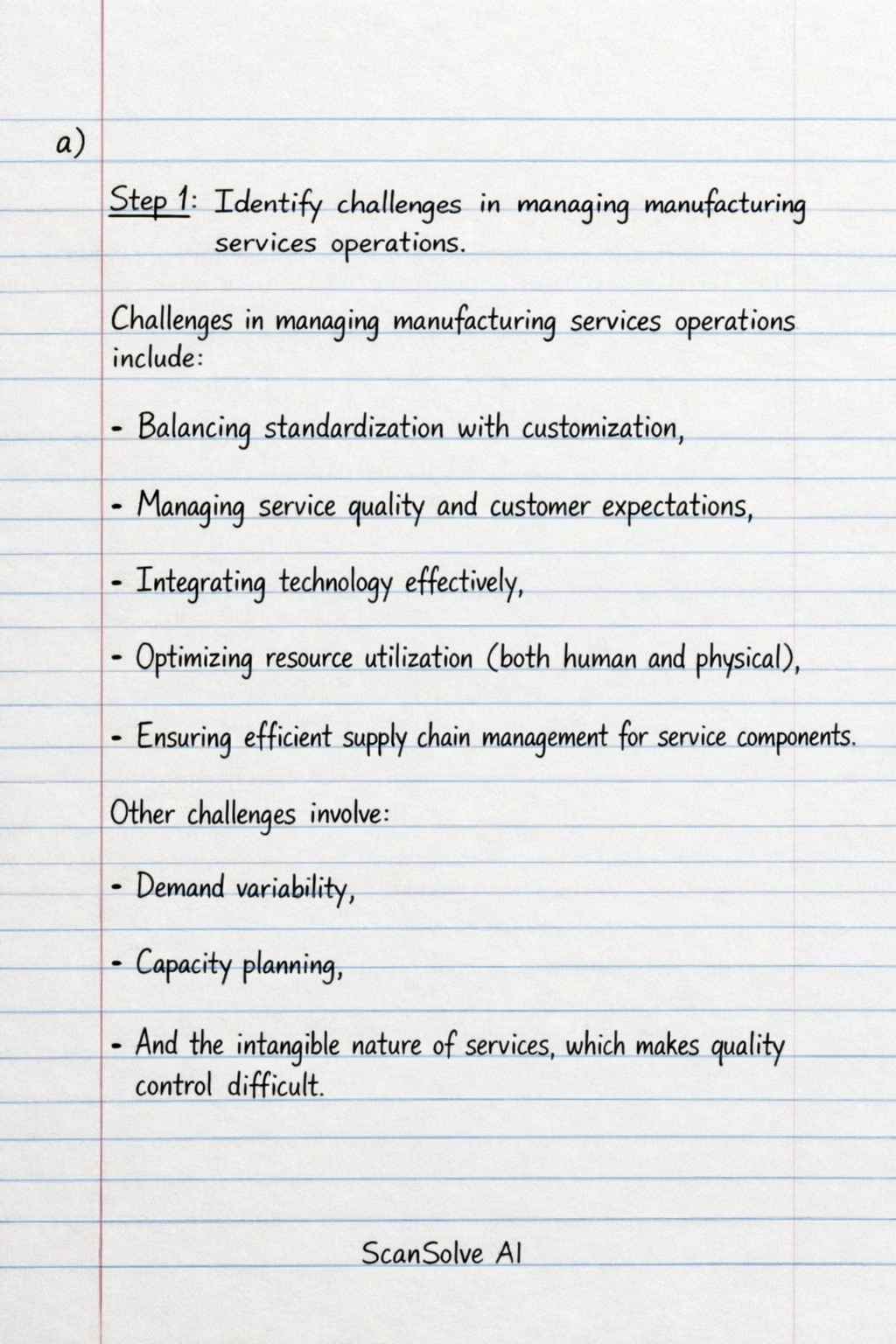
Identify challenges in managing manufacturing services operations.
Challenges in managing manufacturing services operations include balancing standardization with customization, managing service quality and customer expectations, integrating technology effectively, optimizing resource utilization (both human and physical), and ensuring efficient supply chain management for service components. Other challenges involve demand variability, capacity planning, and the intangible nature of services, which makes quality control difficult.
Illustrate with a case study example.
Consider a company that manufactures and installs complex industrial machinery, also providing maintenance and repair services. A case study might highlight challenges such as:
- Demand Variability: Fluctuations in demand for new machinery and maintenance services lead to difficulties in staffing and resource allocation.
- Service Quality: Ensuring consistent quality across diverse service technicians and locations, especially when dealing with unique client issues, is complex.
- Integration: Coordinating the manufacturing schedule with service delivery and spare parts availability requires robust planning and communication systems.
- Customer Expectations: Managing diverse customer expectations regarding service response times, technical expertise, and problem resolution can be challenging.
Part b· 2 steps
Analyze the CEO's argument.
The CEO states they have "never used E-commerce in making any decision" and a board member "never had heard of it." This indicates a complete disregard for a significant and growing aspect of modern business. The intern's unhappiness suggests a recognition of this oversight.
Identify the fallacy.
The fallacy in the CEO's argument is an appeal to ignorance or appeal to tradition/personal experience. The CEO assumes that because they have not personally used or understood e-commerce, it is not relevant or important for their company. This ignores the widespread adoption and strategic importance of e-commerce in the contemporary business landscape, especially for "blue-chip companies." It also demonstrates a lack of foresight and adaptability, which are crucial for business survival and growth.
Part c· 2 steps
Understand COVID-19 as a "transformed input" in the Kenyan economy.
The COVID-19 pandemic acted as a transformed input by fundamentally altering the conditions under which businesses operate. It impacted labor availability, supply chain stability, consumer behavior, and the regulatory environment, forcing companies to adapt their production and operations strategies.
Discuss the impact from a Production and Operations Management (POM) perspective in Kenya.
From a POM perspective, the pandemic significantly affected Kenyan businesses in several ways:
- Supply Chain Disruptions: Global and local lockdowns led to delays in raw material procurement, increased logistics costs, and stockouts, forcing companies to re-evaluate their supply chain resilience and consider local sourcing.
- Labor Management: Restrictions on movement, health protocols, and remote work mandates impacted workforce availability and productivity, necessitating changes in scheduling, safety measures, and training.
- Demand Shifts: Consumer preferences changed rapidly, with increased demand for essential goods and online services, while demand for non-essential items and in-person services declined. This required businesses to quickly adjust production volumes and product mixes.
- Technology Adoption: The need for remote work and contactless transactions accelerated the adoption of digital technologies, automation, and e-commerce platforms to maintain operations and reach customers.
- Capacity Planning: Businesses had to re-evaluate production capacities and flexibility to cope with unpredictable demand and supply, often leading to underutilization or overextension of resources.
Part d· 2 steps
Define Just-in-Time (JIT) Management.
Just-in-Time (JIT) management is an inventory strategy where materials are ordered and received only when needed for production, aiming to reduce waste, inventory costs, and lead times.
Explain common concerns with JIT.
While JIT offers significant benefits, common concerns include:
- Vulnerability to Disruptions: JIT systems rely on a highly efficient and predictable supply chain. Any disruption, such as supplier delays, natural disasters, or transport issues, can halt production entirely due to minimal buffer stock.
- Increased Reliance on Suppliers: Companies become heavily dependent on the reliability and performance of their suppliers, making supplier relationship management critical and any supplier failure potentially catastrophic.
- Quality Control Risks: With less inventory to inspect, defects in incoming materials can quickly propagate through the production process, leading to significant rework or scrap costs.
- Lack of Flexibility for Demand Spikes: JIT systems are optimized for stable demand. Sudden, unexpected increases in customer demand can be difficult to meet quickly without sufficient inventory or production capacity.
- High Implementation Costs: Transitioning to a JIT system often requires significant investment in new processes, technology, and training, as well as a cultural shift within the organization.
Still stuck on this one?
Ask a follow-up, and the answer starts from this question.
More Business/Management Questions
Handwritten Step-by-Step Solution
Get this as a handwritten image on WhatsApp — like a tutor wrote it for you.
Try on WhatsApp