
We read your photo as:
Identify two performance appraisal criteria used at TechMart Group and two rater errors evident in the case study.
ScanSolve AI Answer
Step-by-step solution
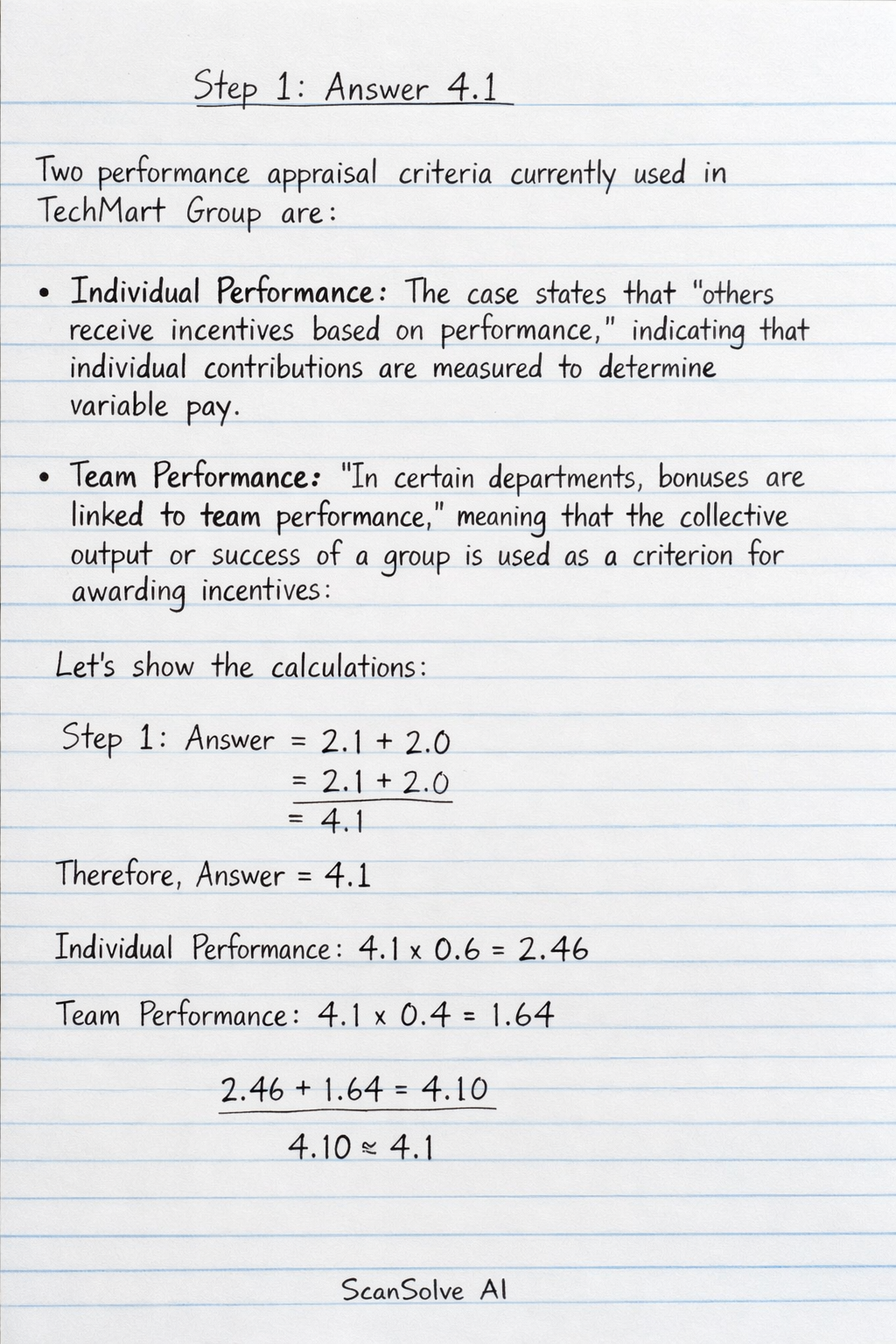
7 stepsAnswer 4.1
Two performance appraisal criteria currently used in TechMart Group are:
- Individual Performance: The case states that "others receive incentives based on performance," indicating that individual contributions are measured to determine variable pay.
- Team Performance: "In certain departments, bonuses are linked to team performance," meaning that the collective output or success of a group is used as a criterion for awarding incentives.
Answer 4.2
Two rater errors evident in the case study and how they negatively affect performance evaluations are:
- Central Tendency Error: This occurs when raters avoid using the extreme ends of the rating scale and rate most employees as "average." In TechMart, if bonuses are linked to team performance and high-performing individuals feel others benefit unfairly, it suggests that individual contributions within a team are not being adequately differentiated, leading to a perception that everyone is rated similarly regardless of individual effort. This demotivates high performers and fails to provide accurate feedback.
- Leniency Error: This occurs when raters consistently give high ratings to most employees, regardless of their actual performance, often to avoid conflict. If high performers are frustrated because others benefit unfairly from team bonuses, it could be due to raters being too lenient with lower-performing team members, giving them similar high ratings or bonuses as high performers. This undermines the credibility of the evaluation system and reduces the motivational impact of rewards.
Answer 4.3
Two actions the HR department can take to improve the effectiveness and fairness of the performance management system are:
- Implement a more objective and transparent performance appraisal system: This involves developing clear, measurable performance standards and using appraisal methods (e.g., Management by Objectives or Behaviorally Anchored Rating Scales) that reduce subjectivity and clearly link individual contributions to rewards, addressing the frustration of high performers.
- Provide comprehensive rater training: Training managers on how to conduct fair and accurate performance appraisals, identify and avoid rater errors (like central tendency or leniency), and provide constructive feedback can significantly improve the consistency and fairness of evaluations.
Answer 4.4
Training focuses on improving an employee's current job-related skills and knowledge, typically for short-term application. Development, on the other hand, focuses on preparing employees for future roles and responsibilities, enhancing their long-term career growth and potential within the organization. Both contribute to organizational effectiveness by increasing employee productivity, adaptability to change, and overall competence, leading to better performance, innovation, and retention.
Answer 4.5
The first phase of the systems approach to training and development (T&D) is Needs Assessment (or Diagnosis).
TechMart should diagnose its training needs by conducting:- Organizational Analysis: Examine the company's strategic goals, resources, and external environment to identify where training can support business objectives (e.g., addressing employee dissatisfaction, improving retention).
- Task Analysis: Identify the specific knowledge, skills, and abilities (KSAs) required for each job, especially in light of new compensation policies or performance management systems, to determine what employees need to learn to perform effectively.
- Person Analysis: Evaluate individual employees' current performance and KSAs against the required standards to pinpoint who needs training and in what specific areas (e.g., managers needing training on fair appraisal practices, employees needing skills to meet new performance targets).
Answer 4.6
Compensation refers to all forms of financial returns and tangible services and benefits employees receive as part of an employment relationship.
One objective of an effective compensation system is to attract and retain qualified employees. By offering competitive salaries, benefits, and incentives, an organization can draw in top talent and encourage them to stay, reducing turnover and ensuring a stable, skilled workforce.Answer 4.7
One compensation system and one incentive-related problem evident in the case study are:
- Compensation System: Fixed Salary System. This is evident as "Some employees are paid fixed salaries," meaning they receive a predetermined amount of money regardless of short-term performance fluctuations.
- Incentive-related Problem: Lack of individual differentiation in team-based incentives. The case states that "bonuses are linked to team performance, which has caused frustration among high-performing individuals who feel that others benefit unfairly." This indicates that the incentive system fails to adequately distinguish and reward individual high performance within a team context, leading to demotivation and perceptions of inequity.
Still stuck on this one?
Ask a follow-up, and the answer starts from this question.
More Business/Management Questions
Handwritten Step-by-Step Solution
Get this as a handwritten image on WhatsApp — like a tutor wrote it for you.
Try on WhatsApp