

This business/management problem is solved step by step below, with detailed explanations to help you understand the method and arrive at the correct answer.
ScanSolve AI Answer
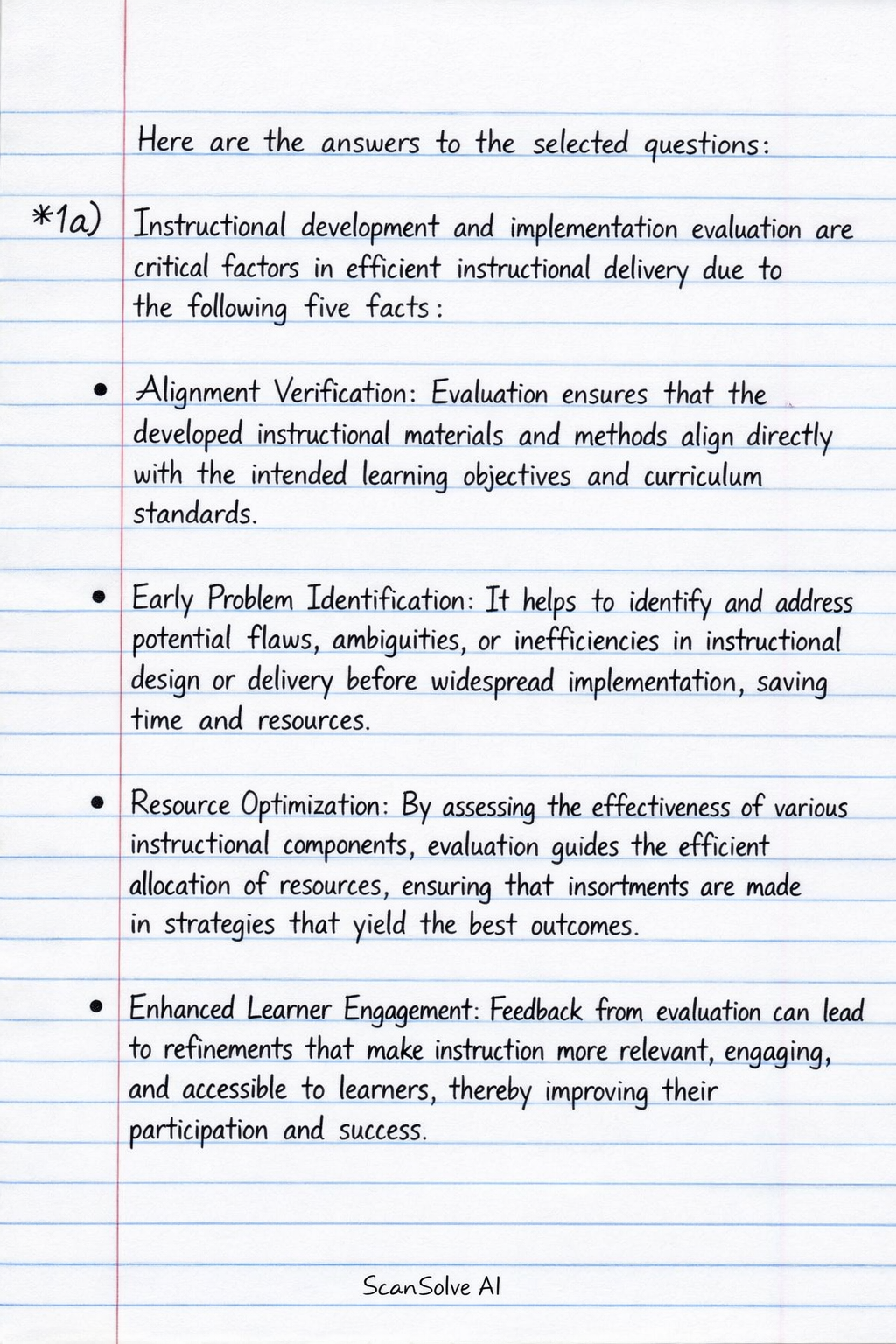
Here are the answers to the selected questions: 1a) Instructional development and implementation evaluation are critical factors in efficient instructional delivery due to the following five facts: • Alignment Verification: Evaluation ensures that the developed instructional materials and methods align directly with the intended learning objectives and curriculum standards. • Early Problem Identification: It helps to identify and address potential flaws, ambiguities, or inefficiencies in instructional design or delivery before widespread implementation, saving time and resources. • Resource Optimization: By assessing the effectiveness of various instructional components, evaluation guides the efficient allocation of resources, ensuring that investments are made in strategies that yield the best outcomes. • Enhanced Learner Engagement: Feedback from evaluation can lead to refinements that make instruction more relevant, engaging, and accessible to learners, thereby improving their participation and success. • Continuous Improvement: Evaluation provides essential data for ongoing refinement and adaptation of instructional practices, fostering a cycle of continuous improvement in educational quality. 2a) Formative evaluation of instructional material guarantees the attainment of instructional goals through the following six points, aligning with principles often emphasized in systematic instructional design: • Identification of Learning Gaps: Formative evaluation helps pinpoint specific areas where learners are struggling or have misconceptions during the learning process, allowing for targeted intervention. • Timely Feedback Provision: It provides immediate and constructive feedback to both students and instructors, enabling learners to correct errors and instructors to adjust their teaching strategies. • Curriculum and Material Adjustment: Data collected informs necessary modifications to instructional content, activities, or materials to better suit learner needs and ensure alignment with goals. • Motivation and Engagement Enhancement: Regular opportunities for feedback and improvement can boost student confidence and motivation, encouraging active participation and deeper learning. • Progress Monitoring: It allows for continuous tracking of student progress towards specific instructional objectives, ensuring that learners are on the correct path to achieving desired outcomes. • Instructional Strategy Refinement: Formative evaluation helps instructors refine their teaching methods and approaches based on real-time student responses, making instruction more effective and goal-oriented. 3a) The evaluation of learning outcomes holds significant relevance for five key reasons: • Accountability: It provides evidence to stakeholders (students, parents, administrators, public) that educational programs are effective and achieving their stated goals. • Program Improvement: Evaluation data identifies strengths and weaknesses in curriculum, instruction, and resources, guiding informed decisions for program enhancement and development. • Student Progress Assessment: It measures individual student achievement and growth, helping to identify areas where students excel or require additional support and intervention. • Informed Decision-Making: Results from outcome evaluations inform critical decisions regarding resource allocation, policy adjustments, and the continuation or modification of educational initiatives. • Quality Assurance: It serves as a mechanism to ensure the quality and effectiveness of educational offerings, contributing to the overall credibility and standards of an institution. 4a) Four methods for evaluating cognitive learning outcomes include: • Multiple-Choice Questions (MCQs): These questions assess a broad range of cognitive skills, from recall and comprehension to application and analysis. They are efficient for covering extensive content and provide objective scoring. • Essay Questions: Essay questions require students to construct their own responses, demonstrating higher-order thinking skills such as analysis, synthesis, evaluation, and the ability to organize and articulate complex ideas. • Problem-Solving Tasks: These tasks involve presenting students with scenarios or problems that require them to apply learned knowledge and skills to find solutions, thereby evaluating their understanding, application, and critical thinking abilities. • Short-Answer Questions: Similar to essays but requiring more concise responses, short-answer questions assess recall, comprehension, and the ability to explain concepts or provide specific details without the extensive writing required for essays. Send me the next one 📸