
We read your photo as:
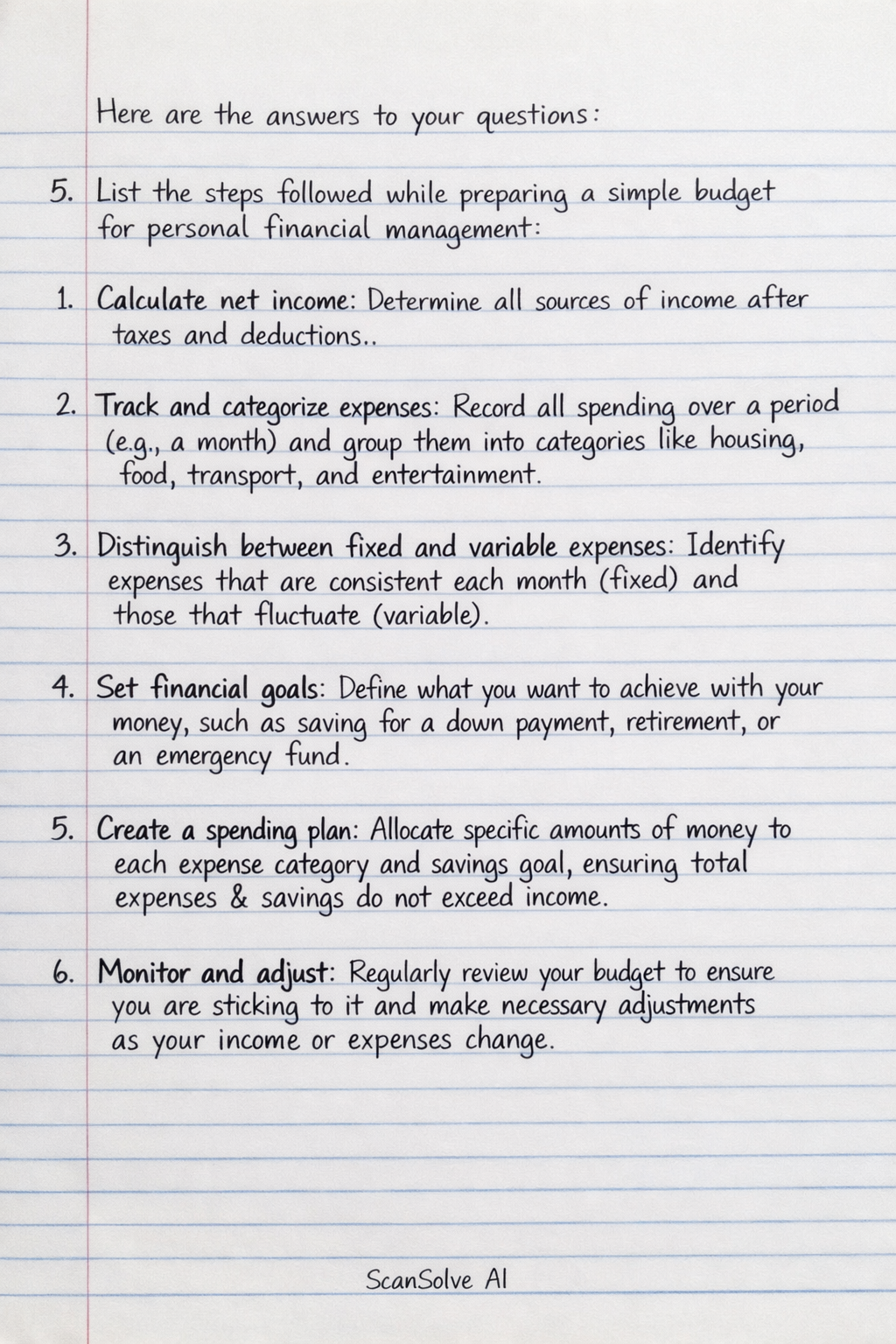
List the steps followed while preparing a simple budget for personal financial management.
ScanSolve AI Answer
Here are the answers to your questions:
5. List the steps followed while preparing a simple budget for personal financial management.
- Calculate net income: Determine all sources of income after taxes and deductions.
- Track and categorize expenses: Record all spending over a period (e.g., a month) and group them into categories like housing, food, transport, and entertainment.
- Distinguish between fixed and variable expenses: Identify expenses that are consistent each month (fixed) and those that fluctuate (variable).
- Set financial goals: Define what you want to achieve with your money, such as saving for a down payment, retirement, or an emergency fund.
- Create a spending plan: Allocate specific amounts of money to each expense category and savings goal, ensuring total expenses and savings do not exceed income.
- Monitor and adjust: Regularly review your budget to ensure you are sticking to it and make necessary adjustments as your income or expenses change.
6. Define the terms below.
- Ethical practices: These are actions or behaviors that conform to accepted moral principles, standards of conduct, and values within a society or profession. They involve honesty, integrity, fairness, and respect for others.
- Unethical practices: These are actions or behaviors that violate accepted moral principles, standards of conduct, or values. They often involve dishonesty, unfairness, deception, or a disregard for the well-being of others.
7. Describe ethical practices to be observed in Income & budgeting.
- Honesty and Transparency: Accurately report all income and expenses without misrepresentation or concealment, especially when managing shared finances.
- Responsibility: Manage funds responsibly, avoiding excessive debt or spending beyond one's means, and fulfilling financial obligations.
- Fairness: Ensure equitable distribution and allocation of funds, particularly in household or joint budgets, considering the needs and contributions of all parties.
- Integrity: Adhere to financial commitments and agreements, and avoid any fraudulent activities or misuse of funds.
- Confidentiality: Protect sensitive financial information of oneself or others involved in the budget.
8. Identify the Importance of Financial planning.
- Achieving Financial Goals: Helps in setting and reaching long-term objectives like retirement, buying a home, or education.
- Managing Cash Flow: Provides a clear picture of income and expenses, allowing for better control over money.
- Making Informed Decisions: Enables individuals to make sound choices about spending, saving, and investing.
- Preparing for Emergencies: Facilitates the creation of an emergency fund to handle unexpected financial setbacks.
- Reducing Financial Stress: Offers peace of mind by providing a structured approach to managing money.
- Wealth Creation: Guides investment decisions to grow assets over time.
- Tax Efficiency: Helps in planning to minimize tax liabilities legally.
9. Imagine that you got a job and you will be receiving a salary of KSh 40,000 per month. Prepare a simple budget that will see you through the month and make some savings.
Here is a simple budget based on a KSh 40,000 monthly salary, incorporating savings:
Monthly Income:
- Salary: KSh 40,000
Monthly Expenses:
- Rent/Housing: KSh 12,000
- Food/Groceries: KSh 9,000
- Transportation: KSh 4,000
- Utilities (Electricity, Water, Internet): KSh 4,000
- Personal Care/Miscellaneous: KSh 3,000
- Entertainment/Social: KSh 3,000
- Total Expenses: KSh 35,000
Savings:
- Income - Total Expenses = KSh 40,000 - KSh 35,000 = KSh 5,000
- Monthly Savings: KSh 5,000
This budget allocates KSh 5,000 for savings, which is 12.5% of the monthly income, allowing for financial growth while covering essential expenses.
Still stuck on this one?
Ask a follow-up, and the answer starts from this question.
Handwritten Step-by-Step Solution
Get this as a handwritten image on WhatsApp — like a tutor wrote it for you.
Try on WhatsApp