
We read your photo as:
Describe alternative funding sources and market data collection methods for a new business.
ScanSolve AI Answer
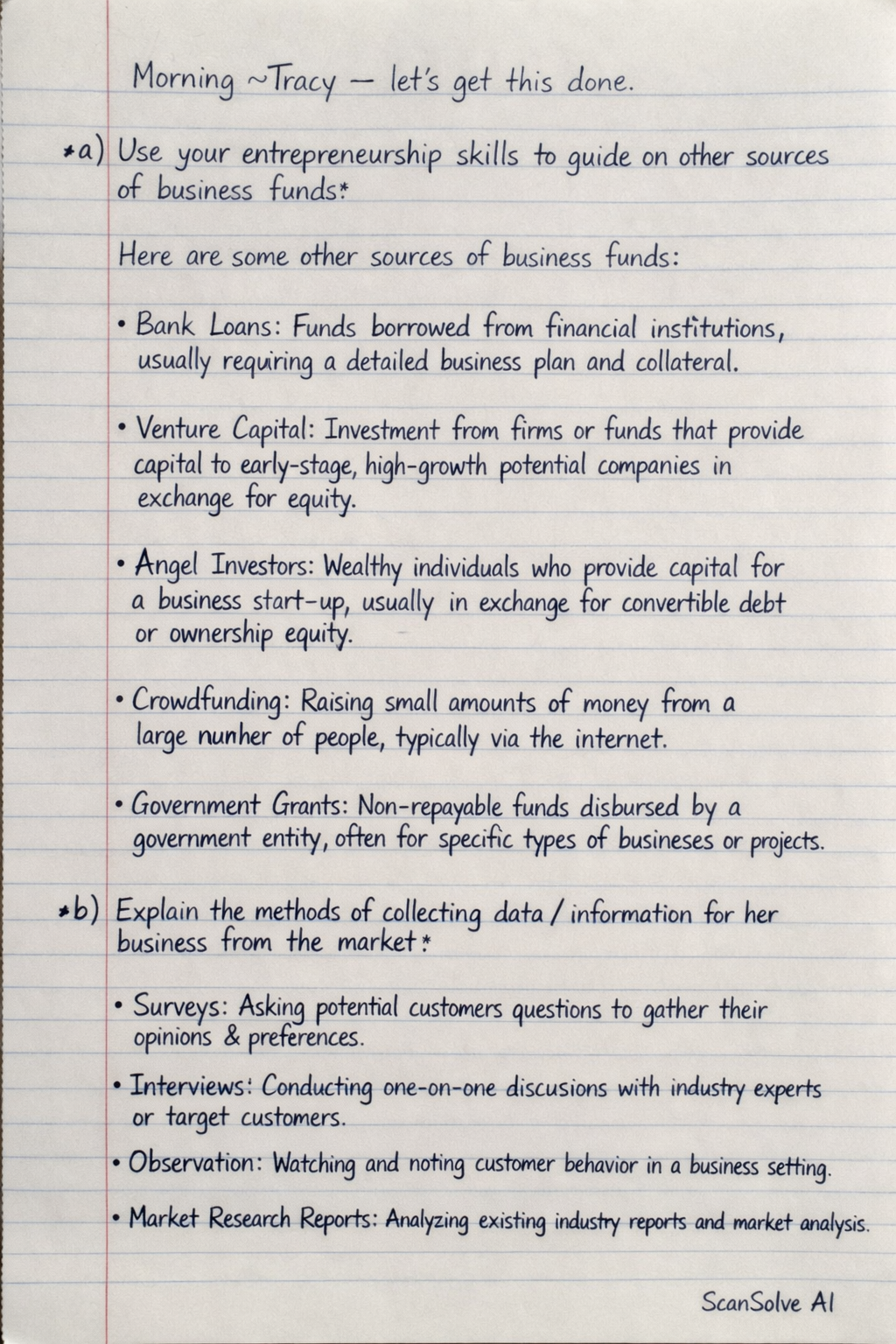
a) Use your entrepreneurship skills to guide on other sources of business funds
Here are some other sources of business funds:
- Bank Loans: Funds borrowed from financial institutions, usually requiring a detailed business plan and collateral.
- Venture Capital: Investment from firms or funds that provide capital to early-stage, high-growth potential companies in exchange for equity.
- Angel Investors: Wealthy individuals who provide capital for a business start-up, usually in exchange for convertible debt or ownership equity.
- Crowdfunding: Raising small amounts of money from a large number of people, typically via the internet.
- Government Grants: Non-repayable funds disbursed by a government entity, often for specific types of businesses or projects.
b) Explain the methods of collecting data/information for her business from the market
Methods for collecting market data include:
- Surveys: Gathering information from a sample of people through questionnaires, either online, by phone, or in person.
- Interviews: Direct, one-on-one conversations with individuals to gather in-depth qualitative information.
- Focus Groups: Bringing together a small group of people to discuss specific topics, providing insights into opinions and perceptions.
- Observation: Watching and recording consumer behavior in natural settings without direct interaction.
- Secondary Research: Analyzing existing data from sources like government reports, industry publications, academic studies, and competitor websites.
c) Help her to understand the different steps she can undertake to start up a bakery.
Here are the steps to start a bakery:
- Develop a Business Plan: Outline your bakery concept, target market, products, marketing strategy, financial projections, and operational details.
- Secure Funding: Determine how you will finance your bakery, whether through personal savings, loans, investors, or grants.
- Choose a Location: Select a suitable site that offers good visibility, foot traffic, and meets zoning requirements for a food establishment.
- Obtain Licenses and Permits: Register your business and acquire all necessary health permits, food safety certifications, and local business licenses.
- Purchase Equipment and Supplies: Invest in essential bakery equipment like ovens, mixers, display cases, and source high-quality ingredients.
- Hire and Train Staff: Recruit bakers, counter staff, and other personnel, ensuring they are skilled and knowledgeable in food handling and customer service.
- Marketing and Launch: Promote your bakery through various channels (social media, local advertising) and plan a grand opening to attract initial customers.
d) Explain for her five different type of business can consider to choose the right one under her plans.
Here are five different types of bakery business models she can consider:
- Retail Bakery: A traditional storefront where customers walk in to purchase freshly baked goods directly.
- Wholesale Bakery: Focuses on producing baked goods in bulk to supply other businesses, such as restaurants, cafes, or grocery stores.
- Online Bakery: Operates primarily through an e-commerce platform, taking orders online for delivery or pickup.
- Specialty Bakery: Concentrates on a niche market, offering specific products like gluten-free, vegan, custom cakes, or artisanal breads.
- Cafe Bakery: Combines a retail bakery with a cafe setting, offering coffee, tea, and light meals alongside baked goods for dine-in customers.
e) Describe three types of business legal forms/forms of ownership.
Here are three types of business legal forms:
- Sole Proprietorship: This is the simplest form of business ownership where one individual owns and operates the business. The owner is personally liable for all business debts and obligations.
- Partnership: A business owned by two or more individuals who agree to share in the profits or losses of the business. Partners typically share personal liability for the business's debts.
- Limited Liability Company (LLC): A hybrid business structure that provides the limited liability features of a corporation and the operational flexibility and tax efficiencies of a partnership or sole proprietorship. Owners are not personally liable for the company's debts.
Still stuck on this one?
Ask a follow-up, and the answer starts from this question.
More Business/Management Questions
Handwritten Step-by-Step Solution
Get this as a handwritten image on WhatsApp — like a tutor wrote it for you.
Try on WhatsApp