
We read your photo as:
Match the following questions between column 'A' with column 'B' (20%)
ScanSolve AI Answer
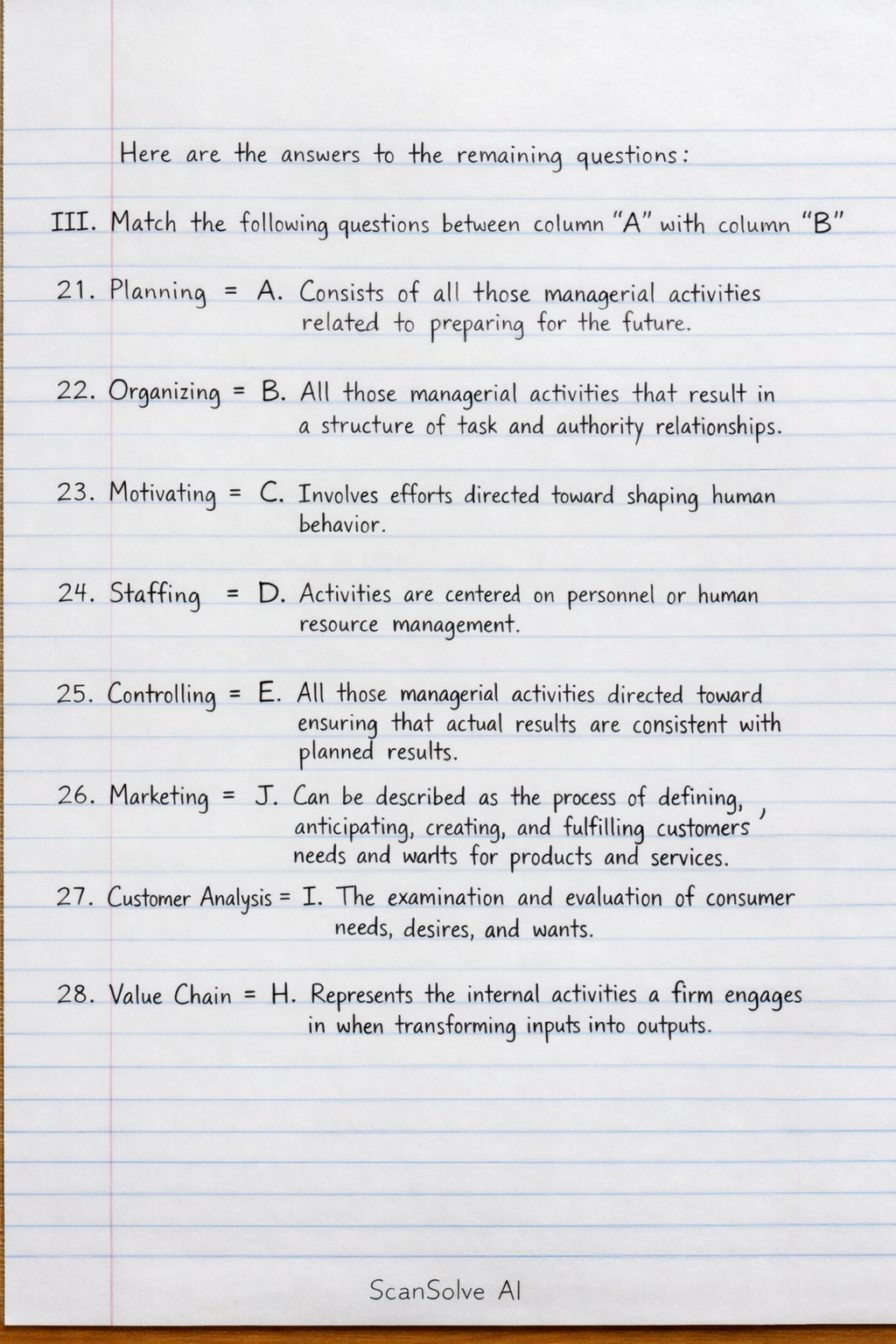
Here are the answers to the remaining questions:
III. Match the following questions between column 'A' with column 'B'
- 21 Planning: A. Consists of all those managerial activities related to preparing for the future.
- 22 Organizing: B. All those managerial activities that result in a structure of task and authority relationships.
- 23 Motivating: C. Involves efforts directed toward shaping human behavior.
- 24 Staffing: D. Activities are centered on personnel or human resource management.
- 25 Controlling: E. All those managerial activities directed toward ensuring that actual results are consistent with planned results.
- 26 Marketing: J. Can be described as the process of defining, anticipating, creating, and fulfilling customers' needs and wants for products and services.
- 27 Customer Analysis: I. The examination and evaluation of consumer needs, desires, and wants.
- 28 Value chain: H. Represents the internal activities a firm engages in when transforming inputs into outputs.
- 29 Forward integration strategy: G. It refers to the transactions between the customers and firm.
- 30 Backward Integration: F. Seeking ownership or increased control of a firm's suppliers.
IV. Give short answers for the following essay questions (10 points)
1. What is strategic management?
Strategic management is the process of formulating, implementing, and evaluating cross-functional decisions that enable an organization to achieve its objectives. It involves setting long-term goals, analyzing the internal and external environments, and making decisions to allocate resources effectively.
2. What are the importance of strategic management?
Strategic management is important because it provides a clear sense of direction, helps organizations adapt to changing environments, enhances decision-making, and improves overall organizational performance and profitability. It also facilitates better resource allocation and fosters a proactive approach to challenges.
3. What are 3(three) general types of diversification strategies:
The three general types of diversification strategies are:
- a) Concentric Diversification: Adding new, but related, products or services to the existing product line.
- b) Horizontal Diversification: Adding new, unrelated products or services that appeal to the company's existing customer base.
- c) Conglomerate Diversification: Adding new, unrelated products or services for new customers.
Still stuck on this one?
Ask a follow-up, and the answer starts from this question.
Handwritten Step-by-Step Solution
Get this as a handwritten image on WhatsApp — like a tutor wrote it for you.
Try on WhatsApp