
We read your photo as:
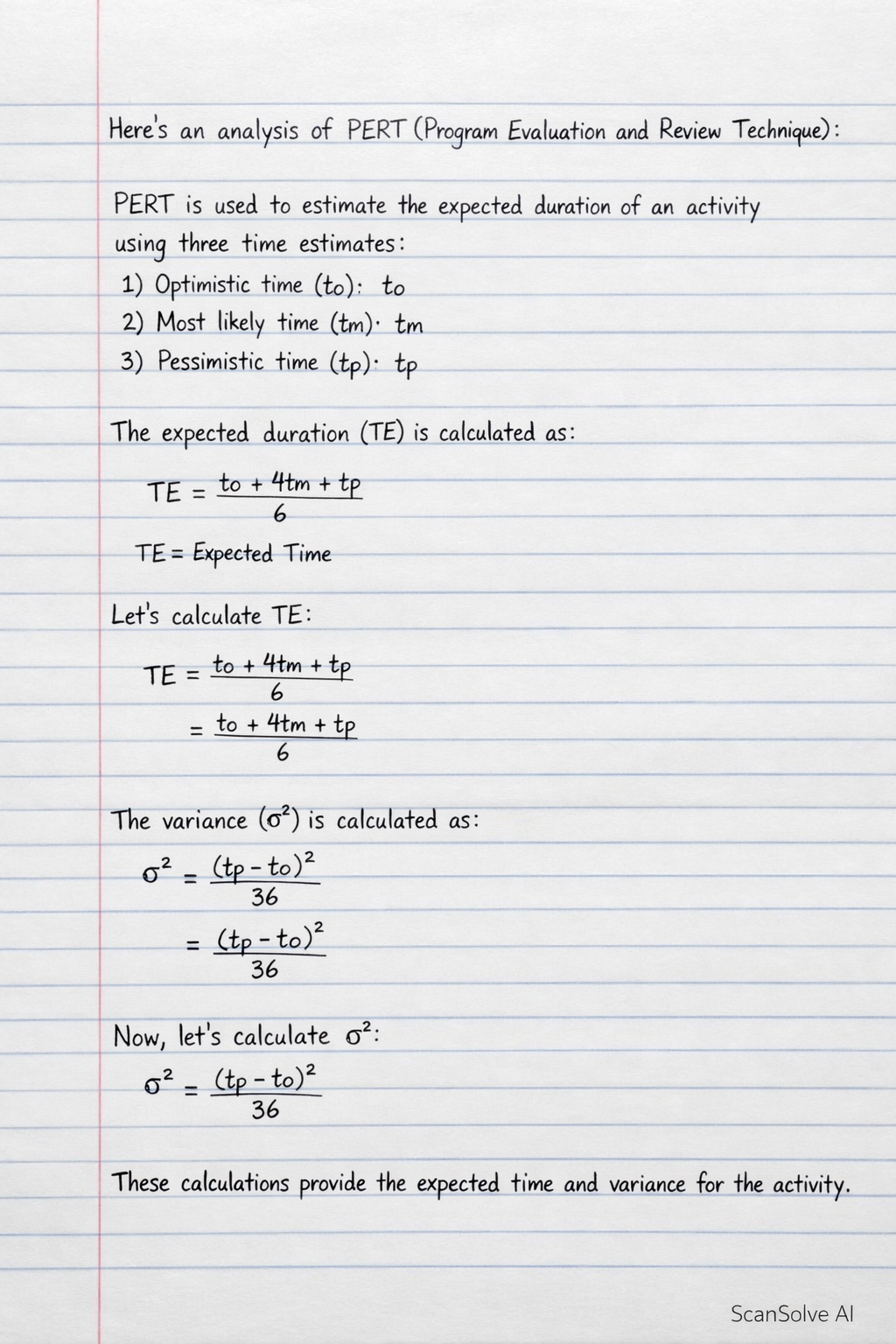
PERT (Program Evaluation and Review Technique) is a project management technique used for planning, scheduling, and controlling complex projects with uncertain activity durations. It employs three
ScanSolve AI Answer
PERT (Program Evaluation and Review Technique) is a project management technique used for planning, scheduling, and controlling complex projects with uncertain activity durations. It employs three time estimates for each activity: optimistic (), most likely (), and pessimistic (), to calculate an expected activity duration and its variance. This probabilistic approach helps in estimating project completion time and assessing the probability of meeting deadlines, making it suitable for research and development projects or those with little historical data.
CPM (Critical Path Method) is a project management technique used for projects with well-defined and predictable activity durations. It uses a single, deterministic time estimate for each activity. CPM focuses on identifying the critical path, which is the longest sequence of activities that determines the minimum project completion time. It also allows for analyzing cost-time trade-offs, enabling project managers to "crash" (accelerate) activities by adding resources to reduce project duration at an increased cost.
Usefulness in Project Management:
- Critical Path Identification: Both PERT and CPM are crucial for identifying the critical path, which highlights the activities that must be completed on time to avoid delaying the entire project. This allows managers to focus resources and attention on these critical tasks.
- Scheduling and Planning: They provide a clear visual representation of project activities, their dependencies, and timelines, aiding in the development of realistic project schedules and overall planning.
- Resource Management: By understanding activity durations and dependencies, managers can better allocate resources, identify potential bottlenecks, and optimize resource utilization across the project.
- Risk Assessment (PERT): PERT's probabilistic nature helps in evaluating the inherent risks associated with project completion times, allowing for contingency planning and setting more realistic expectations for uncertain projects.
- Cost Control and Optimization (CPM): CPM's ability to analyze cost-time trade-offs is invaluable for making informed decisions about project acceleration (crashing) to meet deadlines while managing budget constraints.
- Monitoring and Control: These techniques serve as benchmarks for tracking project progress. Deviations from the planned schedule can be identified early, allowing for corrective actions to keep the project on track.
Still stuck on this one?
Ask a follow-up, and the answer starts from this question.
More Business/Management Questions
Handwritten Step-by-Step Solution
Get this as a handwritten image on WhatsApp — like a tutor wrote it for you.
Try on WhatsApp