
POSTPARTUM HEMORRHAGE Question Mrs. Bupe Phiri aged 38 para 9, has just delivered a baby boy with Apgar score 9/10 at 1 and 5 minutes, weighing 3.8kg. As you were doing observations on her, she complained of feeling dizzy and you realized she is bleeding profusely. A diagnosis of postpartum hemorrhage due to atonic uterus has been made. a) Define Primary postpartum hemorrhage 5% b) Outline five (5) causes of atonic uterus 20% c) Describe the management of Mrs. Bupe Phiri until discharge 50% d) State five (5) preventive measures of postpartum hemorrhage 25%
Business/Management
ScanSolve AI Answer
Step-by-step solution
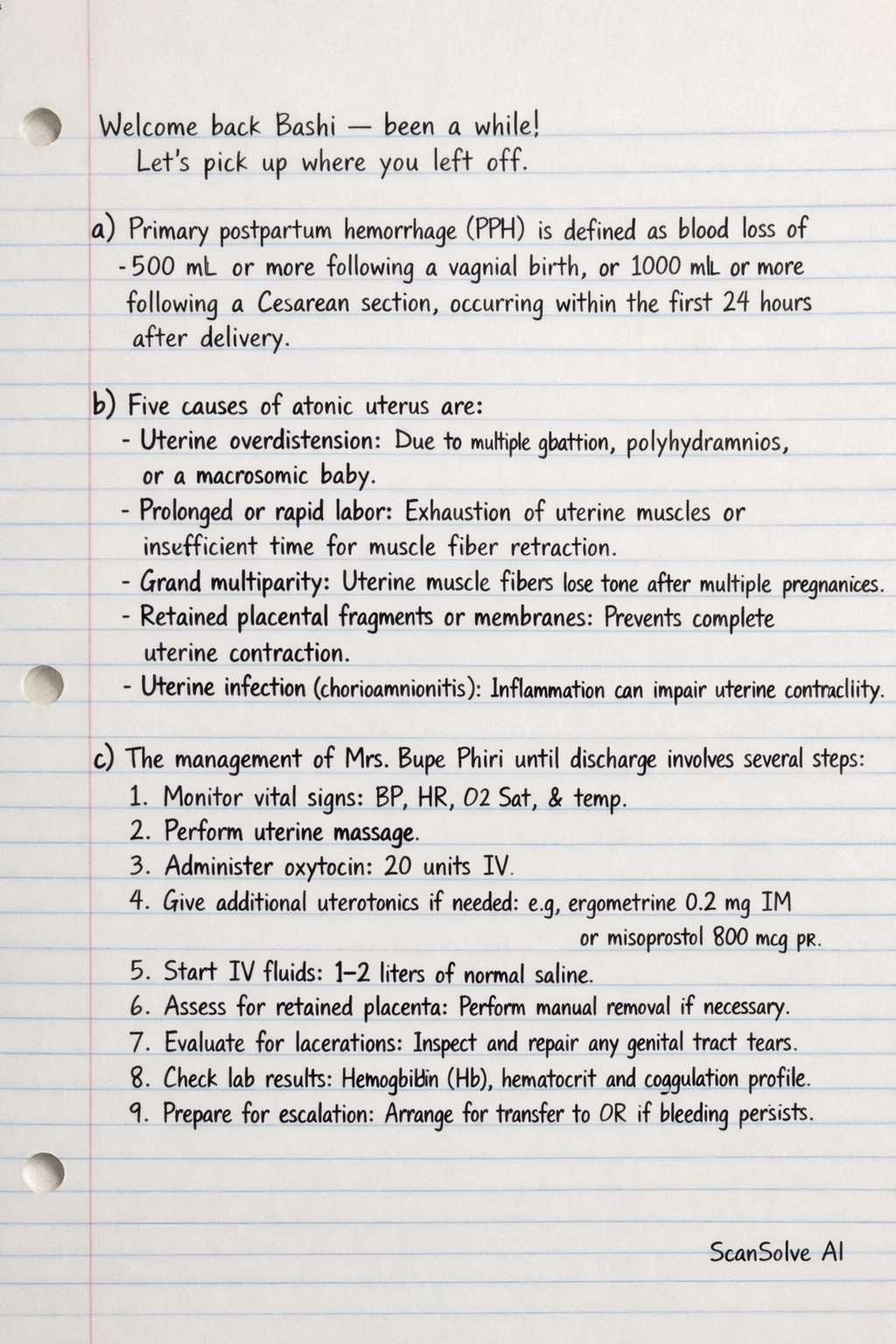
6 stepsa) Primary postpartum hemorrhage (PPH) is defined as blood loss of or more following a vaginal birth, or or more following a Cesarean section, occurring within the first 24 hours after delivery.
Part b
Five causes of atonic uterus are
- Uterine overdistension: Due to multiple gestation, polyhydramnios, or a macrosomic baby.
- Prolonged or rapid labor: Exhaustion of uterine muscles or insufficient time for muscle fiber retraction.
- Grand multiparity: Uterine muscle fibers lose tone after multiple pregnancies.
- Retained placental fragments or membranes: Prevents complete uterine contraction.
- Uterine infection (chorioamnionitis): Inflammation can impair uterine contractility.
Part c· 6 steps
The management of Mrs. Bupe Phiri until discharge involves several steps
Immediate Assessment and Resuscitation
- Call for help and activate the PPH protocol.
- Assess vital signs (blood pressure, pulse, respiratory rate, oxygen saturation) and level of consciousness.
- Establish two large-bore intravenous (IV) lines and rapidly infuse crystalloids (e.g., normal saline or Ringer's lactate) to restore circulating volume.
- Send blood samples for complete blood count, coagulation profile, blood group, and cross-match.
- Administer supplemental oxygen.
Identify and Address the Cause
- Perform vigorous uterine massage to stimulate contractions and expel clots.
- Insert a urinary catheter to monitor urine output and ensure the bladder is empty, as a full bladder can inhibit uterine contraction.
- If bleeding persists, perform bimanual uterine compression while awaiting pharmacological agents.
- Inspect the placenta for completeness and check for any retained fragments.
Pharmacological Management
- Administer oxytocin ( in IV fluid, infused rapidly, then in at for 4 hours).
- If oxytocin is insufficient, consider other uterotonics:
- Ergometrine ( IM or IV slowly, contraindicated in hypertension).
- Misoprostol ( rectally).
- Carboprost ( IM, contraindicated in asthma).
Advanced Interventions (if bleeding continues)
- Consider intrauterine balloon tamponade (e.g., Bakri balloon) to apply pressure to the uterine walls.
- If medical and balloon measures fail, prepare for surgical interventions such as B-Lynch suture, uterine artery ligation, or hysterectomy as a last resort.
- Administer blood products (packed red blood cells, fresh frozen plasma, platelets) as indicated by blood loss and coagulation studies.
Post-Stabilization Care and Monitoring
- Continuously monitor vital signs, blood loss, uterine tone, and urine output.
- Monitor for signs of complications such as disseminated intravascular coagulation (DIC), acute kidney injury, or infection.
- Administer prophylactic antibiotics if there is a risk of infection.
- Provide pain relief and emotional support.
Discharge Planning
- Ensure Mrs. Phiri is hemodynamically stable, with a stable hemoglobin level.
- Prescribe oral iron supplements for anemia.
- Educate her on signs of infection, anemia, and when to seek urgent medical attention.
- Schedule a follow-up appointment for postpartum check-up and counseling on future pregnancies, including the risk of recurrent PPH.
Part d
Five preventive measures of postpartum hemorrhage are
- Active Management of Third Stage of Labor (AMTSL): Involves administering a uterotonic (e.g., oxytocin) immediately after birth, controlled cord traction, and uterine massage after placental delivery.
- Early identification and management of risk factors: Screening for conditions like anemia, multiple gestation, or previous PPH during antenatal care.
- Correction of anemia during pregnancy: Ensuring adequate iron and folate intake to optimize hemoglobin levels before delivery.
- Careful management of labor: Avoiding prolonged labor, judicious use of oxytocin for augmentation, and preventing uterine overdistension.
- Thorough inspection of the placenta and birth canal: Ensuring complete placental delivery and identifying/repairing any lacerations or trauma immediately after birth.
Was this helpful?
Still stuck on this one?
Ask a follow-up, and the answer starts from this question.
Got a different question?Ask your own question
More Business/Management Questions
QOBSTRUCTED LABOUR Question Mrs Muntu Mubaya Ngoni 33 years old, para 6 gravida 7 was admitted to the…Q24-year-old primigravida at 36 weeks gestation is brought to the maternity unit with complaints of…QB1: A 22-year-old primigravida at 11 weeks' gestation presents with slight vaginal bleeding and mild…QQUESTION ONE Mr. Okoro Moses, a 48-year-old auto mechanic sustained head injury with compression of…QTHESE ARE NOT MATHS These are multiple choice questions. Choose the correct answers ANSWER ALL…
Browse by topic:Management
Handwritten Step-by-Step Solution
Get this as a handwritten image on WhatsApp — like a tutor wrote it for you.
Try on WhatsApp