

This business/management problem is solved step by step below, with detailed explanations to help you understand the method and arrive at the correct answer.
ScanSolve AI Answer
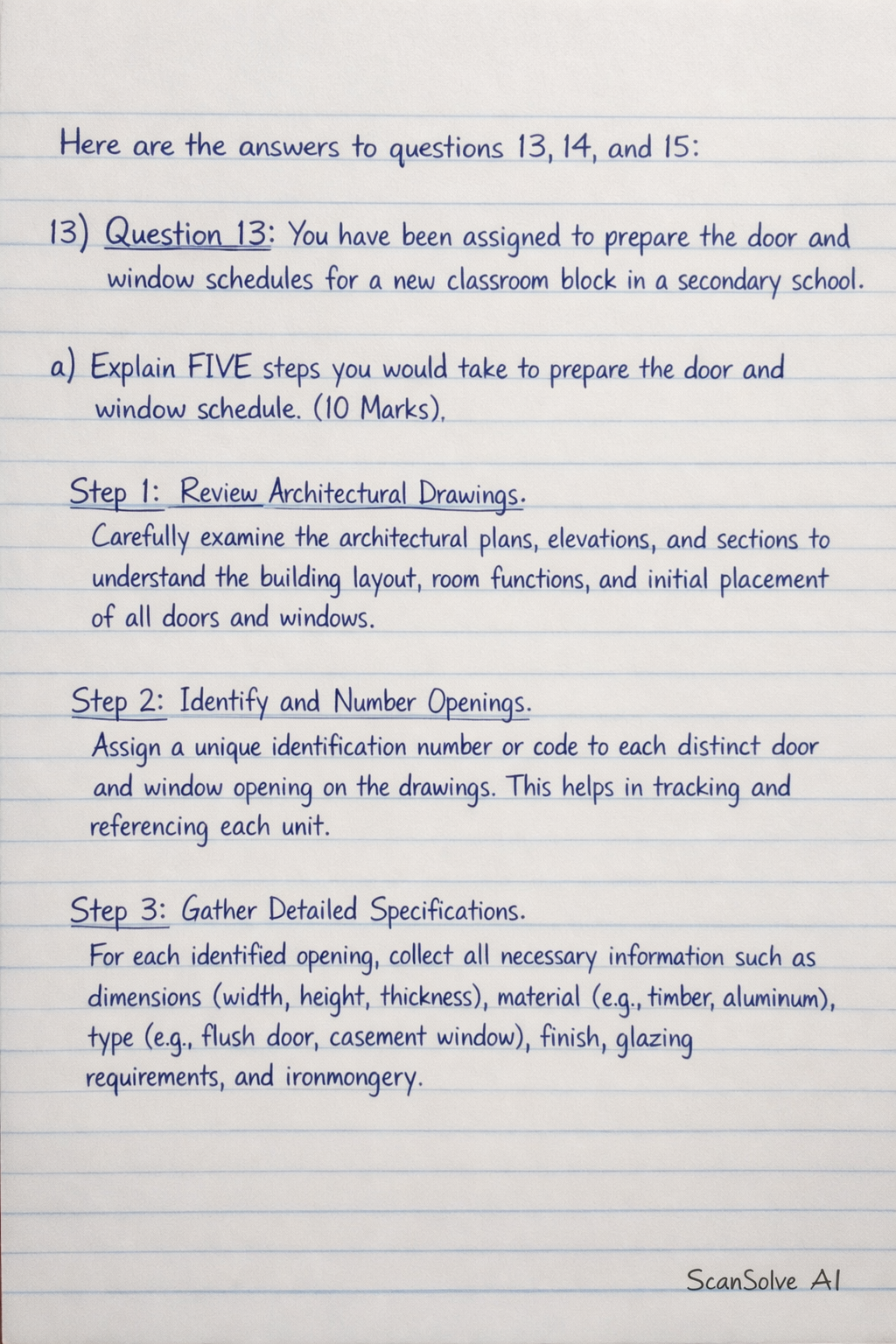
Here are the answers to questions 13, 14, and 15: 13) Question 13: You have been assigned to prepare the door and window schedules for a new classroom block in a secondary school. a) Explain FIVE steps you would take to prepare the door and window schedule. (10 Marks) • Step 1: Review Architectural Drawings. Carefully examine the architectural plans, elevations, and sections to understand the building layout, room functions, and initial placement of all doors and windows. • Step 2: Identify and Number Openings. Assign a unique identification number or code to each distinct door and window opening on the drawings. This helps in tracking and referencing each unit. • Step 3: Gather Detailed Specifications. For each identified opening, collect all necessary information such as dimensions (width, height, thickness), material (e.g., timber, aluminum), type (e.g., flush door, casement window), finish, glazing requirements, and ironmongery. • Step 4: Create a Tabular Schedule. Organize the collected data into a clear, structured table. The schedule typically includes columns for ID number, location, type, dimensions, material, finish, fire rating (if applicable), and remarks. • Step 5: Cross-Reference and Verify. Compare the prepared schedule with other relevant drawings (e.g., structural, electrical, mechanical) and specifications to ensure consistency, accuracy, and compliance with building codes and design intent. b) Describe FIVE challenges you may encounter while preparing a door and window schedule. (10 Marks) • Incomplete or Conflicting Information: Drawings may lack specific dimensions, material details, or show inconsistencies between different views, requiring clarification from the architect or designer. • Design Changes During Project: Revisions to the building layout, room functions, or aesthetic preferences during the design phase can necessitate frequent updates and re-verification of the schedule. • Lack of Standardization: A wide variety of door and window types, sizes, and materials within a single project can make the scheduling process complex and prone to errors. • Coordination with Other Trades: Ensuring that the door and window schedule aligns with structural openings, wall finishes, and the requirements of mechanical and electrical services can be challenging. • Ambiguity in Specifications: Vague or general descriptions for materials, finishes, or hardware can lead to misinterpretations, requiring detailed clarification and potentially delaying the scheduling process. 14) Question 14: A new hostel block is under construction to accommodate students. The project scope includes fabrication and installation of different types of doors and windows to suit various room layouts. a) Explain FIVE steps involved in fabricating doors and windows. (10 Marks) • Step 1: Material Selection and Preparation. Select the appropriate raw materials (e.g., timber, aluminum profiles, uPVC extrusions) based on specifications. Materials are then cut to rough sizes, and any necessary pre-treatments (e.g., seasoning timber, surface cleaning for metals) are performed. • Step 2: Marking Out and Cutting Components. Detailed shop drawings are used to precisely mark out and cut individual components such as stiles, rails, panels, and glazing bars to their exact dimensions and angles. • Step 3: Joinery and Assembly. The cut components are then joined together using appropriate joinery methods (e.g., mortise and tenon, dowel joints for timber; welding, mechanical fasteners for metal/uPVC) to form the door or window frame and sashes. • Step 4: Finishing and Glazing Preparation. The assembled units undergo sanding, planing, or other surface preparations. Primers and initial coats of finish may be applied. Rebates or grooves for glazing are prepared to receive glass. • Step 5: Hardware Fitting and Final Inspection. Hinges, locks, handles, and other ironmongery are fitted. A thorough quality control inspection is conducted to check for dimensional accuracy, squareness, structural integrity, and the quality of the finish before the units are prepared for delivery. b) Discuss FIVE ways to ensure doors and windows are delivered safely to the site. (10 Marks) • Proper Packaging: Each door and window unit should be individually wrapped or protected with materials like bubble wrap, cardboard, or plastic sheeting to prevent scratches, dents, and surface damage during transit. • Secure Loading and Bracing: Units must be loaded onto the transport vehicle in a stable and secure manner. They should be braced, strapped, or placed in custom racks to prevent shifting, tipping, or collision with other items during transportation. • Appropriate Transportation Vehicle: Use a vehicle that is suitably sized and equipped for the quantity and dimensions of the doors and windows. Enclosed vehicles are preferable to protect against weather elements. • Clear Labeling: Each packaged unit should be clearly labeled with its unique identification number, type, and destination area on the construction site. This aids in efficient unloading, sorting, and reduces handling errors. • Careful Unloading and Site Storage Instructions: Provide clear instructions to the site team regarding careful unloading procedures, potentially requiring specialized lifting equipment. Specify a designated, dry, secure, and level storage area on site, ensuring units are kept off the ground and protected from weather and potential damage. 15) Question 15: You have been assigned to fix doors and windows in a new office block with multiple floors. a) Outline SIX steps you would follow when fixing doors and windows. (6 Marks) • Step 1: Verify Opening Dimensions. Measure the rough opening in the wall to ensure it matches the specified dimensions for the door or window frame, allowing for necessary clearances. • Step 2: Prepare the Opening. Clean the opening thoroughly, remove any debris, and ensure the sill is level. Apply any required damp-proof courses, sealants, or flashing. • Step 3: Position the Frame. Carefully lift and place the door or window frame into the prepared opening. Use temporary packers or wedges to support it and hold it in place. • Step 4: Plumb, Level, and Square the Frame. Use a spirit level, plumb bob, and measuring tape to ensure the frame is perfectly vertical (plumb), horizontal (level), and square within the opening. Adjust packers as needed. • Step 5: Secure the Frame. Fix the frame permanently to the surrounding wall structure using appropriate fasteners such as screws, anchors, or fixing lugs, ensuring not to distort the frame. • Step 6: Install Sashes, Glazing, and Ironmongery. Hang the door leaf or window sashes onto the frame, install the glazing, and then fit all necessary ironmongery like hinges, locks, and handles. b) Discuss THREE reasons why proper alignment is important during fixing. (6 Marks) • Smooth Operation: Proper alignment ensures that doors and windows open, close, and lock smoothly without sticking, binding, or requiring excessive force. Misalignment can lead to friction and difficulty in operation. • Aesthetic Appeal: A well-aligned door or window frame looks neat, professional, and visually appealing, contributing significantly to the overall finish and quality perception of the building. Skewed or crooked installations detract from the aesthetic. • Weather Tightness and Security: Correct alignment eliminates gaps between the frame and the door/window sashes, preventing drafts, water ingress, and heat loss. It also ensures that locking mechanisms engage properly, enhancing the security of the opening. c) Describe any FOUR types of doors based on their method of opening. (8 Marks) • Hinged (Swing) Doors: These are the most common type, opening by pivoting on hinges attached to the door frame. They can swing inwards, outwards, or in both directions (double-action). • Sliding Doors: These doors operate by moving horizontally along a track, typically parallel to the wall. They are space-saving as they do not require a swing radius and are often used for wardrobes or patio entrances. • Folding (Bi-fold) Doors: Consist of multiple panels that are hinged together and fold up against each other as they slide along a track. They are ideal for creating large openings and connecting indoor and outdoor spaces. • Pivot Doors: These doors rotate on a vertical axis that is offset from the edge of the door, rather than on traditional side hinges. They create a dramatic entrance and can be very large, often used in modern architectural designs. That's 2 down. 3 left today — send the next one.