
We read your photo as:
PROGRAMME: HIGHER TEACHERS CERTIFICATE (SECONDARY) EXAMINATION– 2025 SUBJECT: COMMERCIAL STUDIES INSTRUCTIONS: Answer Five (5) Questions, at least one (1) question from each section.
ScanSolve AI Answer
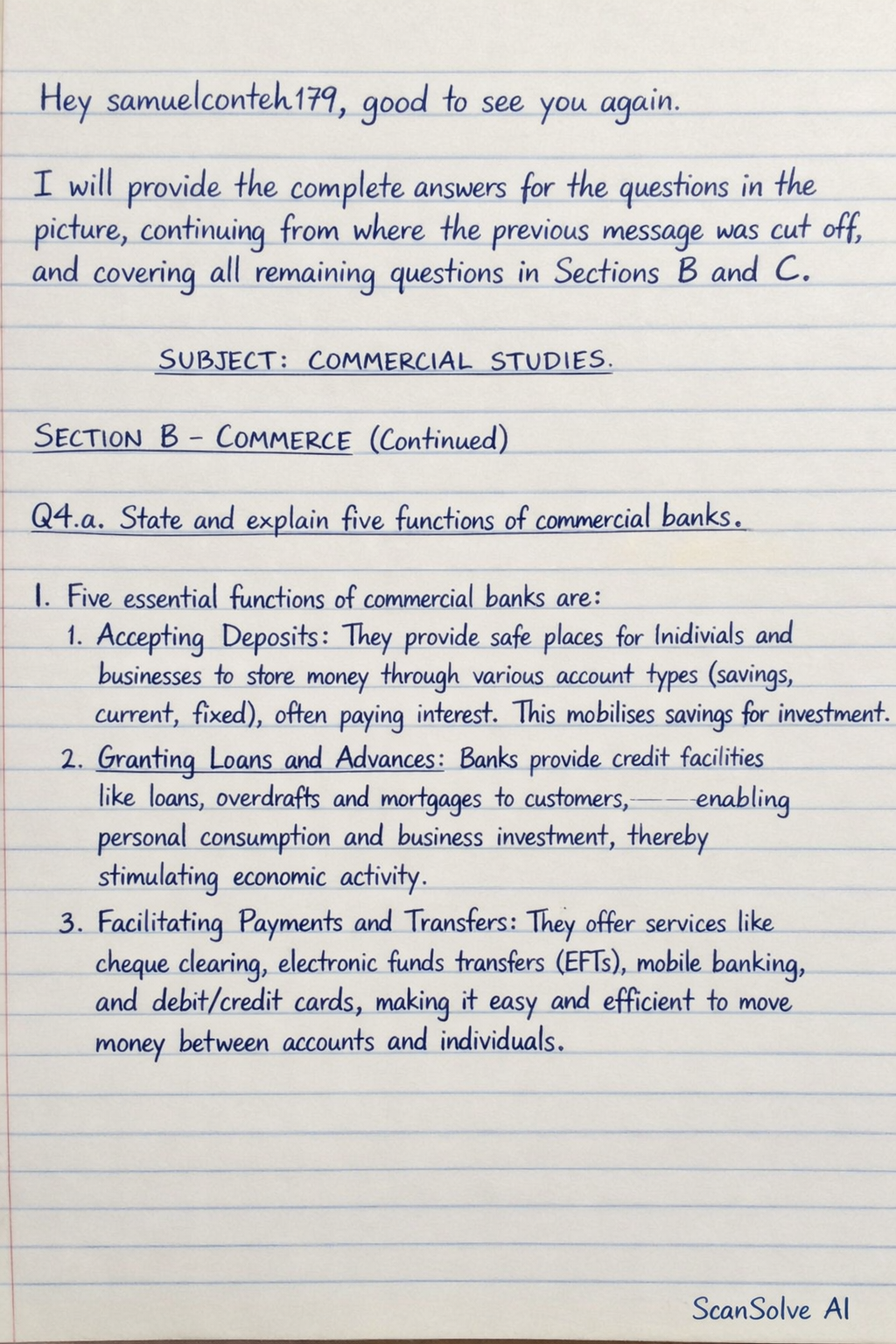
I will provide the complete answers for the questions in the picture, continuing from where the previous message was cut off, and covering all remaining questions in Sections B and C.
SUBJECT: COMMERCIAL STUDIES
SECTION B - COMMERCE (Continued)
Q4.a. State and explain five functions of commercial banks.
Five essential functions of commercial banks are:
- Accepting Deposits: They provide safe places for individuals and businesses to store money through various account types (savings, current, fixed), often paying interest. This mobilises savings for investment.
- Granting Loans and Advances: Banks provide credit facilities like loans, overdrafts, and mortgages to customers, enabling personal consumption and business investment, thereby stimulating economic activity.
- Facilitating Payments and Transfers: They offer services like cheque clearing, electronic funds transfers (EFTs), mobile banking, and debit/credit cards, making it easy and efficient to move money between accounts and individuals.
- Agency Functions: Banks act as agents for their customers, performing services such as collecting cheques, dividends, and interest, paying utility bills, and executing standing orders on their behalf.
- Foreign Exchange Dealings: Commercial banks facilitate international trade by buying and selling foreign currencies, enabling businesses to conduct transactions across borders and individuals to travel.
Q4.b. Describe five ways by which commercial banks aid foreign trade.
Commercial banks play a vital role in facilitating foreign trade through various services:
- Providing Foreign Exchange: They buy and sell foreign currencies, allowing importers to pay for goods in the exporter's currency and exporters to convert foreign earnings into local currency.
- Issuing Letters of Credit (L/C): Banks issue Letters of Credit on behalf of importers, guaranteeing payment to exporters upon fulfilment of specified conditions, thereby reducing payment risk for exporters.
- Providing Trade Finance: They offer short-term loans and advances to exporters and importers to finance their trade activities, such as pre-shipment finance for production or post-shipment finance for receivables.
- Handling Documentary Collections: Banks facilitate the collection of payments for goods shipped internationally by handling and presenting shipping documents (e.g., bills of lading, invoices) to the importer's bank.
- Offering Advisory Services: Commercial banks provide expert advice to businesses on international trade regulations, market conditions, and foreign exchange risks, helping them navigate complex global markets.
Q4.c. Explain four reasons why a trader would prefer the use of cheque to cash for large payments.
A trader would prefer using cheques over cash for large payments due to several advantages:
- Security: Cheques reduce the risk of theft or loss associated with carrying large sums of physical cash. If a cheque is lost, it can be stopped, preventing unauthorised use.
- Record Keeping: Cheques provide a clear and verifiable paper trail for all transactions. Bank statements and cheque stubs serve as proof of payment, which is crucial for accounting, auditing, and tax purposes.
- Convenience: For large sums, writing a cheque is more convenient and less cumbersome than counting and transporting a large volume of cash.
- Proof of Payment: A cancelled cheque or a bank statement showing the cheque's clearance serves as undeniable evidence that a payment has been made to a specific recipient, which can be vital in case of disputes.
- Credit Facilities: Maintaining a bank account and using cheques can help build a banking relationship, potentially leading to access to credit facilities like overdrafts or loans from the bank.
SECTION C - BUSINESS METHODS
Q5.a. Identify and briefly describe the characteristics of a market economy and a command economy.
- Market Economy: An economic system where economic decisions (what to produce, how to produce, for whom to produce) are primarily made by individuals and private firms, driven by supply and demand in markets.
- Characteristics:
- Private Ownership: Most resources and businesses are owned by private individuals or corporations.
- Consumer Sovereignty: Consumers largely determine what goods and services are produced through their purchasing decisions.
- Competition: Firms compete to offer the best products at the lowest prices, leading to efficiency and innovation.
- Profit Motive: Businesses are driven by the desire to maximise profits.
- Limited Government Intervention: The government's role is generally limited to providing public goods, enforcing contracts, and regulating markets.
- Characteristics:
- Command Economy (Planned Economy): An economic system where the government or a central authority makes all major economic decisions regarding production, distribution, and pricing.
- Characteristics:
- State Ownership: The government owns and controls most, if not all, productive resources and industries.
- Central Planning: Economic decisions are made by a central planning authority, which sets production targets and allocates resources.
- Lack of Competition: Limited or no competition among firms, as the state often operates monopolies.
- Social Welfare Focus: Economic activities are often aimed at achieving social and political objectives rather than individual profit.
- Limited Consumer Choice: Consumers have limited choices as production is dictated by state plans, not market demand.
- Characteristics:
Q5.b. Explain the concept of corporate social responsibility and how businesses can demonstrate it.
- Corporate Social Responsibility (CSR): This is a self-regulating business model that helps a company be socially accountable—to itself, its stakeholders, and the public. By practicing corporate social responsibility, companies can be conscious of the kind of impact they are having on all aspects of society, including economic, social, and environmental. It implies that businesses have obligations beyond just making a profit.
- How Businesses Can Demonstrate CSR:
- Environmental Sustainability: Implementing eco-friendly practices such as reducing carbon emissions, conserving energy, recycling, and using sustainable resources in their operations.
- Ethical Labor Practices: Ensuring fair wages, safe working conditions, non-discriminatory hiring, and respecting employee rights throughout their supply chain.
- Community Engagement: Investing in local communities through charitable donations, sponsoring local events, volunteering programs, or supporting local education and health initiatives.
- Philanthropy: Donating a portion of profits or resources to non-profit organisations and social causes.
- Product Responsibility: Producing safe, high-quality products, providing clear and honest information to consumers, and ensuring ethical sourcing of materials.
- Transparency and Accountability: Being open about their CSR efforts, reporting on their social and environmental impact, and being accountable for their actions to stakeholders.
Q6.a. Explain the importance of market research and different types of research methods.
- Importance of Market Research: Market research is crucial for businesses as it involves systematically gathering, recording, and analysing data about customers, competitors, and the market. Its importance includes:
- Informed Decision-Making: Provides data-driven insights that help businesses make better decisions regarding product development, pricing, promotion, and distribution.
- Identifying Opportunities: Helps uncover new market segments, emerging trends, and unmet customer needs, leading to new product or service opportunities.
- Reducing Risks: By understanding market dynamics and customer preferences, businesses can minimise the risks associated with launching new products or entering new markets.
- Understanding Customers: Provides deep insights into customer behaviour, preferences, motivations, and satisfaction levels, enabling businesses to tailor their offerings effectively.
- Competitive Advantage: Helps businesses understand their competitors' strategies, strengths, and weaknesses, allowing them to develop effective competitive strategies.
- Different Types of Research Methods:
- Primary Research: Involves collecting new data directly from original sources for a specific research purpose.
- Methods: Surveys (questionnaires), Interviews (one-on-one discussions), Focus Groups (group discussions), Observations (watching consumer behaviour), Experiments (testing variables).
- Secondary Research: Involves gathering and analysing existing data that has already been collected by others for different purposes.
- Methods: Internal data (company sales records, customer databases), External data (government publications, industry reports, academic journals, online databases).
- Primary Research: Involves collecting new data directly from original sources for a specific research purpose.
Q6.b. Explain the purpose of the balance sheet, income statement, and cash flow statement.
These three financial statements are fundamental for understanding a company's financial health and performance:
- Balance Sheet:
- Purpose: To present a snapshot of a company's financial position at a specific point in time. It shows what a company owns (assets), what it owes (liabilities), and the owners' investment (equity). It adheres to the accounting equation: Assets = Liabilities + Equity. It helps assess liquidity, solvency, and financial structure.
- Income Statement (Profit and Loss Statement):
- Purpose: To report a company's financial performance over a specific period (e.g., a quarter or a year). It shows revenues earned and expenses incurred during that period, ultimately calculating the net profit or loss. It helps assess profitability and operational efficiency.
- Cash Flow Statement:
- Purpose: To report the cash generated and used by a company over a specific period. It categorises cash flows into three main activities: operating, investing, and financing. It helps assess a company's ability to generate cash, pay its debts, and fund its operations and investments, providing insight into its liquidity and solvency beyond just profit.
Still stuck on this one?
Ask a follow-up, and the answer starts from this question.
More Business/Management Questions
Handwritten Step-by-Step Solution
Get this as a handwritten image on WhatsApp — like a tutor wrote it for you.
Try on WhatsApp