
We read your photo as:
Q5. Write short notes on the following financial institutions: (i) Central Bank (ii) Commercial Bank (iii) Development Bank (iv) Micro Finance Institutions
ScanSolve AI Answer
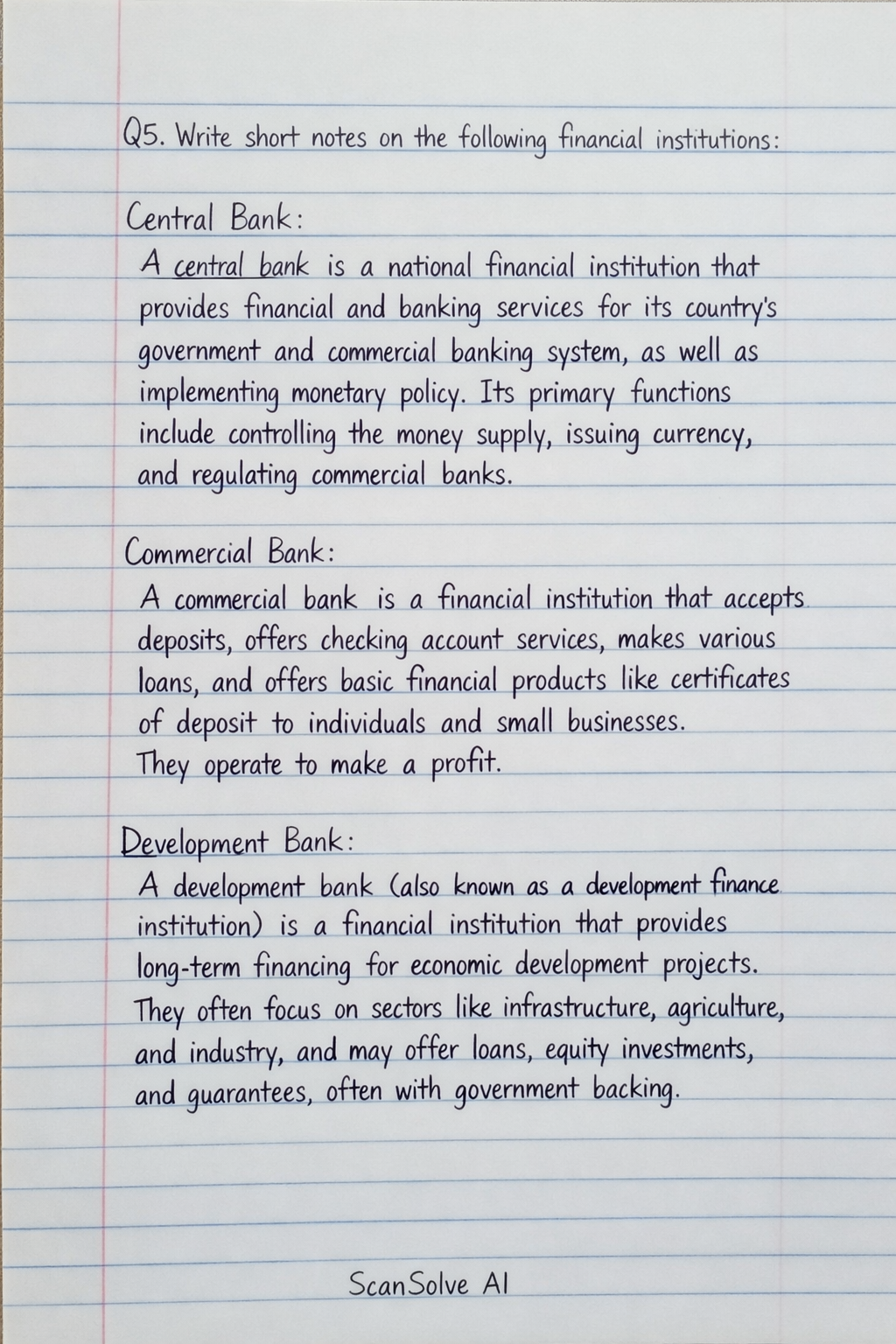
Q5. Write short notes on the following financial institutions:
- Central Bank: A central bank is a national financial institution that provides financial and banking services for its country's government and commercial banking system, as well as implementing monetary policy. Its primary functions include controlling the money supply, issuing currency, and regulating commercial banks.
- Commercial Bank: A commercial bank is a financial institution that accepts deposits, offers checking account services, makes various loans, and offers basic financial products like certificates of deposit to individuals and small businesses. They operate to make a profit.
- Development Bank: A development bank (also known as a development finance institution) is a financial institution that provides long-term financing for economic development projects. They often focus on sectors like infrastructure, agriculture, and industry, and may offer loans, equity investments, and guarantees, often with government backing.
- Micro Finance Institutions: Microfinance institutions (MFIs) are organizations that provide financial services, such as small loans (microcredit), savings, and insurance, to low-income individuals or groups who typically lack access to conventional banking services. Their goal is to alleviate poverty and empower entrepreneurs.
Q6. a. State the importance of small-scale Business Enterprise in the Sierra Leone economy.
Small-scale Business Enterprises (SBEs) are crucial for the Sierra Leone economy because they:
- Create employment opportunities, reducing unemployment.
- Contribute to Gross Domestic Product (GDP) and economic growth.
- Foster innovation and entrepreneurship.
- Provide essential goods and services to local communities.
- Promote income distribution and poverty reduction.
b. Explain any four (4) difficulties encountered by small-scale Business Enterprises in Sierra Leone.
Four difficulties encountered by SBEs in Sierra Leone include:
- Limited access to finance: SBEs often struggle to secure loans from commercial banks due to lack of collateral, high interest rates, and stringent requirements.
- Inadequate infrastructure: Poor roads, unreliable electricity, and limited access to technology increase operational costs and hinder business expansion.
- Lack of managerial and technical skills: Many entrepreneurs lack formal training in business management, marketing, and financial planning, leading to inefficient operations.
- High competition and market access issues: SBEs face intense competition from larger businesses and imported goods, and often struggle to access wider markets beyond their local communities.
Q7. Distinguish between joint Venture partnership and sole proprietorship. Give two (2) advantages and disadvantages of each.
-
Sole Proprietorship: A sole proprietorship is a business owned and run by one individual who is solely responsible for all debts and liabilities.
- Advantages:
- Easy to set up: Minimal legal formalities and low startup costs.
- Complete control: The owner has full decision-making authority.
- Disadvantages:
- Unlimited liability: The owner's personal assets are not protected from business debts.
- Limited capital: Funding is often restricted to the owner's personal savings or small loans.
- Advantages:
-
Joint Venture Partnership: A joint venture partnership is a business arrangement in which two or more parties agree to pool their resources for the purpose of accomplishing a specific task or project.
- Advantages:
- Shared resources and expertise: Partners bring diverse skills, knowledge, and capital, enhancing capabilities.
- Reduced risk: Risks and costs are shared among partners, lessening the burden on any single entity.
- Disadvantages:
- Potential for conflict: Disagreements among partners over management, strategy, or profit sharing can arise.
- Complex decision-making: Decisions may take longer as they require consensus among multiple parties.
- Advantages:
Q8. a. Explain the role of an entrepreneur in National Economic Development
An entrepreneur plays a vital role in national economic development by identifying opportunities, innovating new products and services, and creating businesses. They drive economic growth by generating employment, increasing productivity, fostering competition, and introducing new technologies, ultimately leading to higher national income and improved living standards.
b. Give four (4) reasons why a business activity might fail.
Four reasons why a business activity might fail are:
- Poor financial management: Inadequate cash flow, insufficient capital, or mismanagement of funds can lead to insolvency.
- Lack of market demand or poor marketing: A business may fail if there isn't a sufficient market for its products/services or if it fails to effectively reach its target customers.
- Inexperienced management: Poor decision-making, lack of leadership, or insufficient business acumen from the management team can lead to operational inefficiencies and strategic errors.
- Intense competition or external factors: A highly competitive market, economic downturns, changes in consumer preferences, or unforeseen events (like natural disasters or pandemics) can severely impact a business's viability.
Still stuck on this one?
Ask a follow-up, and the answer starts from this question.
More Business/Management Questions
Handwritten Step-by-Step Solution
Get this as a handwritten image on WhatsApp — like a tutor wrote it for you.
Try on WhatsApp