
We read your photo as:
Read the Case Study below and answer the question that follows: "ROLES OF THE BARTENDER". 1.1 Describe the duties and responsibilities of a Bartender that your HR manager should include in the Bartender job descriptions file.
ScanSolve AI Answer
here are the answers to the questions from the image:
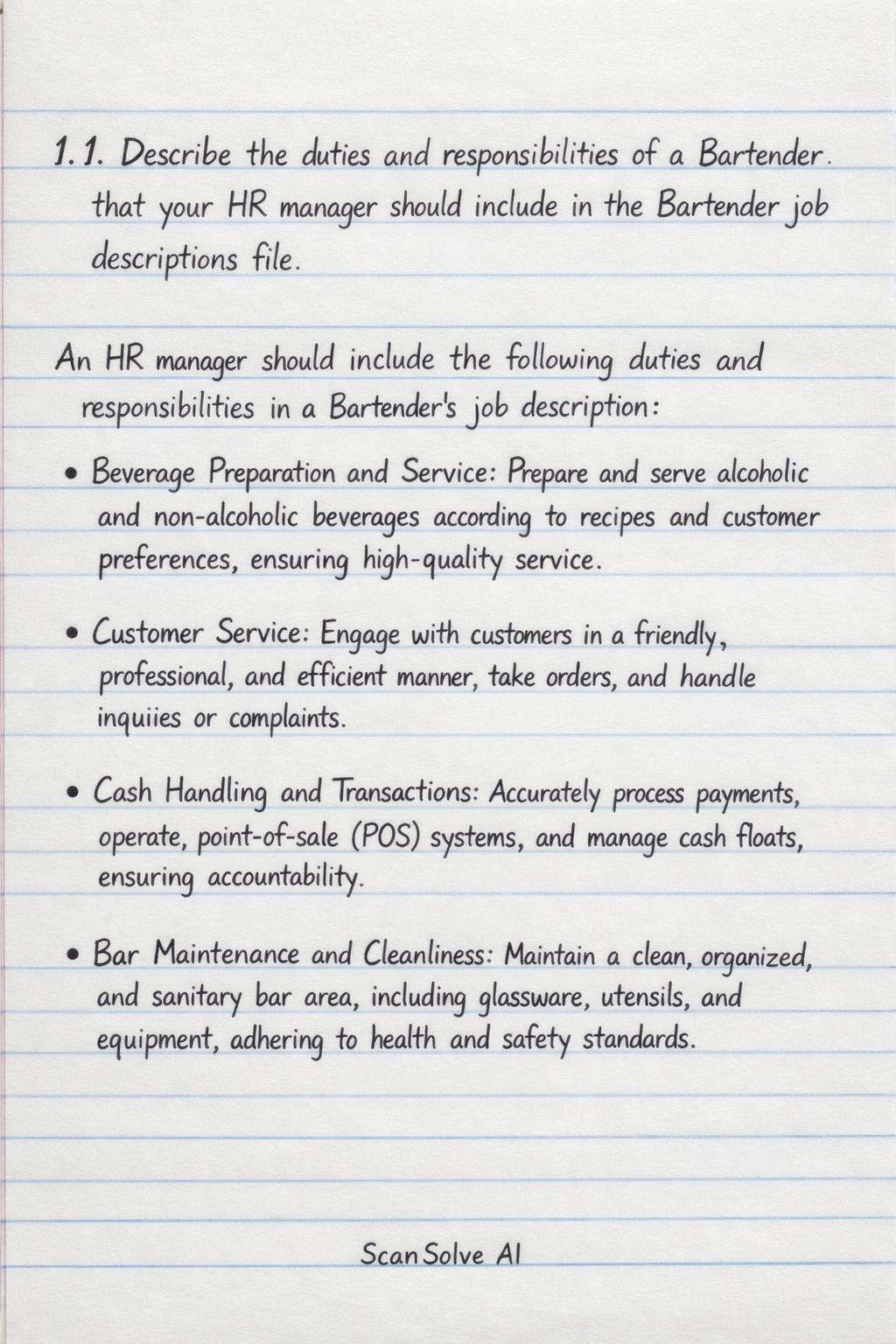
1.1 Describe the duties and responsibilities of a Bartender that your HR manager should include in the Bartender job descriptions file.
An HR manager should include the following duties and responsibilities in a Bartender's job description:
- Beverage Preparation and Service: Prepare and serve alcoholic and non-alcoholic beverages according to recipes and customer preferences, ensuring high-quality service.
- Customer Service: Engage with customers in a friendly, professional, and efficient manner, take orders, and handle inquiries or complaints.
- Cash Handling and Transactions: Accurately process payments, operate point-of-sale (POS) systems, and manage cash floats, ensuring accountability.
- Bar Maintenance and Cleanliness: Maintain a clean, organized, and sanitary bar area, including glassware, utensils, and equipment, adhering to health and safety standards.
- Inventory Management: Monitor and restock bar inventory, including spirits, mixers, garnishes, and supplies, and assist with ordering when necessary.
- Compliance and Safety: Verify customer identification to ensure legal drinking age, adhere to responsible alcohol service practices, and follow all licensing regulations.
- Opening and Closing Procedures: Perform daily opening and closing duties, such as setting up the bar, preparing ingredients, and securing the premises.
2. Use the 10 leadership practices to introduce a beneficial work culture to your subordinates as a general manager of the All Seasons Boutique Hotel.
As a general manager, I would introduce a beneficial work culture using these 10 leadership practices:
- Lead by Example: Consistently demonstrate the desired behaviors, work ethic, and positive attitude I expect from my team.
- Communicate Transparently: Foster open and honest communication by sharing information, explaining decisions, and actively listening to feedback.
- Empower and Delegate: Grant subordinates autonomy and responsibility, trusting them to make decisions and take ownership of their tasks.
- Provide Constructive Feedback: Regularly offer specific, actionable feedback to help employees grow, improve performance, and develop their skills.
- Recognize and Reward Achievements: Acknowledge and celebrate individual and team successes, fostering a sense of appreciation and motivation.
- Foster Teamwork and Collaboration: Encourage employees to work together, share ideas, and support each other to achieve common goals.
- Promote a Positive and Inclusive Environment: Create a workplace where everyone feels valued, respected, and comfortable expressing their ideas.
- Encourage Continuous Learning: Support professional development through training, workshops, and opportunities for skill enhancement.
- Be Approachable and Supportive: Maintain an open-door policy, offering guidance and support to employees facing challenges.
- Set Clear Vision and Goals: Articulate a clear vision for the hotel and define measurable goals, providing direction and purpose for the team.
3. Briefly illustrate between the compulsory, optional and prohibited information that needs to be on Spanish and Portuguese wine labels.
For Spanish and Portuguese wine labels, which adhere to EU regulations, information is categorized as follows:
-
Compulsory Information: This information must be present on the label.
- Product name (e.g., "wine").
- Indication of origin (e.g., for Spain: DO, DOCa; for Portugal: DOP, IGP).
- Nominal volume (e.g., ).
- Actual alcoholic strength by volume (e.g., ).
- Name and address of the bottler/producer.
- Allergen information (e.g., "contains sulfites").
- Lot number.
-
Optional Information: This information may be included but is not legally required.
- Vintage year.
- Grape variety or varieties.
- Sugar content (e.g., "dry," "sweet").
- Specific production methods (e.g., "oak aged," "reserva").
- Awards or medals received.
- Brand name or specific marketing terms.
-
Prohibited Information: This information is not allowed on the label.
- Any misleading information regarding the wine's origin, quality, or characteristics.
- Claims that imply health benefits from alcohol consumption.
- Information that could confuse consumers about the true nature of the product.
- Terms reserved for specific wine categories if the wine does not meet those criteria.
Still stuck on this one?
Ask a follow-up, and the answer starts from this question.
More Business/Management Questions
Handwritten Step-by-Step Solution
Get this as a handwritten image on WhatsApp — like a tutor wrote it for you.
Try on WhatsApp