
Redox reaction and example using electron gain and electron loss
ScanSolve AI Answer
Answer
A redox reaction (reduction-oxidation reaction) is a chemical reaction in which there is a change in the oxidation states of atoms, meaning electrons are transferred between reactants.
- Oxidation: The process of losing electrons. The species that loses electrons is said to be oxidized.
- Reduction: The process of gaining electrons. The species that gains electrons is said to be reduced.
Example: The reaction between magnesium metal and oxygen gas to form magnesium oxide.
Let's break this down into half-reactions showing electron transfer:
-
Oxidation (electron loss): Magnesium atoms lose two electrons each to become magnesium ions.
Magnesium is oxidized.
-
Reduction (electron gain): Oxygen molecules gain four electrons (two electrons per oxygen atom) to become oxide ions.
Oxygen is reduced.
In this reaction, magnesium loses electrons (is oxidized), and oxygen gains electrons (is reduced). Therefore, it is a redox reaction.
Still stuck on this one?
Ask a follow-up, and the answer starts from this question.
More Business/Management Questions
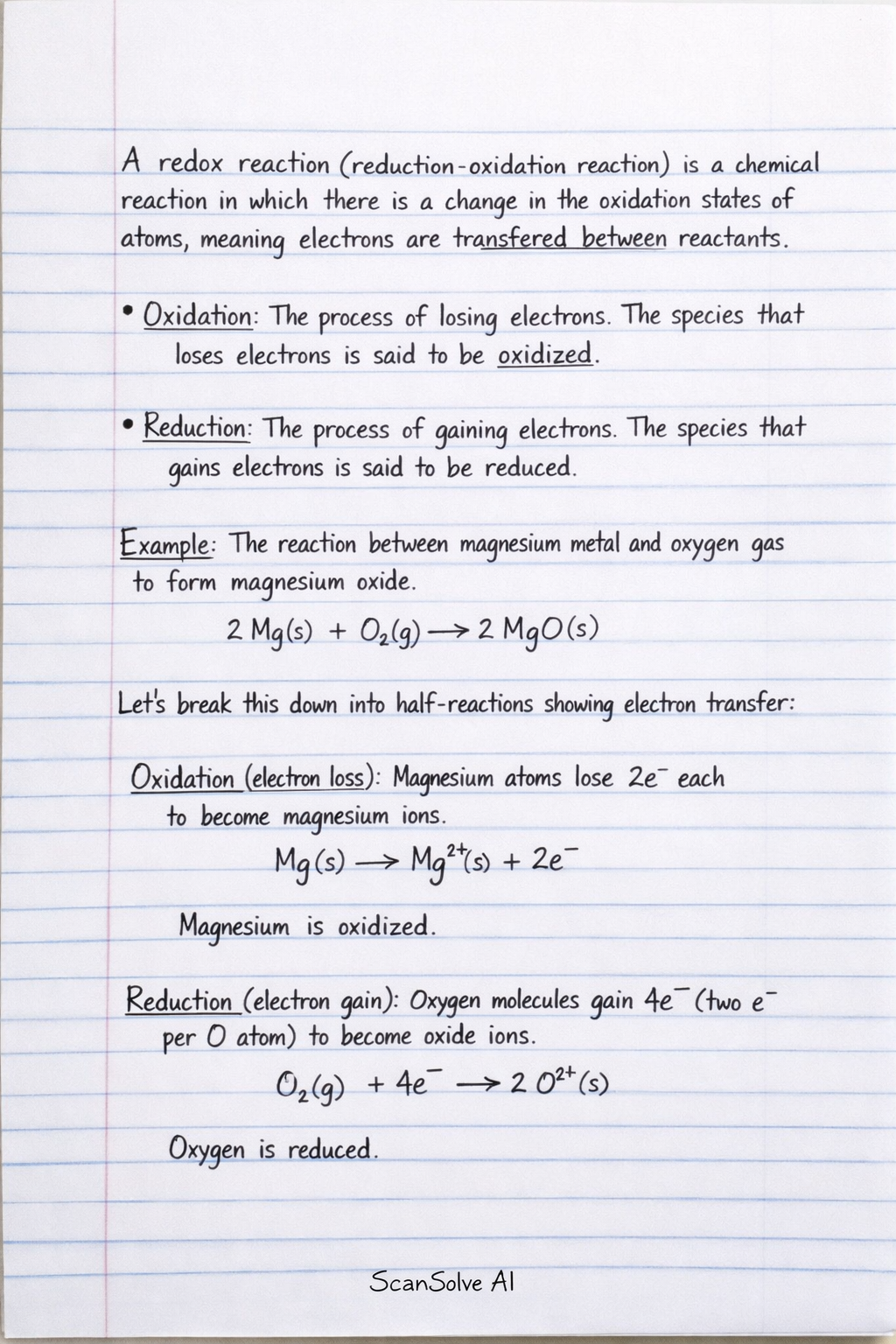
Handwritten Step-by-Step Solution
Get this as a handwritten image on WhatsApp — like a tutor wrote it for you.
Try on WhatsApp