
We read your photo as:
Refers to the type of shares that has no fixed amount of benefit. (A)Ordinary shares (B)preference shares (C)Consumer shares (D)Producer shares
ScanSolve AI Answer
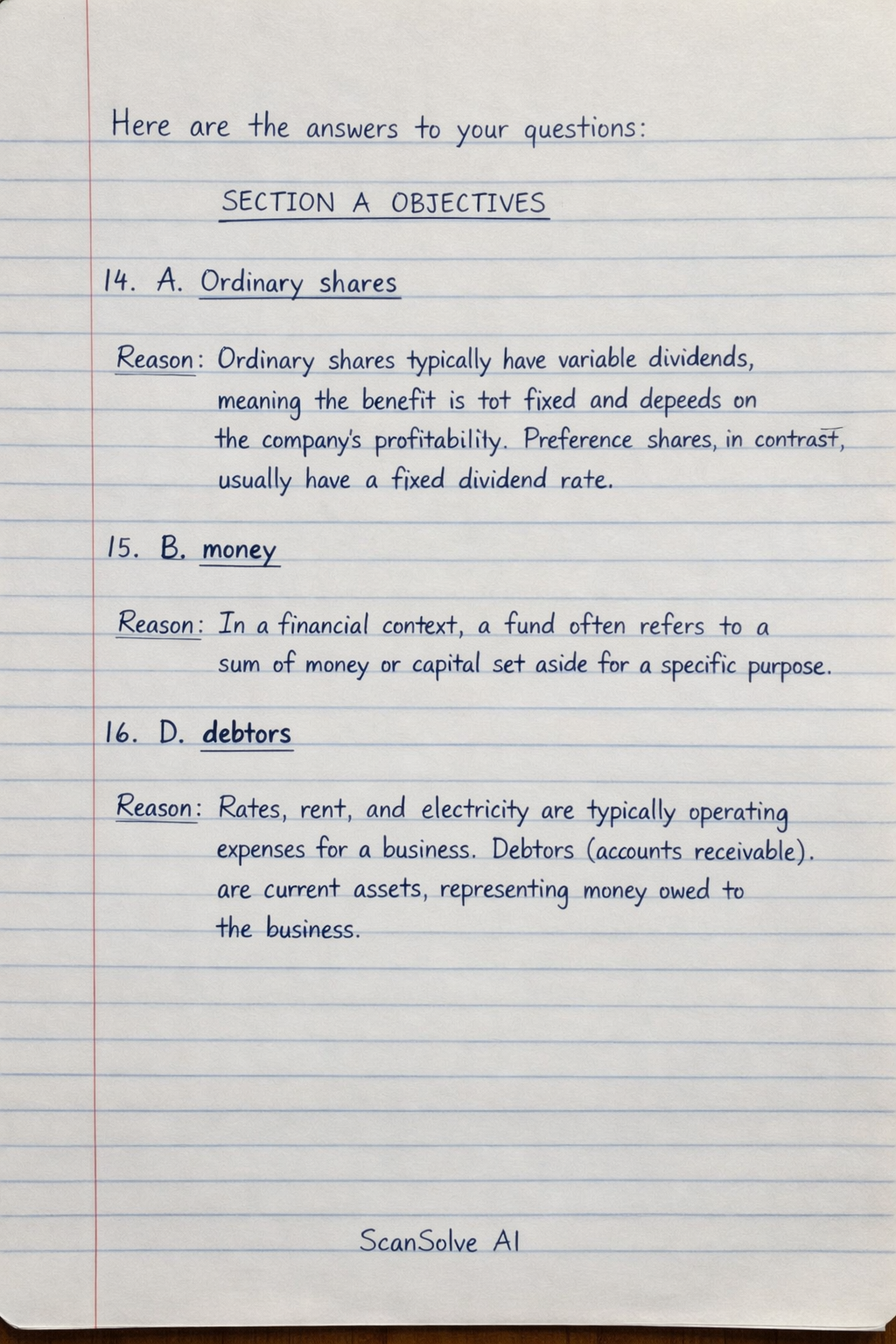
Here are the answers to your questions:
SECTION A OBJECTIVES
-
refers to the type of shares that has no fixed amount of benefit.
- A. Ordinary shares
- Reason: Ordinary shares typically have variable dividends, meaning the benefit is not fixed and depends on the company's profitability. Preference shares, in contrast, usually have a fixed dividend rate.
-
Another name for fund is _____.
- B. money
- Reason: In a financial context, a fund often refers to a sum of money or capital set aside for a specific purpose.
-
One of the following is not an expense _____.
- D. debtors
- Reason: Rates, rent, and electricity are typically operating expenses for a business. Debtors (accounts receivable) are current assets, representing money owed to the business.
-
One of the following is not an account _____.
- D. balance sheet
- Reason: A cash book, ledger, and trial balance are all related to accounts or lists of account balances. A balance sheet is a financial statement that summarizes a company's assets, liabilities, and equity at a specific point in time, not an account itself.
-
One of the following items is not a fixed asset of a business.
- A. loan
- Reason: Fixtures, premises, and plant and machinery are all examples of fixed assets (long-term tangible assets). A loan, if taken by the business, is a liability; if given by the business, it's an asset but typically not classified as a fixed asset in the same way as property or equipment.
-
The sharing of profit and losses in the dissolution of partnership is in which of the following accounts.
- C. Dissolution account
- Reason: During the dissolution of a partnership, a Realization Account (often called a Dissolution Account) is prepared to ascertain the profit or loss arising from the sale of assets and payment of liabilities. This profit or loss is then transferred to the partners' capital accounts for sharing.
-
The market that grants short term loan to investors is called _____.
- B. money market
- Reason: The money market deals with short-term borrowing and lending, typically for periods of less than one year. The capital market deals with long-term funds.
-
One of the following does not fall on the debit side of the trading account of a business.
- C. Sales
- Reason: Opening stock, purchases, and carriage inwards are all debited to the trading account as costs related to goods sold. Sales revenue is credited to the trading account.
-
One of the following is not an income
- B. discount allowed
- Reason: Discount received, commission received, and bank deposit interest are all forms of income. Discount allowed is an expense incurred by the business when it grants a reduction in price to customers.
-
The type of shareholder that has a fixed rate of benefit is called _____.
- A. preference
- Reason: Preference shareholders typically receive a fixed dividend payment before ordinary shareholders.
-
The benefits accrued to a shareholder is called _____.
- B. dividend
- Reason: Dividends are distributions of a company's earnings to its shareholders. Interest is paid on debt, not shares.
-
Those who buy shares from companies are called _____.
- A. shareholders
- Reason: Individuals or entities who purchase shares (equity) in a company become its shareholders.
-
When total assets of a business is deducted from the total liability, we obtain _____.
- A. the net asset
- Reason: The accounting equation is Assets = Liabilities + Equity (or Capital). Therefore, Assets - Liabilities = Equity. "Net asset" is another term for owner's equity or capital.
-
The name given to the person who sells a business is called _____.
- C. vendor
- Reason: A vendor is a person or entity that sells something, including a business.
-
What is the name given the situation where two or more companies join their operations together?
- D. Amalgamation
- Reason: Amalgamation is the process of combining two or more companies into a single new entity.
-
One of the following is not among the current assets of a business?
- B. Land and building
- Reason: Debtors, cash, and bills receivable are all current assets (expected to be converted to cash or used within one year). Land and building are fixed assets (long-term assets).
-
One of the following is not an asset _____.
- A. Overdraft
- Reason: Cash, bank (positive balance), and debtors are assets. An overdraft is a liability, representing money owed to the bank when the account balance goes below zero.
SECTION B: Theory part
Note: Question 1 (a) and (b) are incomplete in the provided image, as the actual questions are not visible, only the preamble for a partnership problem.
Mention and Explain (3) Types of Meeting
- Statutory Meeting: This is the first general meeting of shareholders of a public company, held once in its lifetime, usually within a specific period (e.g., 6 months) after commencing business. Its purpose is to inform shareholders about the company's formation, share allotment, and financial position.
- Annual General Meeting (AGM): This is a compulsory yearly meeting of shareholders where they review the company's financial statements, appoint auditors, declare dividends, and elect directors. It provides an opportunity for shareholders to question the management.
- Extraordinary General Meeting (EGM): Any general meeting of shareholders other than the annual general meeting is an EGM. These are called to discuss urgent matters that cannot wait until the next AGM, such as amending the company's articles, issuing new shares, or approving a merger.
Explain the following terms; (i) Share (ii) Stocks
- (i) Share: A share represents a unit of ownership in a company. When you buy a share, you become a part-owner (shareholder) of that company, entitling you to a portion of its profits (dividends) and voting rights in company decisions.
- (ii) Stocks: In a financial context, "stocks" is often used interchangeably with "shares" to refer to ownership units in a company. However, it can also refer more broadly to a collection of shares or other securities. In accounting, "stock" (or inventory) refers to the goods held by a business for sale or for use in production.
Still stuck on this one?
Ask a follow-up, and the answer starts from this question.
More Business/Management Questions
Handwritten Step-by-Step Solution
Get this as a handwritten image on WhatsApp — like a tutor wrote it for you.
Try on WhatsApp