

This business/management problem is solved step by step below, with detailed explanations to help you understand the method and arrive at the correct answer.
ScanSolve AI Answer
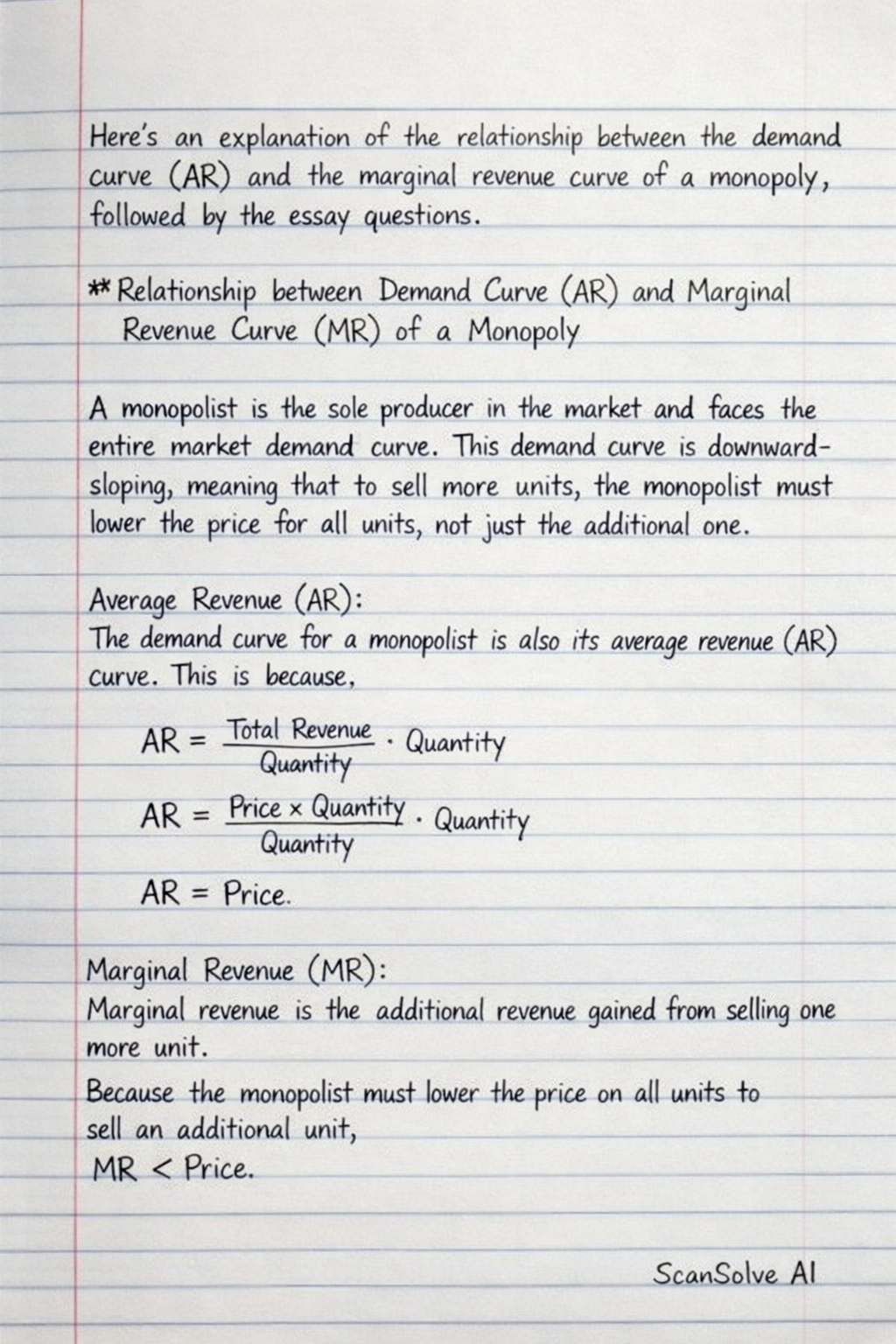
Here's an explanation of the relationship between the demand curve (AR) and the marginal revenue curve of a monopoly, followed by the essay questions. Relationship between Demand Curve (AR) and Marginal Revenue Curve (MR) of a Monopoly A monopolist is the sole producer in the market and faces the entire market demand curve. This demand curve is downward-sloping, meaning that to sell more units, the monopolist must lower the price for all units, not just the additional one. Average Revenue (AR): The demand curve for a monopolist is also its average revenue (AR) curve. This is because average revenue is total revenue divided by quantity (AR = Total RevenueQuantity = Price × QuantityQuantity = Price). Marginal Revenue (MR): Marginal revenue is the additional revenue gained from selling one more unit. Because the monopolist must lower the price on all units to sell an additional unit, the marginal revenue from that additional unit will be less than its price. Therefore, the marginal revenue (MR) curve for a monopolist lies below the average revenue (AR) curve and has a steeper slope. When MR is positive, total revenue is increasing. When MR is zero, total revenue is maximized. When MR is negative, total revenue is decreasing. Graph Description: Imagine a graph with Quantity (Q) on the horizontal axis and Price (P) and Revenue (R) on the vertical axis. The Demand Curve (AR) is a downward-sloping line. The Marginal Revenue Curve (MR) is also a downward-sloping line, but it starts at the same point on the vertical axis as the AR curve and then falls twice as fast, lying entirely below the AR curve. The MR curve will intersect the horizontal axis at a quantity where the AR curve is still positive. ESSAY Compare and contrast the perfect market and a monopoly. A perfect market (perfect competition) and a monopoly represent two extreme market structures. Number of Firms: A perfect market has many small firms, each with a negligible market share, while a monopoly has only one* firm that constitutes the entire industry. Product Differentiation: Firms in a perfect market sell homogeneous (identical) products, making it impossible for consumers to distinguish between sellers. A monopolist sells a unique* product with no close substitutes. Barriers to Entry/Exit: There are no barriers to entry or exit in a perfect market, allowing firms to freely enter or leave the industry. Monopolies are characterized by high barriers* to entry, which prevent new firms from competing. Price Setting Power: Firms in a perfect market are price takers; they must accept the market price. A monopolist is a price maker* (or price setter) and has significant control over the price of its product. Demand Curve: A perfectly competitive firm faces a perfectly elastic (horizontal) demand curve at the market price, meaning AR = MR = P. A monopolist faces the downward-sloping market demand curve*, where AR > MR. Profits: In the long run, perfectly competitive firms earn zero economic profit. Monopolies can earn positive economic profits* in the long run due to barriers to entry. Efficiency: Perfect competition leads to both allocative efficiency (P = MC) and productive efficiency (P = minimum ATC) in the long run. Monopolies are generally inefficient*, producing less output at a higher price than a perfectly competitive market. Why is it difficult for monopolies to charge excessive prices for their products? While a monopolist has significant market power, several factors limit its ability to charge excessively high prices: Downward-Sloping Demand Curve: Even a monopolist faces the market demand curve. If the price is set too high, the quantity demanded will fall significantly, potentially reducing total revenue and profit. Consumers will simply buy less or not at all. Elasticity of Demand: The ability to charge high prices depends on the elasticity of demand* for the product. If demand is relatively elastic (consumers are sensitive to price changes), raising prices excessively will lead to a large drop in sales, making such a strategy unprofitable. Potential for Substitutes: Although a monopolist's product has no close substitutes, consumers might find imperfect* substitutes or simply choose to forgo the product if the price becomes prohibitive. Over time, new technologies or products can emerge to challenge the monopoly. Government Regulation: Many monopolies, especially natural monopolies (e.g., utilities), are subject to government regulation*. Regulators may impose price caps, profit limits, or other controls to prevent exploitation of consumers and ensure fair pricing. Threat of Entry and Innovation: High monopoly profits can attract potential competitors, encouraging them to find ways to overcome barriers to entry or develop innovative substitute products. This long-term threat can deter a monopolist from charging extreme prices. Public Opinion and Boycotts: Charging excessively high prices can lead to negative public perception, consumer backlash, and even boycotts, which can damage the firm's reputation and long-term profitability. Send me the next one 📸