
We read your photo as:
What safety signs are needed in a storeroom, and where should they be placed?
Business/Management
ScanSolve AI Answer
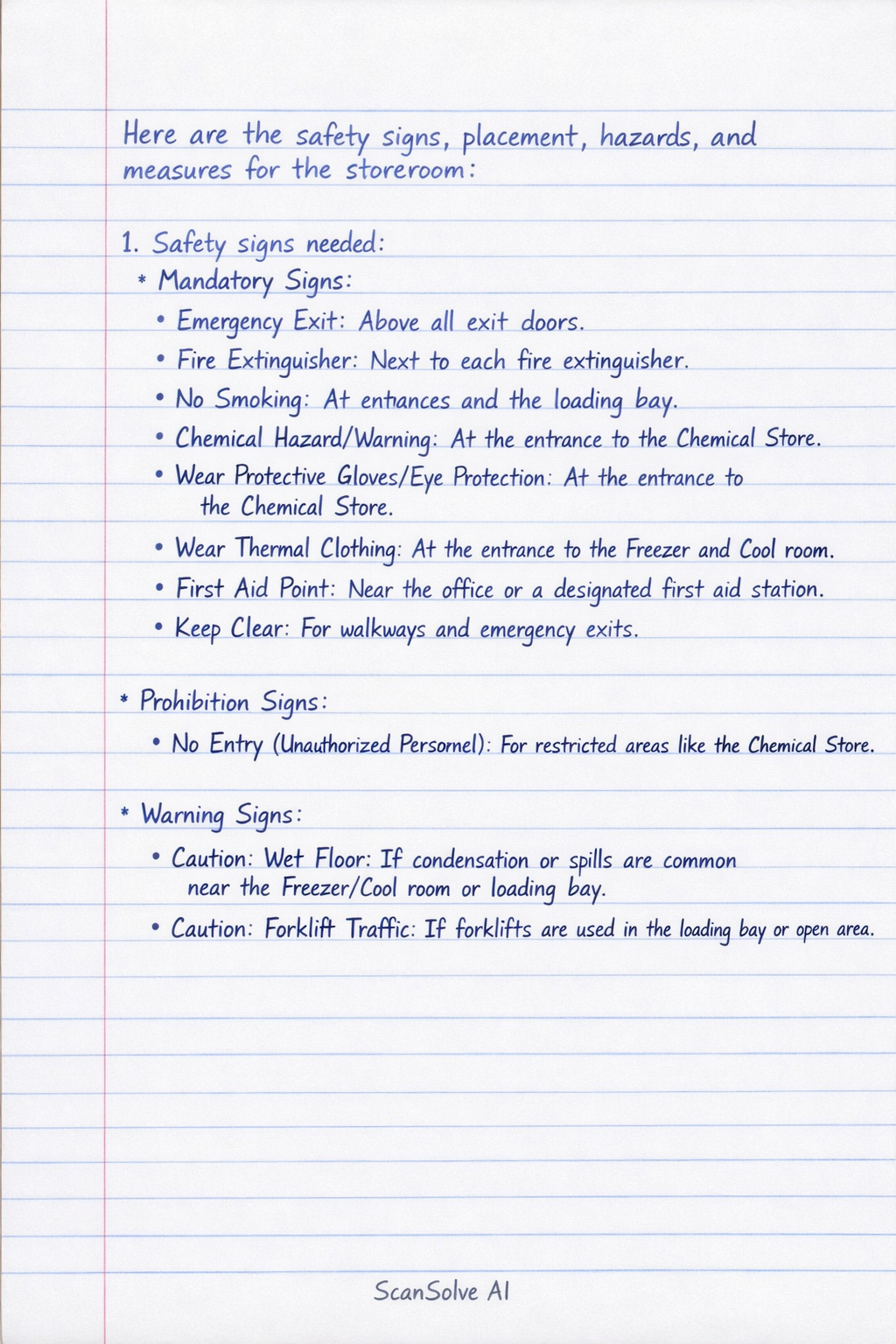
Here are the safety signs, placement, hazards, and measures for the storeroom:
-
Safety signs needed:
- Mandatory Signs:
- Emergency Exit: Above all exit doors.
- Fire Extinguisher: Next to each fire extinguisher.
- No Smoking: At entrances and the loading bay.
- Chemical Hazard/Warning: At the entrance to the Chemical Store.
- Wear Protective Gloves/Eye Protection: At the entrance to the Chemical Store.
- Wear Thermal Clothing: At the entrance to the Freezer and Cool room.
- First Aid Point: Near the office or a designated first aid station.
- Keep Clear: For walkways and emergency exits.
- Prohibition Signs:
- No Entry (Unauthorized Personnel): For restricted areas like the Chemical Store.
- Warning Signs:
- Caution: Wet Floor: If condensation or spills are common near the Freezer/Cool room or loading bay.
- Caution: Forklift Traffic: If forklifts are used in the loading bay or open area.
- Mandatory Signs:
-
Sign placement:
- Emergency Exit: Clearly visible above the main entrance/exit doors and any other designated emergency exits.
- Fire Extinguisher: Mounted on walls adjacent to the fire extinguishers, ensuring they are easily seen and accessible.
- No Smoking: Placed prominently at the main entrance, loading bay, and within the open area.
- Chemical Hazard/Warning & PPE requirements: Directly on the door or wall leading into the Chemical Store.
- Thermal Clothing: On the doors of the Freezer and Cool room.
- First Aid Point: On the wall near the Office or a central, easily accessible location.
- Keep Clear: On walls adjacent to emergency exits and along main walkways in the Open area.
-
Health, safety & security hazards:
- Physical Hazards:
- Slips, Trips, and Falls: Due to spills (especially near Freezer/Cool room), clutter in the Open area or around Trolleys and Shelves, and uneven surfaces in the Loading bay.
- Manual Handling Injuries: From lifting and moving heavy items in the Loading bay, Dry Store, Freezer, Cool room, and when stocking Shelves or Storage Bins.
- Temperature Extremes: Exposure to very low temperatures in the Freezer and Cool room.
- Falling Objects: From improperly stacked items on Shelves or in Storage Bins.
- Blocked Exits: If Trolleys, Storage Bins, or other items obstruct pathways or emergency exits.
- Fire: Electrical faults in refrigeration units (Freezer, Cool room), office equipment, or flammable materials in the Chemical Store.
- Health Hazards:
- Chemical Exposure: From spills, fumes, or improper handling of substances in the Chemical Store.
- Poor Ventilation: Potential build-up of fumes in the Chemical Store if ventilation is inadequate.
- Noise Pollution: From refrigeration units, loading bay activities, or equipment.
- Security Hazards:
- Unauthorized Access: To the entire storeroom, especially the Chemical Store, Equipment Store, and Office.
- Theft: Of valuable goods from the Dry Store, Equipment Store, or chemicals.
- Lack of Surveillance: Blind spots or inadequate monitoring of entry/exit points and high-value areas.
- Physical Hazards:
-
Measures to address hazards:
- Clear Walkways: Implement a 5S program (Sort, Set in order, Shine, Standardize, Sustain) to ensure designated storage for Trolleys, Storage Bins, and other equipment, keeping all pathways clear.
- Safety Equipment Installation: Install fire extinguishers and smoke detectors throughout the storeroom, especially near the Chemical Store and electrical equipment. Provide spill kits in the Chemical Store.
- Training Programs: Conduct mandatory training for staff on manual handling techniques, chemical safety (COSHH), emergency procedures (fire evacuation, spill response), and first aid.
- Risk Assessments: Regularly conduct and review risk assessments for all tasks and areas, especially the Loading bay, Chemical Store, Freezer, and Cool room.
- Personal Protective Equipment (PPE): Ensure appropriate PPE (e.g., thermal clothing, safety gloves, eye protection, safety footwear) is available and mandatory for specific tasks and areas.
- Access Control: Install lockable doors for the Chemical Store, Equipment Store, and Office. Implement a key control system and potentially CCTV monitoring for the entire storeroom and loading bay.
- Ventilation: Ensure adequate ventilation systems are in place, particularly in the Chemical Store, to prevent fume build-up.
- Maintenance: Implement a regular maintenance schedule for all equipment, including refrigeration units, trolleys, and scales, to prevent breakdowns and ensure safe operation.
-
Specialist assistance:
- Occupational Health and Safety (OHS) Consultants: For comprehensive safety audits, risk assessments, development of safety policies and procedures, and general compliance with health and safety regulations.
- Fire Safety Engineers/Consultants: To conduct detailed fire risk assessments, design fire suppression systems, advise on emergency lighting and evacuation plans, and ensure compliance with fire safety codes.
- Chemical Safety Specialists: For expert advice on the safe storage, handling, and disposal of chemicals in the Chemical Store, including COSHH assessments and spill response planning.
- Security Consultants: To assess vulnerabilities, recommend and implement access control systems, CCTV surveillance, and develop security protocols to prevent theft and unauthorized entry.
- Ergonomics Specialists: To evaluate manual handling tasks and workstation setups, providing recommendations to reduce the risk of musculoskeletal injuries.
Was this helpful?
Still stuck on this one?
Ask a follow-up, and the answer starts from this question.
Got a different question?Ask your own question
More Business/Management Questions
QComplete a worksheet identifying two health hazards in a storeroom, suggesting specialists, and…QDevelop a communication plan for a storeroom safety investigation, including steps for arranging a…QWhat are the safety precautions and hazard symbols related to chemicals in a laboratory setting?QWork place safety rulesQWhat are the best practices for maintaining a safe and clean work area and why are they important?
Handwritten Step-by-Step Solution
Get this as a handwritten image on WhatsApp — like a tutor wrote it for you.
Try on WhatsApp