
We read your photo as:
SECTION B: STRUCTURED QUESTIONS (30 MARKS) Answer ANY THREE questions in this section. Each question carries 10 marks.
ScanSolve AI Answer
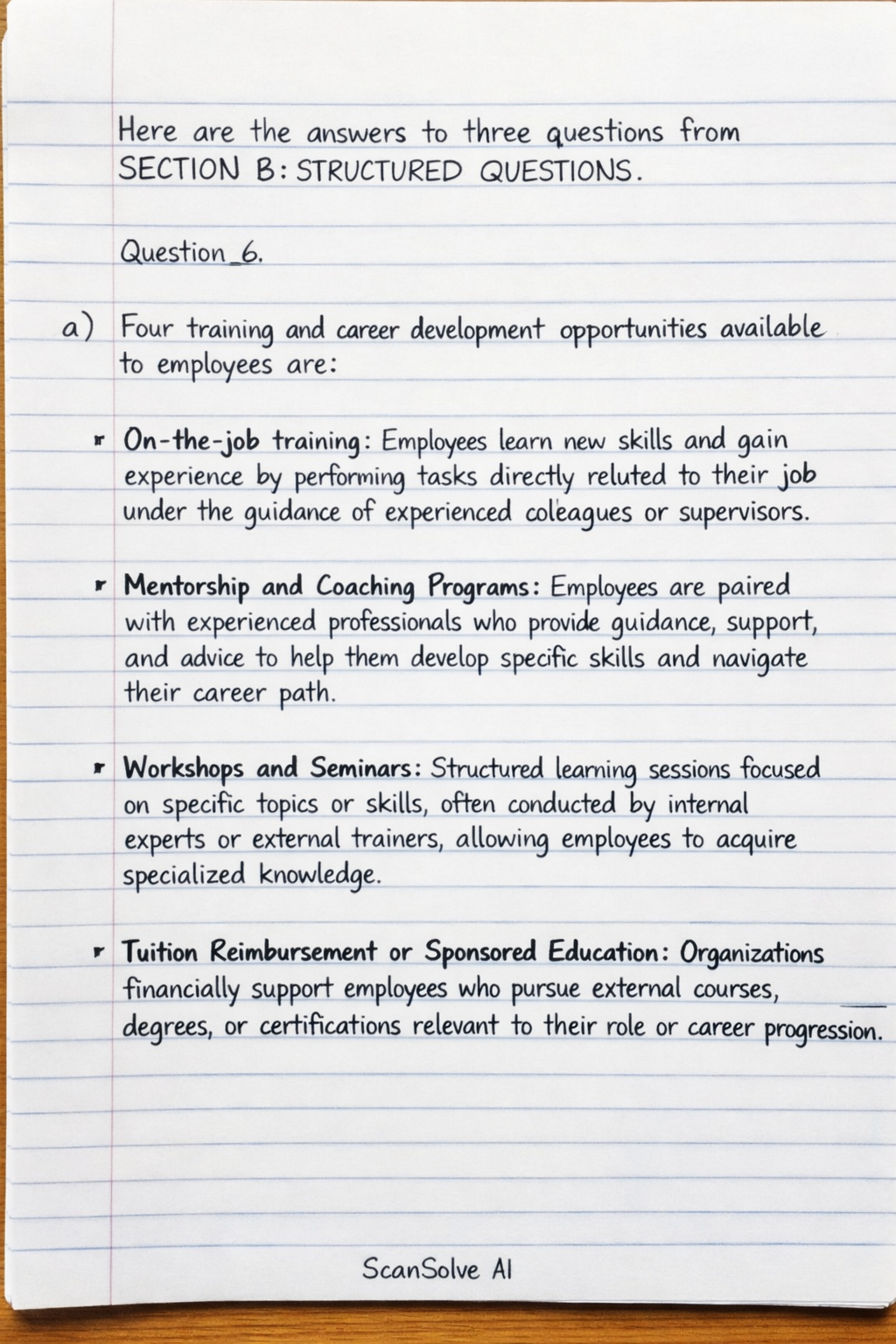
Here are the answers to three questions from SECTION B: STRUCTURED QUESTIONS.
Question 6
a) Four training and career development opportunities available to employees are:
- On-the-job training: Employees learn new skills and gain experience by performing tasks directly related to their job under the guidance of experienced colleagues or supervisors.
- Mentorship and Coaching Programs: Employees are paired with experienced professionals who provide guidance, support, and advice to help them develop specific skills and navigate their career path.
- Workshops and Seminars: Structured learning sessions focused on specific topics or skills, often conducted by internal experts or external trainers, allowing employees to acquire specialized knowledge.
- Tuition Reimbursement or Sponsored Education: Organizations financially support employees who pursue external courses, degrees, or certifications relevant to their role or career progression.
b) Three strategies for balancing work priorities and personal commitments are:
- Effective Time Management and Prioritization: Employees can use tools like calendars, to-do lists, and prioritization matrices (e.g., Eisenhower Matrix) to manage their workload, set realistic deadlines, and allocate time for both work tasks and personal activities. This involves clearly defining boundaries between work and personal life.
- Flexible Work Arrangements: Organizations can offer options such as remote work, flextime (flexible start/end times), or compressed workweeks. These arrangements allow employees greater autonomy over their schedules, making it easier to attend to personal appointments, family needs, or pursue personal interests.
- Delegation and Saying No: Learning to delegate tasks when appropriate and politely declining additional responsibilities when already overloaded is crucial. This prevents burnout and ensures that employees have sufficient time and energy for their personal commitments without compromising work quality.
Question 7
a) Four characteristics of creative and innovative solutions are:
- Novelty/Originality: The solution introduces a new idea, approach, or method that has not been used before in that specific context, moving beyond conventional thinking.
- Utility/Effectiveness: The solution effectively addresses the problem at hand, providing a practical and functional outcome that achieves the desired results or significantly improves the current situation.
- Feasibility/Practicality: While creative, the solution must be realistic and implementable within the available resources, technology, and organizational constraints.
- Scalability/Adaptability: An innovative solution often has the potential to be expanded, modified, or applied to other similar problems or contexts, demonstrating its broader impact and versatility.
b) The six steps involved in solving workplace problems are:
- Identify and Define the Problem: Clearly articulate what the problem is, its scope, and its impact. This involves gathering initial information and ensuring everyone understands the core issue.
- Gather Information and Analyze Causes: Collect relevant data, facts, and perspectives from all stakeholders. Analyze this information to understand the root causes of the problem, not just its symptoms.
- Generate Potential Solutions: Brainstorm a wide range of possible solutions without immediate judgment. Encourage diverse ideas, even those that seem unconventional at first.
- Evaluate Solutions and Make a Decision: Assess each potential solution based on criteria such as feasibility, cost, impact, risks, and alignment with organizational goals. Select the most appropriate solution.
- Implement the Chosen Solution: Develop an action plan, assign responsibilities, allocate resources, and put the selected solution into practice. Communicate the plan to all affected parties.
- Monitor and Evaluate Results: Track the progress and outcomes of the implemented solution. Assess whether the problem has been resolved effectively and if any adjustments or further actions are needed.
Question 8
a) Five ways through which organizations can mobilize resources for employee training and development are:
- Dedicated Budget Allocation: Organizations can set aside specific funds in their annual budget solely for training programs, workshops, certifications, and educational support.
- Leveraging Internal Expertise: Utilizing experienced employees as mentors, coaches, or internal trainers to share their knowledge and skills with less experienced staff, reducing reliance on external resources.
- Partnerships with Educational Institutions: Collaborating with universities, colleges, or vocational schools to access specialized courses, discounted programs, or custom-designed training modules.
- Government Grants and Subsidies: Applying for government funding or tax incentives available for companies investing in employee training and skill development initiatives.
- Technology-Based Learning Platforms: Investing in e-learning platforms, online courses, webinars, and virtual reality (VR) training tools that can be accessed flexibly and often at a lower per-employee cost.
b) Five forms of professional recognition that indicate career advancement are:
- Promotion to a Higher Position: Being moved to a role with increased responsibilities, authority, and often a more senior title (e.g., from Analyst to Senior Analyst, or Manager to Director).
- Significant Salary Increase or Performance Bonus: A substantial increase in compensation that reflects a higher level of contribution, expertise, and value to the organization, often accompanying a promotion or expanded role.
- Assignment to Lead Key Projects or Teams: Being entrusted with the leadership of critical projects, strategic initiatives, or a team of colleagues, demonstrating trust in one's capabilities and leadership potential.
- Mentorship or Coaching Role: Being asked to mentor junior employees or new hires, signifying that one's experience and knowledge are highly valued and that they are seen as a role model within the organization.
- Professional Awards or Accolades: Receiving internal company awards, industry recognition, or public acknowledgment for outstanding achievements, innovation, or long-term contributions, which often precedes or accompanies career progression.
Still stuck on this one?
Ask a follow-up, and the answer starts from this question.
More Business/Management Questions
Handwritten Step-by-Step Solution
Get this as a handwritten image on WhatsApp — like a tutor wrote it for you.
Try on WhatsApp