
We read your photo as:
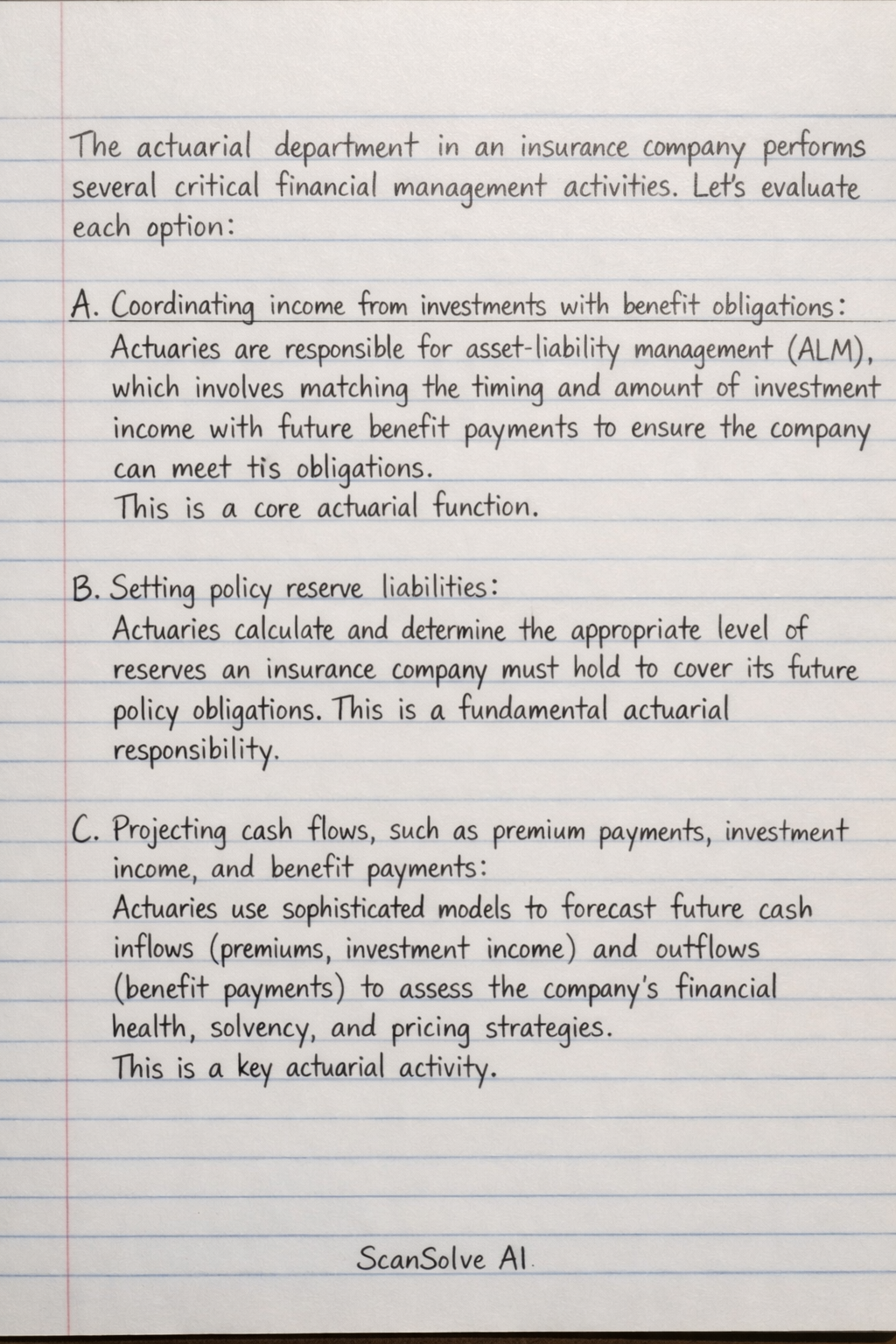
The actuarial department in an insurance company performs several critical financial management activities. Let's evaluate each option:
Business/Management
ScanSolve AI Answer
The actuarial department in an insurance company performs several critical financial management activities. Let's evaluate each option:
- A. Coordinating income from investments with benefit obligations: Actuaries are responsible for asset-liability management (ALM), which involves matching the timing and amount of investment income with future benefit payments to ensure the company can meet its obligations. This is a core actuarial function.
- B. Setting policy reserve liabilities: Actuaries calculate and determine the appropriate level of reserves an insurance company must hold to cover its future policy obligations. This is a fundamental actuarial responsibility.
- C. Projecting cash flows, such as premium payments, investment income, and benefit payments: Actuaries use sophisticated models to forecast future cash inflows (premiums, investment income) and outflows (benefit payments) to assess the company's financial health, solvency, and pricing strategies. This is a key actuarial activity.
- D. Conducting internal audits: Internal audits are typically performed by an independent internal audit department to evaluate the effectiveness of internal controls, risk management, and governance processes. While actuaries may be involved in providing information or being audited, conducting internal audits is not their primary role.
Based on this analysis, activities A, B, and C are typical financial management activities performed by an actuarial department. Activity D is not.
Therefore, the correct option is the one that includes A, B, and C only.
The final answer is
Was this helpful?
Still stuck on this one?
Ask a follow-up, and the answer starts from this question.
Got a different question?Ask your own question
More Business/Management Questions
QTo identify ways an insurance company can raise capital. Let's analyze each option:QWhich of the following statements accurately describes the role of an executive in an insurance…QIdentify the type of insurance and the financial statement described in each scenario.QWhich of the following is an external user of an insurance company's accounting information?QWhich report assumes a company will be in business going forward and helps users assess…
Handwritten Step-by-Step Solution
Get this as a handwritten image on WhatsApp — like a tutor wrote it for you.
Try on WhatsApp