
We read your photo as:
What are the answers to the workshop hazards worksheet?
ScanSolve AI Answer
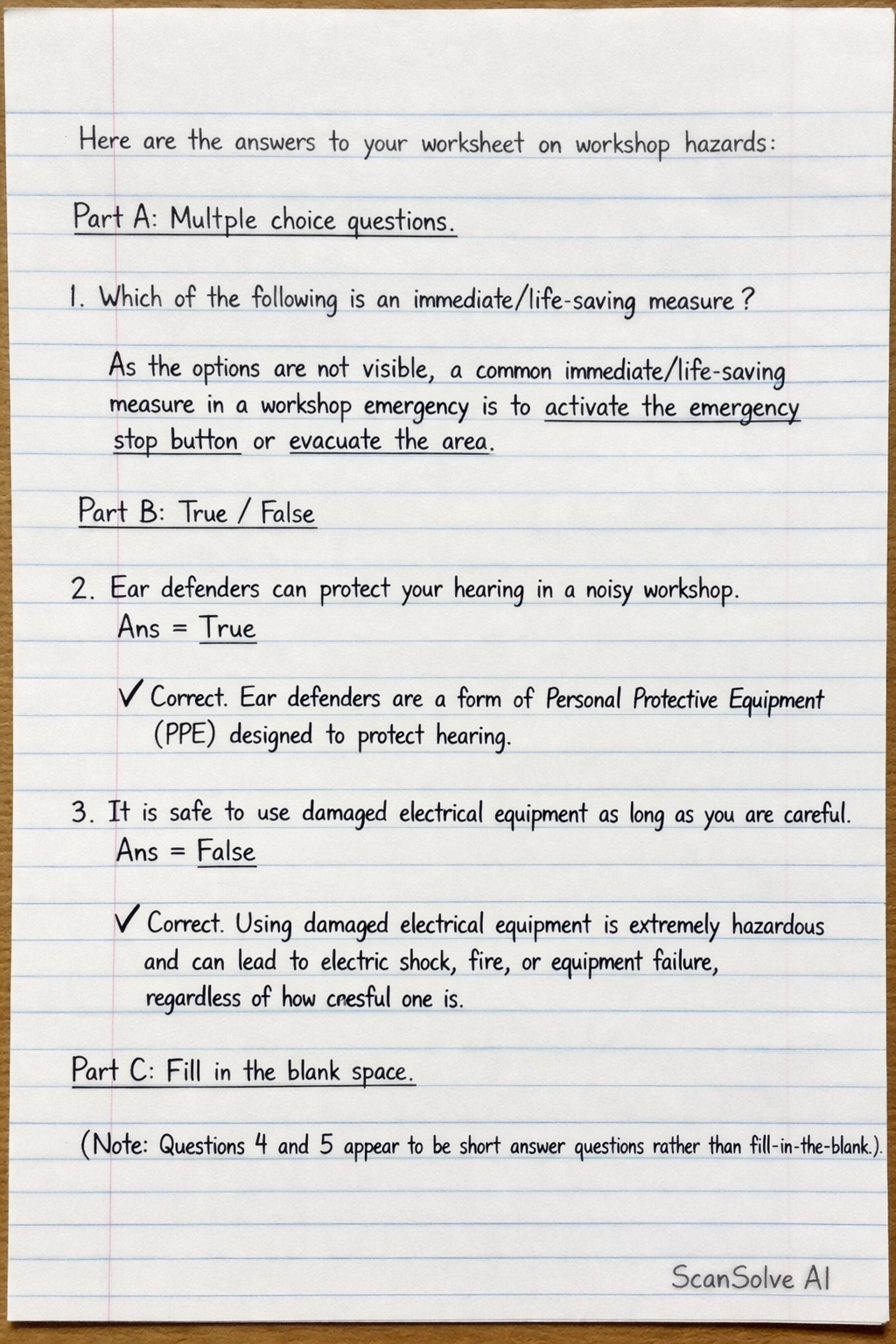
Here are the answers to your worksheet on workshop hazards:
Part A: Multiple choice questions.
- Which of the following is an immediate/life-saving measure?
- As the options are not visible, a common immediate/life-saving measure in a workshop emergency is to activate the emergency stop button or evacuate the area.
Part B: True / False
-
Ear defenders can protect your hearing in a noisy workshop.
- Ans is = True ✅ Correct. Ear defenders are a form of Personal Protective Equipment (PPE) designed to protect hearing.
-
It is safe to use damaged electrical equipment as long as you are careful.
- Ans is = False ✅ Correct. Using damaged electrical equipment is extremely hazardous and can lead to electric shock, fire, or equipment failure, regardless of how careful one is.
Part C: Fill in the blank space.
(Note: Questions 4 and 5 appear to be short answer questions rather than fill-in-the-blank.)
-
What is a common cause of fire in a workshop?
- Ans is = electrical equipment ✅ Correct. Faulty or overloaded electrical equipment is a very common cause of fires in workshops.
-
How can you reduce the risk of slips and trips?
- Ans is = good housekeeping ✅ Correct. Good housekeeping, such as keeping floors clean and dry, clearing clutter, and ensuring proper lighting, significantly reduces the risk of slips and trips.
Part D: Short answer question
- Name two hazards related to chemicals in a workshop.
Two hazards related to chemicals in a workshop are:
- Skin irritation or chemical burns from direct contact.
- Respiratory problems or poisoning from inhaling hazardous fumes or vapors.
Part E: Read and explain (Scenario-Based)
-
You are working in a workshop and notice a colleague is not wearing appropriate PPE for the task they are performing. What steps should you take?
If you notice a colleague not wearing appropriate PPE for their task, you should take the following steps:
- Step 1: Gently Approach and Observe. Approach your colleague calmly and observe the task they are performing to confirm the PPE requirements and the specific hazard they are exposed to.
- Step 2: Politely Point Out the Concern. Discreetly and politely inform your colleague that they are not wearing the correct PPE for the task. Explain the potential risks or hazards associated with not wearing it.
- Step 3: Offer Assistance. If they are unsure where to find the correct PPE or how to use it, offer to help them locate it or demonstrate its proper use.
- Step 4: Escalate if Necessary. If your colleague refuses to wear the appropriate PPE or if the situation poses an immediate and serious danger, you should report the incident to your supervisor or the designated safety officer. This is crucial for ensuring everyone's safety and maintaining a safe work environment.
Still stuck on this one?
Ask a follow-up, and the answer starts from this question.
More Business/Management Questions
Handwritten Step-by-Step Solution
Get this as a handwritten image on WhatsApp — like a tutor wrote it for you.
Try on WhatsApp