The homework questions appear to be from a business or economics class, covering topics like accounting, taxation, and entrepreneurship. There are also questions in Igbo.

Business/Management
The homework questions appear to be from a business or economics class, covering topics like accounting, taxation, and entrepreneurship. There are also questions in Igbo.

ScanSolve AI Answer

Answer

Good character refers to positive moral and ethical qualities that guide an individual's behavior and interactions.

I can now clearly read the Igbo questions. Here are the answers:

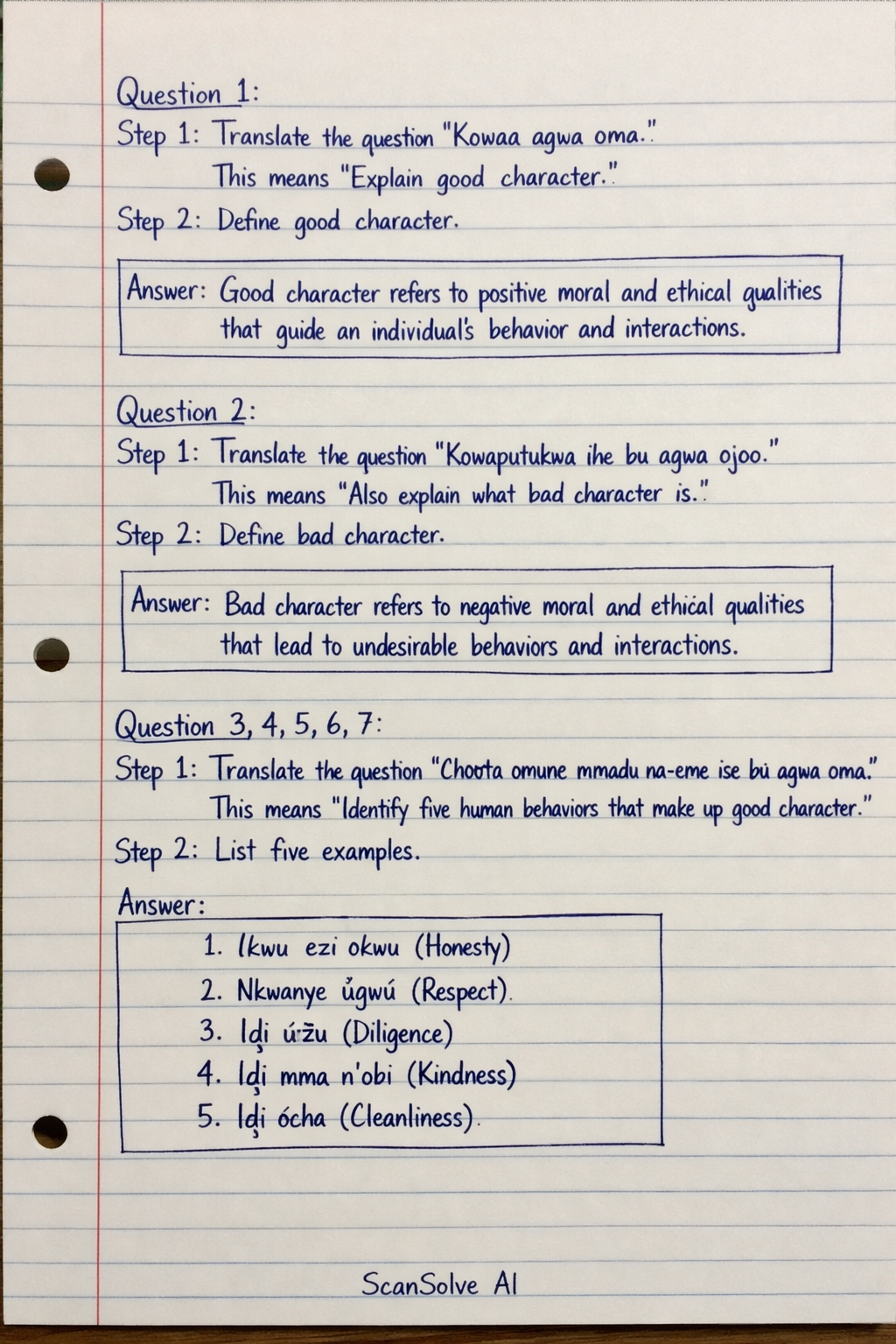
Question 1: Step 1: Translate the question "Kowaa agwa oma". This means "Explain good character". Step 2: Define good character. Answer: Goodcharacterreferstopositivemoralandethicalqualitiesthatguideanindividualsbehaviorandinteractions.\boxed{Good character refers to positive moral and ethical qualities that guide an individual's behavior and interactions.}

Question 2: Step 1: Translate the question "Kowaputakwa ihe bu agwa ojoo". This means "Also explain what bad character is". Step 2: Define bad character. Answer: Badcharacterreferstonegativemoralandethicalqualitiesthatleadtoundesirablebehaviorsandinteractions.\boxed{Bad character refers to negative moral and ethical qualities that lead to undesirable behaviors and interactions.}

Question 3, 4, 5, 6, 7: Step 1: Translate the question "Choputa omume mmadu na-eme ise bu agwa oma". This means "Identify five human behaviors that make up good character". Step 2: List five examples. Answer: 1.Ikwueziokwu(Honesty),2.Nkwanyeuˋgwuˋ(Respect),3.duchu(Diligence),4.dmmanobi(Kindness),5.dịọcha(Cleanliness)\boxed{1. Ikwu eziokwu (Honesty), 2. Nkwanye ùgwù (Respect), 3. Ịdị uchu (Diligence), 4. Ịdị mma n'obi (Kindness), 5. Ịdị ọcha (Cleanliness)}

Question 8, 9, 10, 11, 12, 13, 14, 15, 16: Step 1: Translate the question "Gosiputa agwa ojoo ise a kuziri gi". This means "Show five bad characters you were taught". Step 2: List five examples. Answer: 1.ghagha(Lying),2.dumengw(Laziness),3.dmpako(Arrogance),4.danyaukwu(Greed),5.dekworo(Envy)\boxed{1. Ịgha ụgha (Lying), 2. Ịdị umengwụ (Laziness), 3. Ịdị mpako (Arrogance), 4. Ịdị anya ukwu (Greed), 5. Ịdị ekworo (Envy)}

Question 17, 18, 19, 20, 21, 22: Step 1: Translate the question "Olee uru ano agwa oma bara?". This means "What are four benefits of good character?". Step 2: List four benefits. Answer: 1.nwetankwanyeuˋgwuˋ(Gainingrespect),2.dnudonahammad(Livingpeacefullyinsociety),3.nwetantkwasobi(Gainingtrust),4.gankemanand(Achievingsuccessinlife)\boxed{1. Ịnweta nkwanye ùgwù (Gaining respect), 2. Ịdị n'udo na ọha mmadụ (Living peacefully in society), 3. Ịnweta ntụkwasị obi (Gaining trust), 4. Ịga nke ọma na ndụ (Achieving success in life)}

Question 23, 24, 25, 26, 27, 28, 29, 30, 31, 32: Step 1: Translate the question "Ndi Igbo nwere otutu aka oru n'oge mbu ma ugbu a, deputa iri n'ime ha". This means "Igbo people have many occupations in the past and present, list ten of them". Step 2: List ten examples. Answer: 1.rugbo(Farming),2.kpaaˊkwaˋ(Weaving),3.kihe(Carving),4.kite(Pottery),5.kaka(Blacksmithing),6.zaha(Trading),7.kaz(Fishing),8.kpisi(Barbering),9.kwaakwa(Tailoring),10.kụọla(Jewellerymaking)\boxed{1. Ọrụ ugbo (Farming), 2. Ịkpa ákwà (Weaving), 3. Ịkụ ihe (Carving), 4. Ịkụ ite (Pottery), 5. Ịkụ aka (Blacksmithing), 6. Ịzụ ahịa (Trading), 7. Ịkụ azụ (Fishing), 8. Ịkpụ isi (Barbering), 9. Ịkwa akwa (Tailoring), 10. Ịkụ ọla (Jewellery making)}

Question 33, 34, 35, 36: Step 1: Translate the question "Choputa uru ano aka oru bara". This means "Identify four benefits of occupations". Step 2: List four benefits. Answer: 1.nwetaego(Earningmoney),2.kwadoezinl(Supportingfamily),3.meptar(Jobcreation),4.kwaliteaknba(Promotingeconomicgrowth)\boxed{1. Ịnweta ego (Earning money), 2. Ịkwado ezinụlọ (Supporting family), 3. Ịmepụta ọrụ (Job creation), 4. Ịkwalite akụnụba (Promoting economic growth)}

Question 37, 38, 39, 40, 41, 42, 43, 44, 45, 46: Step 1: Translate the question "Enwere oru nwoke na nwanyi na-aruko oru n'ala Igbo, deputa iri n'ime ha". This means "There are male and female occupations in Igboland, list ten of them". Step 2: List ten examples. Answer: 1.rugbo(Farming),2.zaha(Trading),3.kwaakwa(Tailoring),4.kpisi(Barbering/Hairdressing),5.kite(Pottery),6.kpaaˊkwaˋ(Weaving),7.kaka(Blacksmithing),8.kihe(Carving),9.kaz(Fishing),10.kụọla(Jewellerymaking)\boxed{1. Ọrụ ugbo (Farming), 2. Ịzụ ahịa (Trading), 3. Ịkwa akwa (Tailoring), 4. Ịkpụ isi (Barbering/Hairdressing), 5. Ịkụ ite (Pottery), 6. Ịkpa ákwà (Weaving), 7. Ịkụ aka (Blacksmithing), 8. Ịkụ ihe (Carving), 9. Ịkụ azụ (Fishing), 10. Ịkụ ọla (Jewellery making)}

That's all the questions from the image! Send me the next one 📸

Was this helpful?

Need help with your own homework?

Get instant step-by-step solutions to any question. Free to start.

Ask Your Question
Handwritten step-by-step solution preview

Handwritten Step-by-Step Solution

Get this as a handwritten image on WhatsApp — like a tutor wrote it for you.

Try on WhatsApp

Still have questions?

Quick Answer

I can now clearly read the Igbo questions. Here are the answers: Question 1: Step 1: Translate the question "Kowaa agwa oma".

The homework questions appear to be from a business or economics class, covering topics like accounting, taxation, and entrepreneurship. There are also questions in Igbo.
Business/Management

This business/management problem is solved step by step below, with detailed explanations to help you understand the method and arrive at the correct answer.

ScanSolve AI Answer
I can now clearly read the Igbo questions. Here are the answers: Question 1: Step 1: Translate the question "Kowaa agwa oma". This means "Explain good character". Step 2: Define good character. Answer: Good character refers to positive moral and ethical qualities that guide an individual's behavior and interactions. Question 2: Step 1: Translate the question "Kowaputakwa ihe bu agwa ojoo". This means "Also explain what bad character is". Step 2: Define bad character. Answer: Bad character refers to negative moral and ethical qualities that lead to undesirable behaviors and interactions. Question 3, 4, 5, 6, 7: Step 1: Translate the question "Choputa omume mmadu na-eme ise bu agwa oma". This means "Identify five human behaviors that make up good character". Step 2: List five examples. Answer: 1. Ikwu eziokwu (Honesty), 2. Nkwanye ùgwù (Respect), 3. Ịdị uchu (Diligence), 4. Ịdị mma n'obi (Kindness), 5. Ịdị ọcha (Cleanliness) Question 8, 9, 10, 11, 12, 13, 14, 15, 16: Step 1: Translate the question "Gosiputa agwa ojoo ise a kuziri gi". This means "Show five bad characters you were taught". Step 2: List five examples. Answer: 1. Ịgha ụgha (Lying), 2. Ịdị umengwụ (Laziness), 3. Ịdị mpako (Arrogance), 4. Ịdị anya ukwu (Greed), 5. Ịdị ekworo (Envy) Question 17, 18, 19, 20, 21, 22: Step 1: Translate the question "Olee uru ano agwa oma bara?". This means "What are four benefits of good character?". Step 2: List four benefits. Answer: 1. Ịnweta nkwanye ùgwù (Gaining respect), 2. Ịdị n'udo na ọha mmadụ (Living peacefully in society), 3. Ịnweta ntụkwasị obi (Gaining trust), 4. Ịga nke ọma na ndụ (Achieving success in life) Question 23, 24, 25, 26, 27, 28, 29, 30, 31, 32: Step 1: Translate the question "Ndi Igbo nwere otutu aka oru n'oge mbu ma ugbu a, deputa iri n'ime ha". This means "Igbo people have many occupations in the past and present, list ten of them". Step 2: List ten examples. Answer: 1. Ọrụ ugbo (Farming), 2. Ịkpa ákwà (Weaving), 3. Ịkụ ihe (Carving), 4. Ịkụ ite (Pottery), 5. Ịkụ aka (Blacksmithing), 6. Ịzụ ahịa (Trading), 7. Ịkụ azụ (Fishing), 8. Ịkpụ isi (Barbering), 9. Ịkwa akwa (Tailoring), 10. Ịkụ ọla (Jewellery making) Question 33, 34, 35, 36: Step 1: Translate the question "Choputa uru ano aka oru bara". This means "Identify four benefits of occupations". Step 2: List four benefits. Answer: 1. Ịnweta ego (Earning money), 2. Ịkwado ezinụlọ (Supporting family), 3. Ịmepụta ọrụ (Job creation), 4. Ịkwalite akụnụba (Promoting economic growth) Question 37, 38, 39, 40, 41, 42, 43, 44, 45, 46: Step 1: Translate the question "Enwere oru nwoke na nwanyi na-aruko oru n'ala Igbo, deputa iri n'ime ha". This means "There are male and female occupations in Igboland, list ten of them". Step 2: List ten examples. Answer: 1. Ọrụ ugbo (Farming), 2. Ịzụ ahịa (Trading), 3. Ịkwa akwa (Tailoring), 4. Ịkpụ isi (Barbering/Hairdressing), 5. Ịkụ ite (Pottery), 6. Ịkpa ákwà (Weaving), 7. Ịkụ aka (Blacksmithing), 8. Ịkụ ihe (Carving), 9. Ịkụ azụ (Fishing), 10. Ịkụ ọla (Jewellery making) That's all the questions from the image! Send me the next one 📸