
We read your photo as:
What are the principles of safe manual handling, including risks and preventative measures?
ScanSolve AI Answer
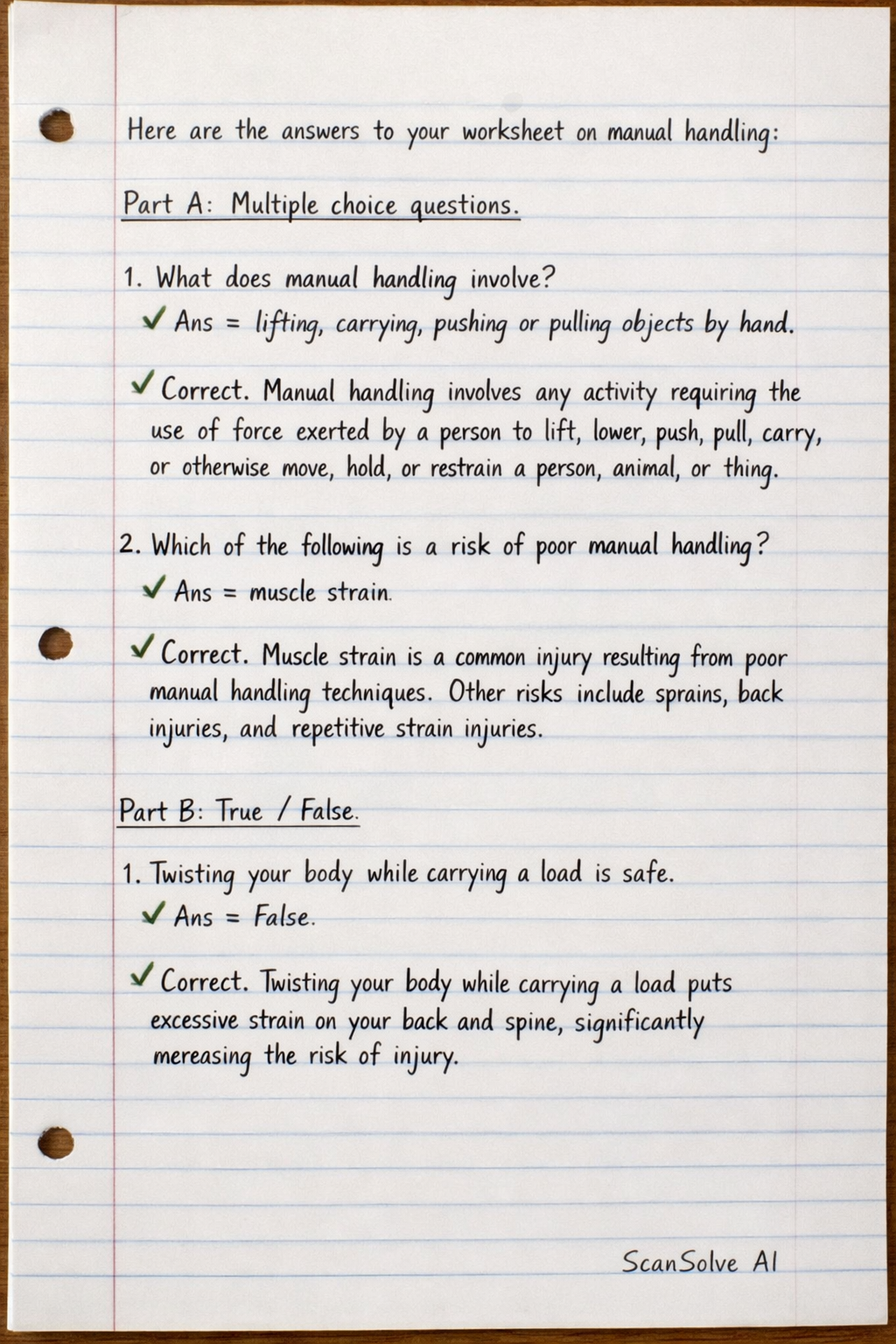
Here are the answers to your worksheet on manual handling:
Part A: Multiple choice questions.
-
What does manual handling involve?
- Ans is = lifting, carrying, pushing or pulling objects by hand ✅ Correct. Manual handling involves any activity requiring the use of force exerted by a person to lift, lower, push, pull, carry, or otherwise move, hold, or restrain a person, animal, or thing.
-
Which of the following is a risk of poor manual handling?
- Ans is = muscle strain ✅ Correct. Muscle strain is a common injury resulting from poor manual handling techniques. Other risks include sprains, back injuries, and repetitive strain injuries.
Part B: True / False
-
Twisting your body while carrying a load is safe.
- Ans is = False ✅ Correct. Twisting your body while carrying a load puts excessive strain on your back and spine, significantly increasing the risk of injury.
-
Always bend your back when lifting.
- Ans is = False ✅ Correct. You should bend your knees and keep your back straight, using your leg muscles to lift, not your back.
-
Mechanical aids like trolleys can help reduce injury risk.
- Ans is = True ✅ Correct. Mechanical aids reduce the physical effort required, thereby lowering the risk of manual handling injuries.
Part C: Short answer questions
-
List three tips for safe manual handling.
- Ans is =
- Assess the load (weight, size, shape)
- Avoid twisting your body while lifting
- Move slowly and slowly
- Get help if the load is too heavy or awkward
- Ask for help or use a mechanical aid. ✅ Correct. Your tips are all valid. Here are three concise tips:
- Assess the load before lifting to determine if it's safe to handle alone.
- Keep the load close to your body and maintain a firm grip.
- Bend your knees, not your back, and lift with your legs.
- Ans is =
-
When lifting an object, you should:
- Ans is = keep the load close to your body. ✅ Correct. Keeping the load close to your body reduces the leverage on your back and makes the lift easier and safer.
-
What should you do if the load is too heavy or awkward?
- Ans is = ask for help or use a mechanical aid. ✅ Correct. If a load is too heavy or awkward, you should ask for help from a colleague or use mechanical aids such as trolleys, forklifts, or hoists.
-
Why is it important to plan your lift before moving an object?
- Ans is = Recognize the risks associated with improper manual handling because to prevent the injury. ✅ Correct. Planning your lift is important because it allows you to identify potential hazards (like obstacles or slippery surfaces), assess the load's characteristics, and determine the safest route and method for moving the object. This proactive approach helps prevent injuries associated with improper manual handling.
Still stuck on this one?
Ask a follow-up, and the answer starts from this question.
More Business/Management Questions
Handwritten Step-by-Step Solution
Get this as a handwritten image on WhatsApp — like a tutor wrote it for you.
Try on WhatsApp