
We read your photo as:
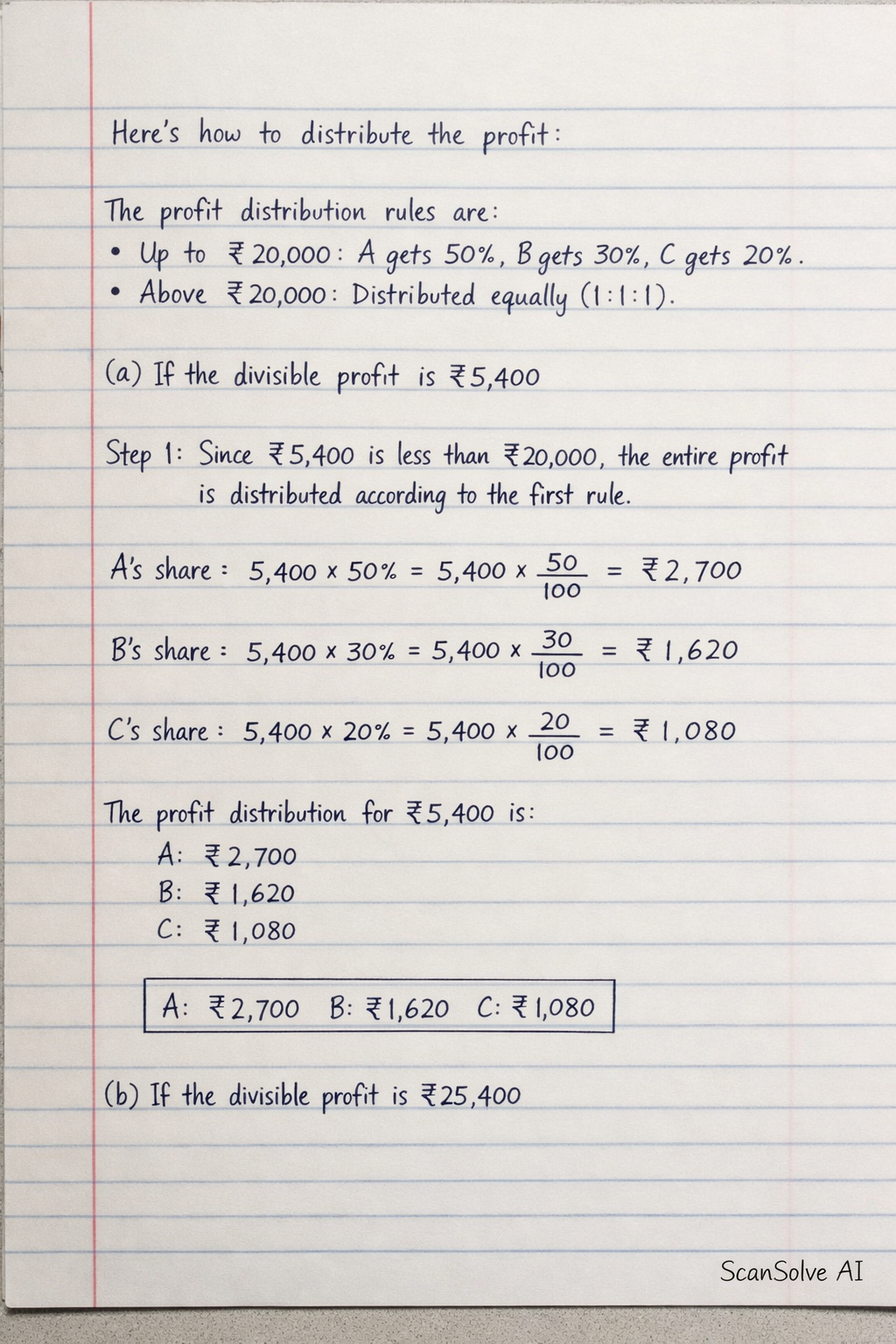
The profit distribution rules are:
Business/Management
ScanSolve AI Answer
Answers
2 partsStep-by-step solution
5 stepsHere's how to distribute the profit:
The profit distribution rules are:
- Up to ₹20,000: A gets 50%, B gets 30%, C gets 20%.
- Above ₹20,000: Distributed equally (1:1:1).
Part a· 1 step
If the divisible profit is ₹5,400
Since ₹5,400 is less than ₹20,000, the entire profit is distributed according to the first rule.
A's share:
B's share:
C's share:
The profit distribution for ₹5,400 is:
A: ₹2,700
B: ₹1,620
C: ₹1,080
Part b
If the divisible profit is ₹25,400
Distribute the first ₹20,000 according to the first rule.
A's share from first ₹20,000:
B's share from first ₹20,000:
C's share from first ₹20,000:
Calculate the profit above ₹20,000.
Distribute the excess profit equally among A, B, and C.
Each partner's share from excess profit:
Calculate the total share for each partner.
Total A's share:
Total B's share:
Total C's share:
The profit distribution for ₹25,400 is:
A: ₹11,800
B: ₹7,800
C: ₹5,800
Was this helpful?
Try one yourself
A new problem that tests the same skill.
Still stuck on this one?
Ask a follow-up, and the answer starts from this question.
Got a different question?Ask your own question
More Business/Management Questions
QPartnership Agreement Details for Profit Distribution (Financial Year: 1 May 2020 − 30 April 2021):QExplain the various types of profitQState the formula for profit.QIdentify the ratio and the total profit.QIn 2025 the directors decided to change the policy on distribution of profits in the form of…
Handwritten Step-by-Step Solution
Get this as a handwritten image on WhatsApp — like a tutor wrote it for you.
Try on WhatsApp