
We read your photo as:
The question describes a situation where accountants compared actual financial results to anticipated budgeted results and found that Winslow's actual sales and marketing expenses exceeded the budgete
Business/Management
ScanSolve AI Answer
Answer
The question describes a situation where accountants compared actual financial results to anticipated budgeted results and found that Winslow's actual sales and marketing expenses exceeded the budgeted expenses. The difference between actual expenses and budgeted expenses is known as a budget variance.
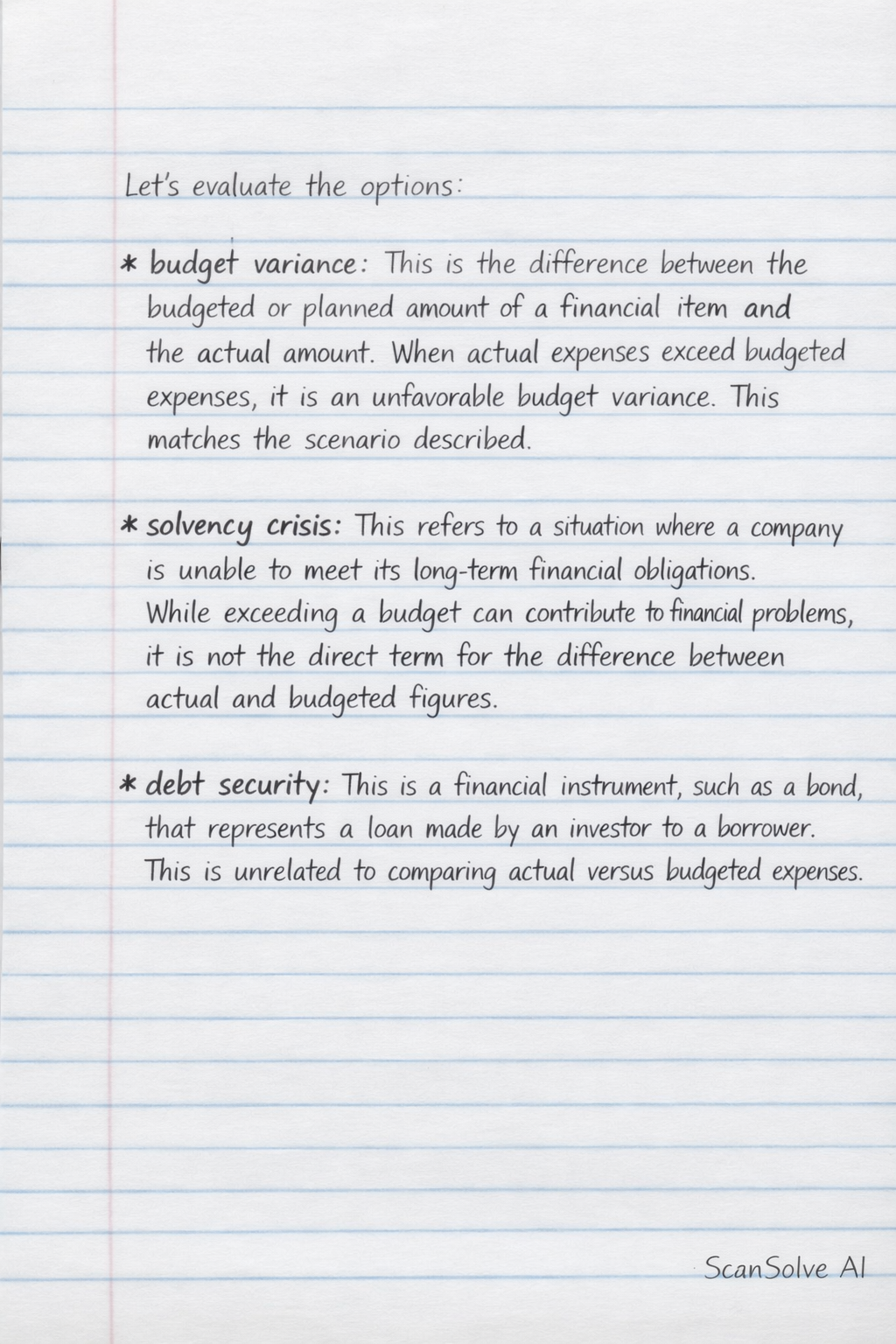
Let's evaluate the options:
- budget variance: This is the difference between the budgeted or planned amount of a financial item and the actual amount. When actual expenses exceed budgeted expenses, it is an unfavorable budget variance. This matches the scenario described.
- solvency crisis: This refers to a situation where a company is unable to meet its long-term financial obligations. While exceeding a budget can contribute to financial problems, it is not the direct term for the difference between actual and budgeted figures.
- debt security: This is a financial instrument, such as a bond, that represents a loan made by an investor to a borrower. This is unrelated to comparing actual versus budgeted expenses.
- capital gain: This is the profit earned from the sale of an asset (like stocks or real estate) that has increased in value. This is unrelated to comparing actual versus budgeted expenses.
Therefore, the correct term is budget variance.
The final answer is
Was this helpful?
Try one yourself
A new problem that tests the same skill.
Still stuck on this one?
Ask a follow-up, and the answer starts from this question.
Got a different question?Ask your own question
More Business/Management Questions
QA budget in which revenue exceeds its expenditure is ______ budget.QTo identify the FALSE statement about an internal financial audit.QPrepare income statements under absorption and marginal costing and reconcile the difference in…QExtract from the Cash Budget. Comparison of budgeted figures to actual figures for December 2026.QWhen the company wants to assess how effective it is using its assets and resources to generate…
Browse by topic:Marketing
Handwritten Step-by-Step Solution
Get this as a handwritten image on WhatsApp — like a tutor wrote it for you.
Try on WhatsApp