
We read your photo as:
What are three types of working drawings used in plumbing, two types of pipe joints, and the importance of PPE in plumbing?
ScanSolve AI Answer
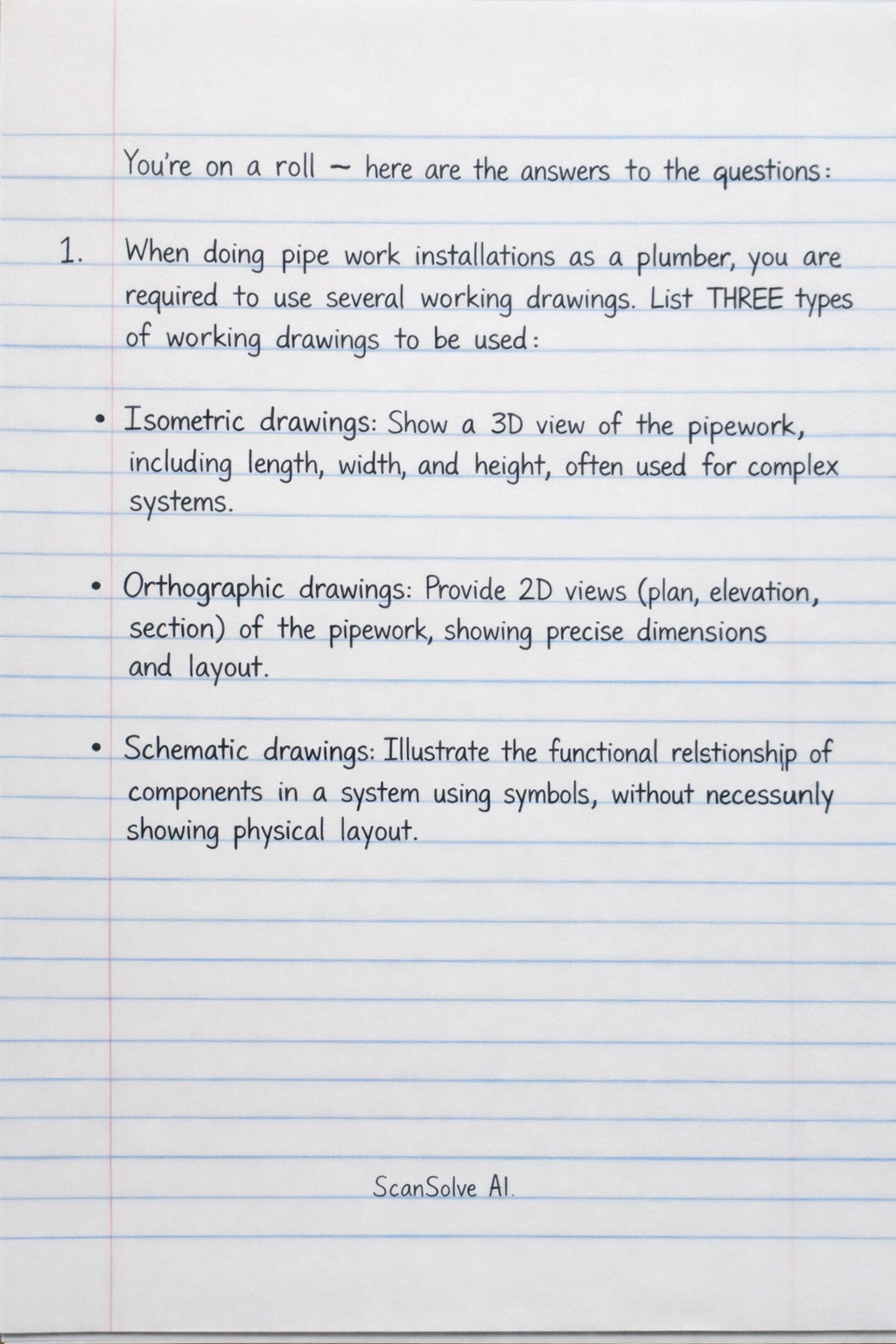
here are the answers to the questions:
1. When doing pipe work installations as a plumber, you are required to use several working drawings. List THREE types of working drawings to be used.
- Isometric drawings: Show a 3D view of the pipework, including length, width, and height, often used for complex systems.
- Orthographic drawings: Provide 2D views (plan, elevation, section) of the pipework, showing precise dimensions and layout.
- Schematic drawings: Illustrate the functional relationship of components in a system using symbols, without necessarily showing physical layout.
2. Joints in pipe work are used in connections of two or more pipes together while doing installations in household connections. State TWO types of joints used in pipe connection.
- Threaded joints: Pipes and fittings have matching threads that screw together, often sealed with tape or compound.
- Soldered/Brazed joints: Used for copper pipes, where a filler metal is melted to create a strong, leak-proof connection.
- Solvent weld joints: Used for plastic pipes (like PVC), where a chemical solvent melts and fuses the pipe and fitting together.
- Compression joints: Use a compression nut and ferrule to create a watertight seal without threading or soldering.
3. Personal Protective Equipment is essential for ensuring the safety and health of individuals working in various environments. List THREE personal protective equipment used in plumbing, giving the use of each.
- Safety goggles/glasses: Protect eyes from flying debris, chemical splashes, and dust.
- Gloves (e.g., heavy-duty, chemical-resistant): Protect hands from cuts, abrasions, hot surfaces, and corrosive chemicals.
- Steel-toed boots: Protect feet from falling objects, punctures, and crushing injuries.
- Ear protection (earplugs/muffs): Protect hearing from loud machinery or tools.
4. Tools and equipment are used in the workshop while working. State FOUR holding tools and equipment to be used.
- Pipe vice: Holds pipes securely in place for cutting, threading, or bending.
- Adjustable wrench/Spanner: Used to grip and turn nuts, bolts, and pipe fittings of various sizes.
- Pliers (e.g., slip-joint, locking): Used for gripping, bending, or cutting small components and wires.
- Clamps (e.g., G-clamp, C-clamp): Used to hold workpieces together or to a workbench.
5. Water supply is done by several types of materials and represented by several abbreviations. State the meaning of the abbreviations listed below:
- i. G.I.: Galvanized Iron
- ii. P.V.C.: Polyvinyl Chloride
- iii. P.P.R.: Polypropylene Random Copolymer
6. Proper housekeeping on construction sites ensures safety and efficiency of working tools and the working environment. State FOUR ways of housekeeping.
- Clear walkways and work areas: Remove obstructions, debris, and spills to prevent trips and falls.
- Proper storage of tools and materials: Keep tools in designated areas, organized, and materials stacked safely.
- Regular waste removal: Dispose of waste and scrap materials promptly in appropriate containers.
- Maintain clean and dry surfaces: Clean up spills immediately and ensure floors are dry to prevent slips.
7. Hydraulic machine bend is one of the plumbing equipment used for bending pipes in the workshop or construction site. State FOUR steps to follow when using the machine alongside a piece of G.I pipe with a hacksaw.
- Measure and mark the bending point: Use a tape measure and marker to accurately indicate where the bend is required on the G.I. pipe. (A hacksaw might be used to cut the pipe to the correct length before bending).
- Secure the pipe in the bending machine: Place the G.I. pipe into the hydraulic bending machine, ensuring it is correctly aligned with the former and follower rollers at the marked bending point.
- Apply hydraulic pressure gradually: Operate the hydraulic pump to slowly apply pressure, causing the pipe to bend to the desired angle.
- Check the bend angle and release pressure: Continuously monitor the bend angle using a protractor or template, and once the desired angle is achieved, release the hydraulic pressure and remove the bent pipe.
8. Pipework faults can disrupt water flow and cause damage after installation in a residential building. List FOUR faults that might occur after water installation.
- Leaks: Water escaping from joints, fittings, or damaged sections of pipe.
- Reduced water pressure: Caused by blockages, narrow pipes, or multiple fixtures running simultaneously.
- Water hammer: A banging noise in pipes caused by sudden changes in water flow direction or pressure.
- Corrosion/Rusting: Degradation of metal pipes leading to discolored water, reduced flow, and eventual leaks.
- Burst pipes: Due to freezing, excessive pressure, or material fatigue.
9. Fittings are plumbing elements that are used when connecting pipes on a line of installation. State the functions of the pipe fittings listed below:
- i. Tee: Used to split or combine fluid flow in three directions, typically at a 90-degree angle.
- ii. Elbow bend: Used to change the direction of pipe flow, commonly at 90 or 45 degrees.
- iii. Union: Used to connect two pipes that can be easily disconnected for maintenance or replacement without disturbing the rest of the pipework.
- iv. Socket: Used to connect two pipes of the same diameter in a straight line.
10. Valves are fittings used to control the flow of water or liquid while doing installation. State TWO types of valves.
- Gate valve: Used to completely stop or allow flow, typically fully open or fully closed.
- Globe valve: Used to regulate or throttle flow, allowing for precise control of flow rate.
- Ball valve: Used for quick shut-off, with a rotating ball to control flow.
- Check valve: Allows fluid to flow in only one direction, preventing backflow.
Still stuck on this one?
Ask a follow-up, and the answer starts from this question.
More Business/Management Questions
Handwritten Step-by-Step Solution
Get this as a handwritten image on WhatsApp — like a tutor wrote it for you.
Try on WhatsApp