
We read your photo as:
To identify which option is not considered a goal indicator within the traditional effectiveness approach. The goal approach to organizational effectiveness focuses on whether an organization achi
ScanSolve AI Answer
Answer
Human resources
The question asks to identify which option is not considered a goal indicator within the traditional effectiveness approach. The goal approach to organizational effectiveness focuses on whether an organization achieves its stated goals.
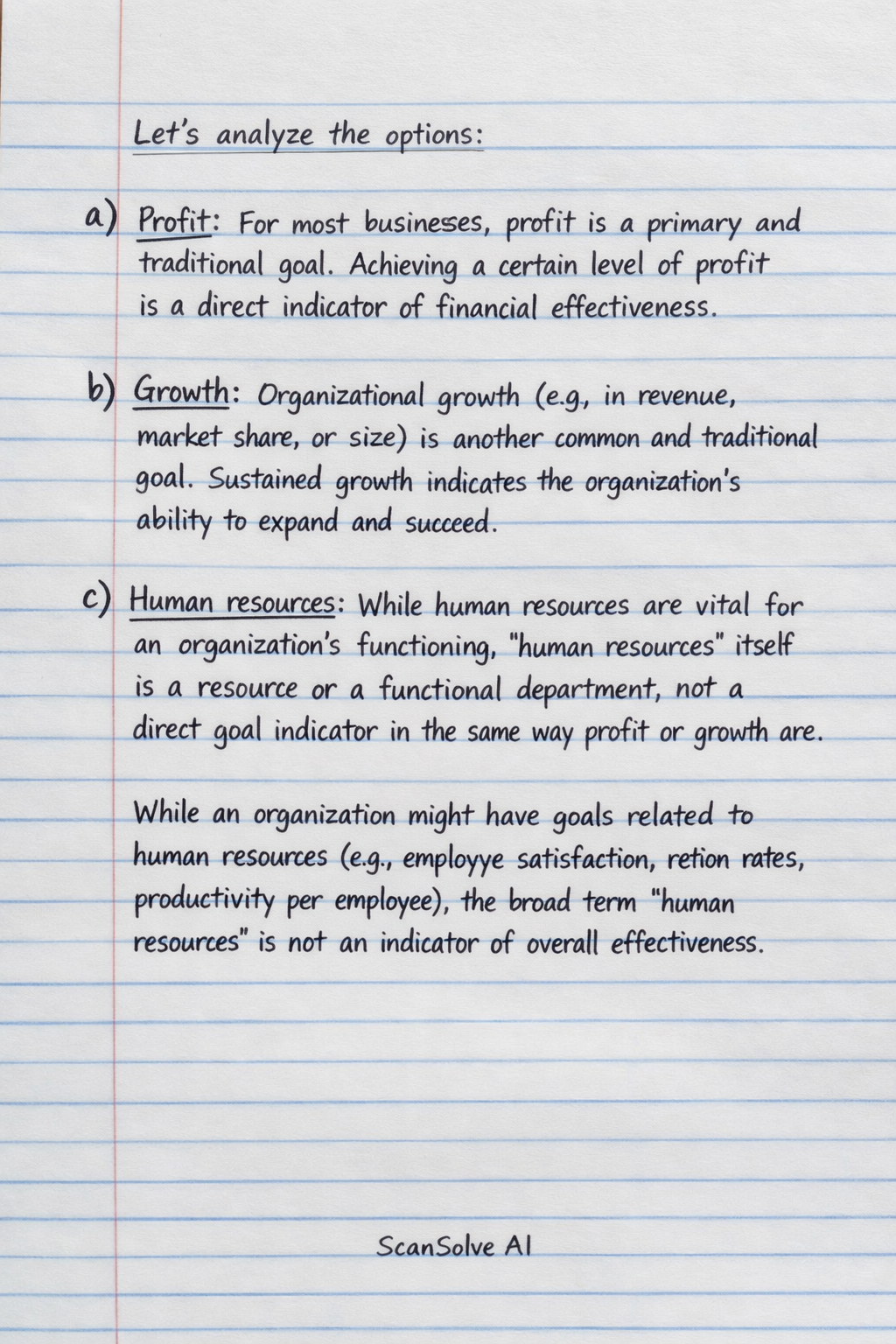
Let's analyze the options:
- a) Profit: For most businesses, profit is a primary and traditional goal. Achieving a certain level of profit is a direct indicator of financial effectiveness.
- b) Growth: Organizational growth (e.g., in revenue, market share, or size) is another common and traditional goal. Sustained growth indicates the organization's ability to expand and succeed.
- c) Human resources: While human resources are vital for an organization's functioning, "human resources" itself is a resource or a functional department, not a direct goal indicator in the same way profit or growth are. While an organization might have goals related to human resources (e.g., employee satisfaction, retention rates, productivity per employee), the broad term "human resources" is not an indicator of overall effectiveness.
- d) Product: Similar to human resources, "product" refers to what an organization produces. However, product-related goals such as product quality, innovation, or market share for a specific product are often key indicators of effectiveness, especially in the context of output goals.
In the traditional goal approach, the focus is on measurable outcomes. Profit and growth are direct, quantifiable outcomes. Product-related success (e.g., market share, quality) also falls under output goals. "Human resources," however, is more of an input or an internal function, and while its management contributes to effectiveness, the term itself is not a direct goal indicator.
Therefore, "Human resources" is the option that is not typically considered a direct goal indicator in the traditional effectiveness approach.
The correct option is c) Human resources.
The final answer is
Try one yourself
A new problem that tests the same skill.
Still stuck on this one?
Ask a follow-up, and the answer starts from this question.
More Business/Management Questions
Handwritten Step-by-Step Solution
Get this as a handwritten image on WhatsApp — like a tutor wrote it for you.
Try on WhatsApp