
We read your photo as:
Using LIFO method of pricing issues, what is the gross profit?
ScanSolve AI Answer
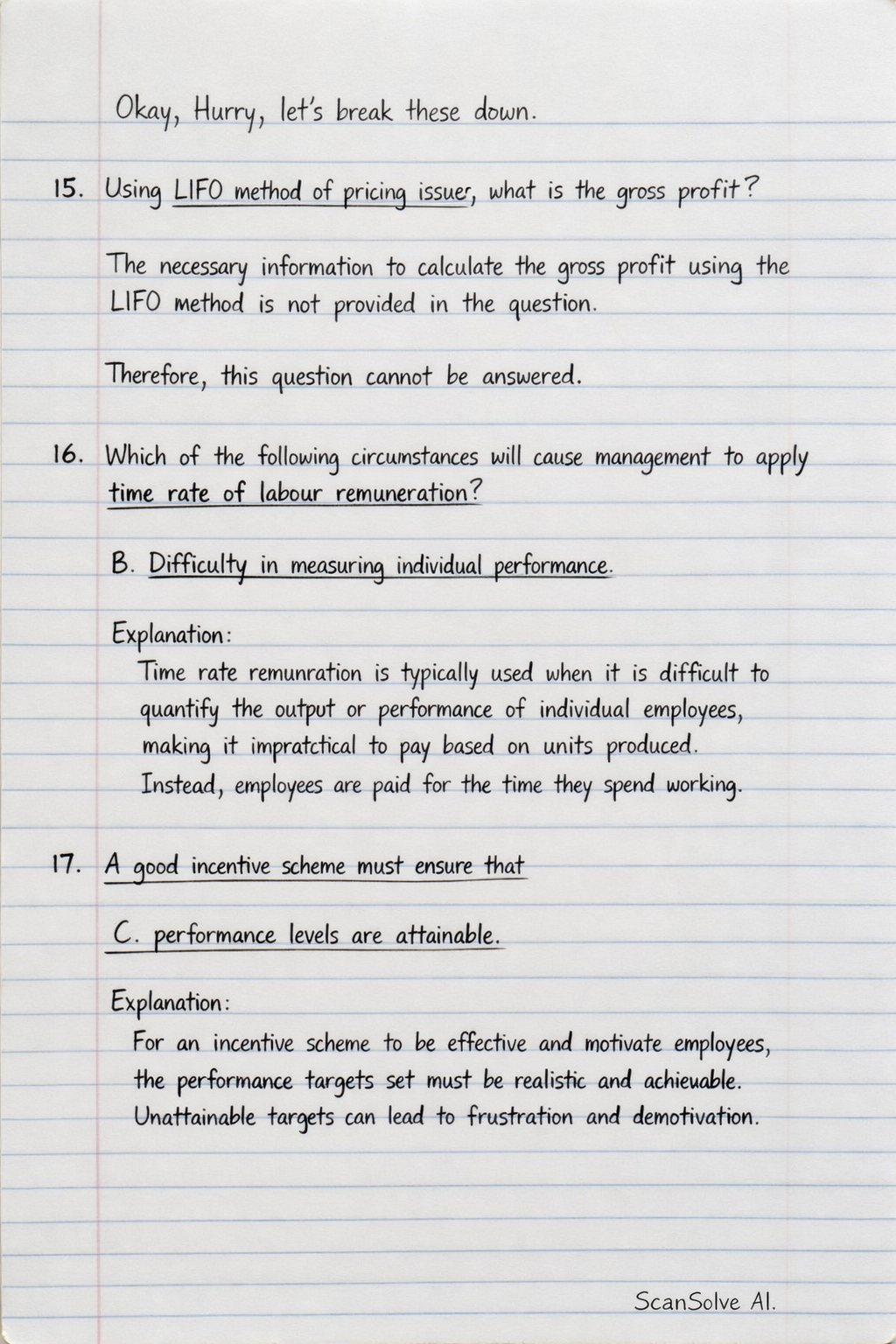
Okay, Hurry, let's break these down.
15. Using LIFO method of pricing issues, what is the gross profit?
The necessary information (inventory purchase and sales data) to calculate the gross profit using the LIFO method is not provided in the question. Therefore, this question cannot be answered.
16. Which of the following circumstances will cause management to apply time rate of labour remuneration?
- B. Difficulty in measuring individual performance
- Explanation: Time rate remuneration is typically used when it is difficult to quantify the output or performance of individual employees, making it impractical to pay based on units produced. Instead, employees are paid for the time they spend working.
17. A good incentive scheme must ensure that
- C. performance levels are attainable.
- Explanation: For an incentive scheme to be effective and motivate employees, the performance targets set must be realistic and achievable. Unattainable targets can lead to frustration and demotivation.
18. Employees are paid GH¢ 12 per unit produced, subject to a minimum wage of GH¢ 4,200 per month. The minimum wage of GH¢ 4,200 is
- B. guaranteed wage.
- Explanation: A guaranteed wage is a minimum amount of pay that an employee is assured of receiving, regardless of their output, if their earnings from a piece-rate system fall below this minimum.
19. Wages sheet prepared by the accountant of BO Company to analyze payment to all employees is
- A. payroll.
- Explanation: A payroll is a comprehensive list or record detailing the salaries, wages, bonuses, and deductions for all employees of a company for a specific period. It is used to analyze total payments.
20. Wages paid for normal idle time is treated as
- B. an indirect labour cost.
- Explanation: Normal idle time refers to periods when employees are paid but are not actively engaged in production (e.g., due to machine breakdown or power failure). Since this cost is not directly attributable to a specific product, it is treated as an indirect labour cost and forms part of factory overheads.
21. The straight piece rate method of labour remuneration pays employees based on
- C. quantity produced at a fixed rate per unit.
- Explanation: In a straight piece-rate system, employees are paid a fixed amount for each unit of output they produce, directly linking their earnings to their productivity.
22. When overhead absorbed is D 23,540 and actual overheads are D 22,400, there is
- A. over absorption of D 1,140.
- Explanation: Since the absorbed overheads (D 23,540) are greater than the actual overheads (D 22,400), there is an over-absorption of D 1,140.
23. The most appropriate basis for apportioning cost of lighting is
- A. floor space.
- Explanation: The cost of lighting is generally proportional to the area that needs to be illuminated. Therefore, floor space (or area occupied) is considered the most appropriate basis for apportioning lighting costs among different departments or cost centers.
Still stuck on this one?
Ask a follow-up, and the answer starts from this question.
More Business/Management Questions
Handwritten Step-by-Step Solution
Get this as a handwritten image on WhatsApp — like a tutor wrote it for you.
Try on WhatsApp