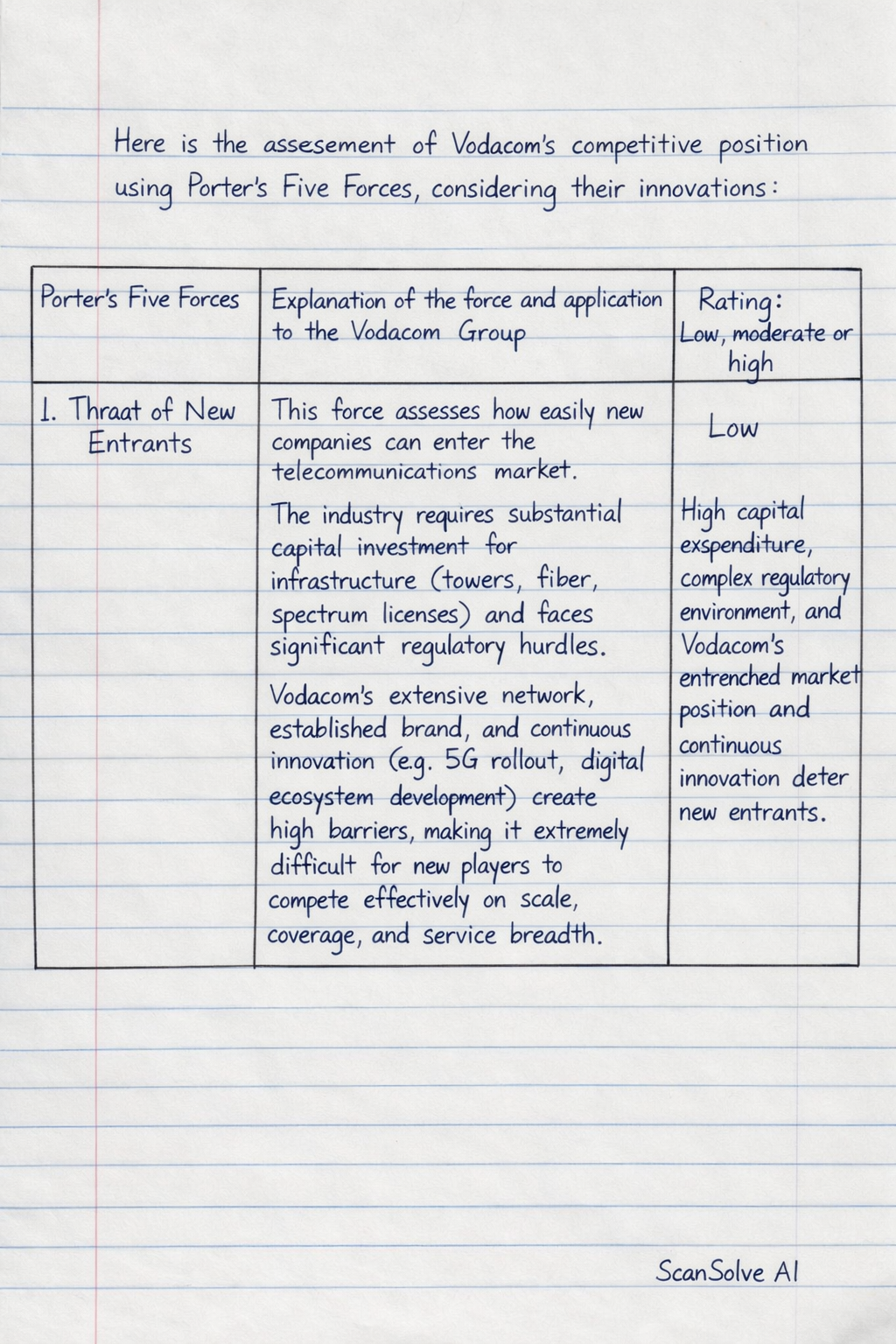
Here is the assessment of Vodacom's competitive position using Porter's Five Forces, considering their innovations: |l|l|l| Porter's Five Forces & Explanation of the force and application to the Vodacom Group & Rating: Low, moderate or high \\ 1. Threat of New Entrants & This force assesses how easily new companies can enter the telecommunications market. The industry requires substantial capital investment for infrastructure (towers, fiber, spectrum licenses) and faces significant regulatory hurdles. Vodacom's extensive network, established brand, and continuous innovation (e.g., 5G rollout, digital ecosystem development) create high barriers, making it extremely difficult for new players to compete effectively on scale, coverage, and service breadth. & Low. High capital expenditure, complex regulatory environment, and Vodacom's entrenched market position and continuous innovation deter new entrants. \\ 2. Bargaining Power of Buyers & This force measures the ability of customers to drive down prices or demand more value. In the telecommunications sector, customers have multiple choices (e.g., MTN, Cell C) and relatively low switching costs due to number portability. However, Vodacom's innovations in value-added services (e.g., VodaPay, M-Pesa in relevant markets, IoT solutions) and superior network quality differentiate its offerings beyond mere price, creating customer stickiness and reducing the direct power of buyers to solely dictate terms. & Moderate. While competition provides buyers with options, Vodacom's differentiated services and network quality, driven by innovation, mitigate some of their power. \\ 3. Bargaining Power of Suppliers & This force examines the influence suppliers have over the industry, particularly if their inputs are critical or unique. Key suppliers for Vodacom include network equipment providers (e.g., Ericsson, Huawei, Nokia) and governments for spectrum licenses. The limited number of major equipment vendors and the monopolistic nature of spectrum allocation give these suppliers significant power. Vodacom's scale provides some negotiation leverage, but critical components and spectrum remain areas where supplier power is notable. & Moderate to High. Limited major network equipment suppliers and government control over spectrum give these suppliers considerable leverage. \\ 4. Threat of Substitute Products or Services & This force considers the availability of alternative products or services that can fulfill the same customer need. Over-The-Top (OTT) services like WhatsApp, Zoom, and Skype are significant substitutes for traditional voice calls and SMS, impacting Vodacom's legacy revenue. Wi-Fi and fiber broadband also substitute for mobile data in many contexts. Vodacom's innovation strategy includes developing its own digital services (e.g., VodaPay) and expanding into fiber (Vodacom Fibre) to directly compete with and mitigate these threats by offering integrated solutions. & High. OTT services and alternative broadband solutions pose a substantial threat to traditional telecom services, requiring continuous innovation from Vodacom to stay relevant. \\ 5. Rivalry Among Existing Competitors & This force measures the intensity of competition among current players in the market. The telecommunications market in Africa is highly competitive, with strong rivals like MTN and other regional operators. Competition is fierce across price, network quality, coverage, and innovative digital services. Vodacom's continuous investment in network technology (e.g., 5G, network reliability) and expansion of its digital ecosystem (e.g., VodaPay, M-Pesa) are critical innovations that enable it to differentiate itself and maintain market share in this intense competitive landscape. & High. The market is saturated with strong competitors, leading to aggressive competition on price, network, and service innovation. \\ That's 2 down. 3 left today — send the next one.