
We read your photo as:
How will you react to this situation? How will you treat the following cheques issued by your customer before his death?
ScanSolve AI Answer
Step-by-step solution
3 stepsUnderstand the legal principle.
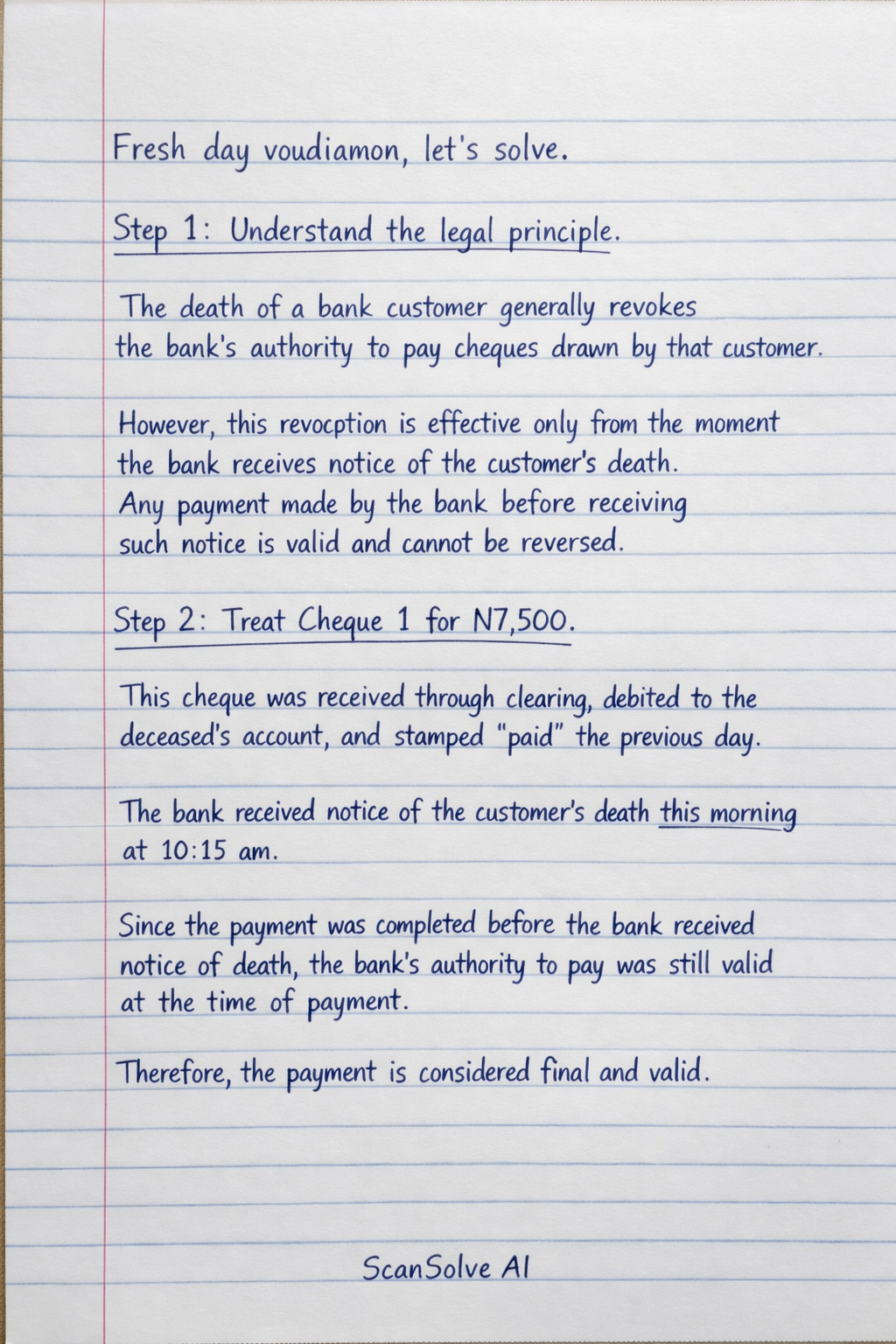
The death of a bank customer generally revokes the bank's authority to pay cheques drawn by that customer. However, this revocation is effective only from the moment the bank receives notice of the customer's death. Any payment made by the bank before receiving such notice is valid and cannot be reversed.
Treat Cheque 1 for .
This cheque was received through clearing, debited to the deceased's account, and stamped "paid" the previous day. The bank received notice of the customer's death this morning at 10:15 am. Since the payment was completed before the bank received notice of death, the bank's authority to pay was still valid at the time of payment. Therefore, the payment is considered final and valid.
Treat Cheque 2 for .
This cheque was lodged this morning before notice of death was received. However, the problem states that "no entry has however been made in the account of the deceased." This indicates that the payment process was not finalized by debiting the account before the bank received notice of death at 10:15 am. Upon receiving the death certificate, the bank's mandate to pay this cheque is revoked. The information given to Mr. Pam David that the cheque was paid was incorrect, as the payment was not completed. Therefore, the bank must stop payment on this cheque.
Summary of treatment:
- Cheque for : Payment is valid and final.
- Cheque for : Payment must be stopped.
Still stuck on this one?
Ask a follow-up, and the answer starts from this question.
More Business/Management Questions
Handwritten Step-by-Step Solution
Get this as a handwritten image on WhatsApp — like a tutor wrote it for you.
Try on WhatsApp