
We read your photo as:
When 0.482g of gaseous hydrocarbon is injected into a 334.09 cm³ container, at 102°C, it exerts a pressure of 102.352 kNm⁻². Calculate the molar mass of the hydrocarbon. (R=8.314 Jmol⁻¹K)
Chemistry
ScanSolve AI Answer
Answer
Step-by-step solution
4 stepsConvert all given values to SI units.
The ideal gas law requires consistent units.
- Mass () =
- Volume () =
- Temperature () =
- Pressure () =
- Gas constant () =
State the ideal gas law and the relationship between moles, mass, and molar mass.
The ideal gas law is:
Where is the number of moles. The number of moles can also be expressed as:
Where is the mass and is the molar mass.
Substitute the expression for into the ideal gas law and rearrange to solve for molar mass ().
Substituting into :
Rearranging to solve for :
Substitute the converted values into the rearranged formula and calculate the molar mass.
Rounding to three significant figures, consistent with the mass given:
The molar mass of the hydrocarbon is .
Was this helpful?
Try one yourself
A new problem that tests the same skill.
Still stuck on this one?
Ask a follow-up, and the answer starts from this question.
Got a different question?Ask your own question
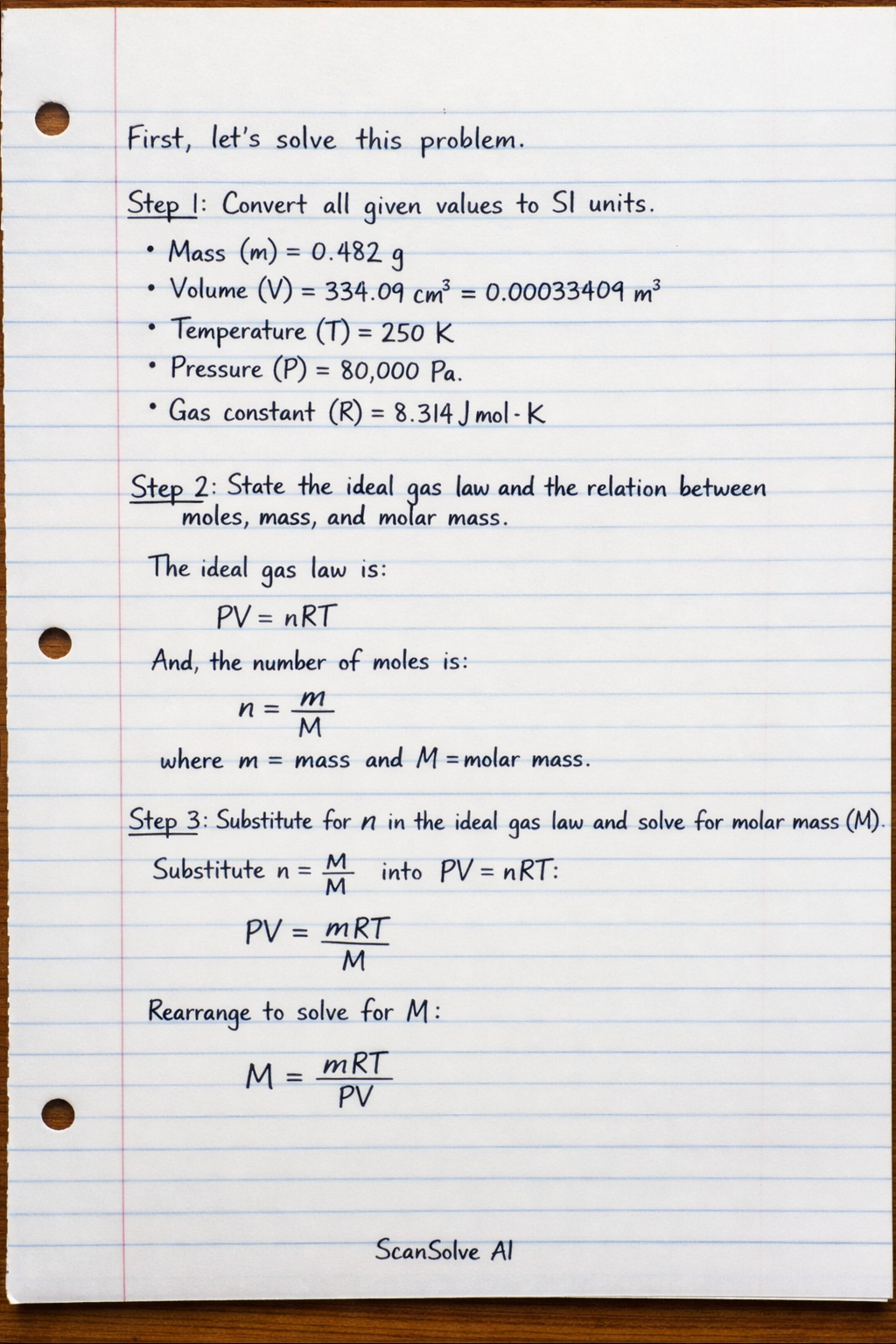
Handwritten Step-by-Step Solution
Get this as a handwritten image on WhatsApp — like a tutor wrote it for you.
Try on WhatsApp