
We read your photo as:
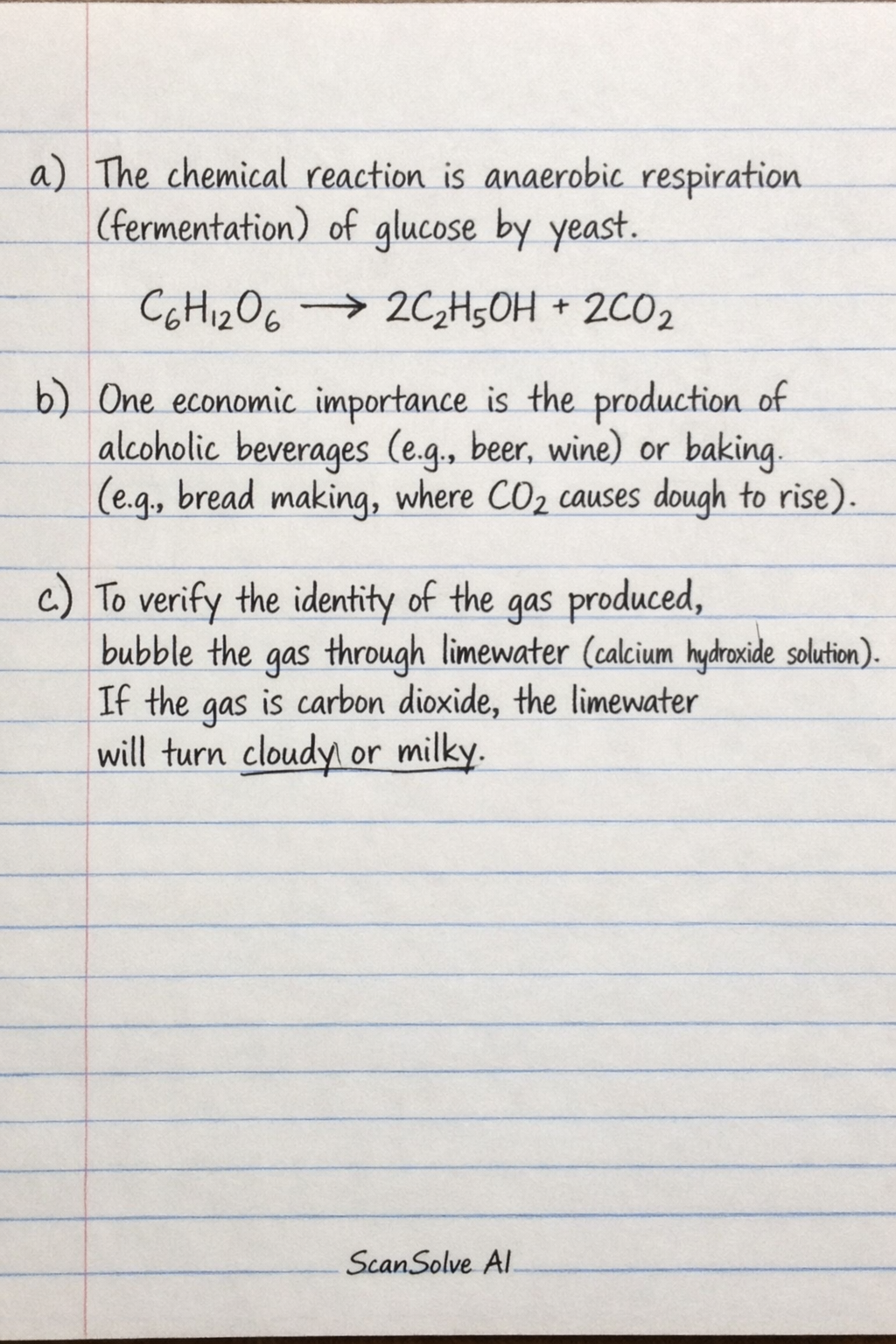
A) The chemical reaction is anaerobic respiration (fermentation) of glucose by yeast.
ScanSolve AI Answer
Step-by-step solution
3 steps- a) The chemical reaction is anaerobic respiration (fermentation) of glucose by yeast.
b) One economic importance is the production of alcoholic beverages (e.g., beer, wine) or baking (e.g., bread making, where causes dough to rise).
c) To verify the identity of the gas produced, bubble the gas through limewater (calcium hydroxide solution). If the gas is carbon dioxide, the limewater will turn cloudy or milky.
- a) It is difficult to calculate the respiratory quotient (RQ) in plants because plants also perform photosynthesis, which consumes carbon dioxide and produces oxygen. This interferes with the accurate measurement of the net carbon dioxide produced and oxygen consumed solely by respiration.
b) i) Balance the equation:
Balance carbon atoms.
There are 16 carbon atoms on the left, so place a coefficient of 16 in front of .
Balance hydrogen atoms.
There are 32 hydrogen atoms on the left, so place a coefficient of 16 in front of ().
Balance oxygen atoms.
Count oxygen atoms on the right side: .
Count oxygen atoms on the left side: 2 O from .
We need from . Since has 2 oxygen atoms, we need molecules.
The balanced equation is:
Still stuck on this one?
Ask a follow-up, and the answer starts from this question.
More Chemistry Questions
Handwritten Step-by-Step Solution
Get this as a handwritten image on WhatsApp — like a tutor wrote it for you.
Try on WhatsApp