
We read your photo as:
Define Chemistry.
ScanSolve AI Answer
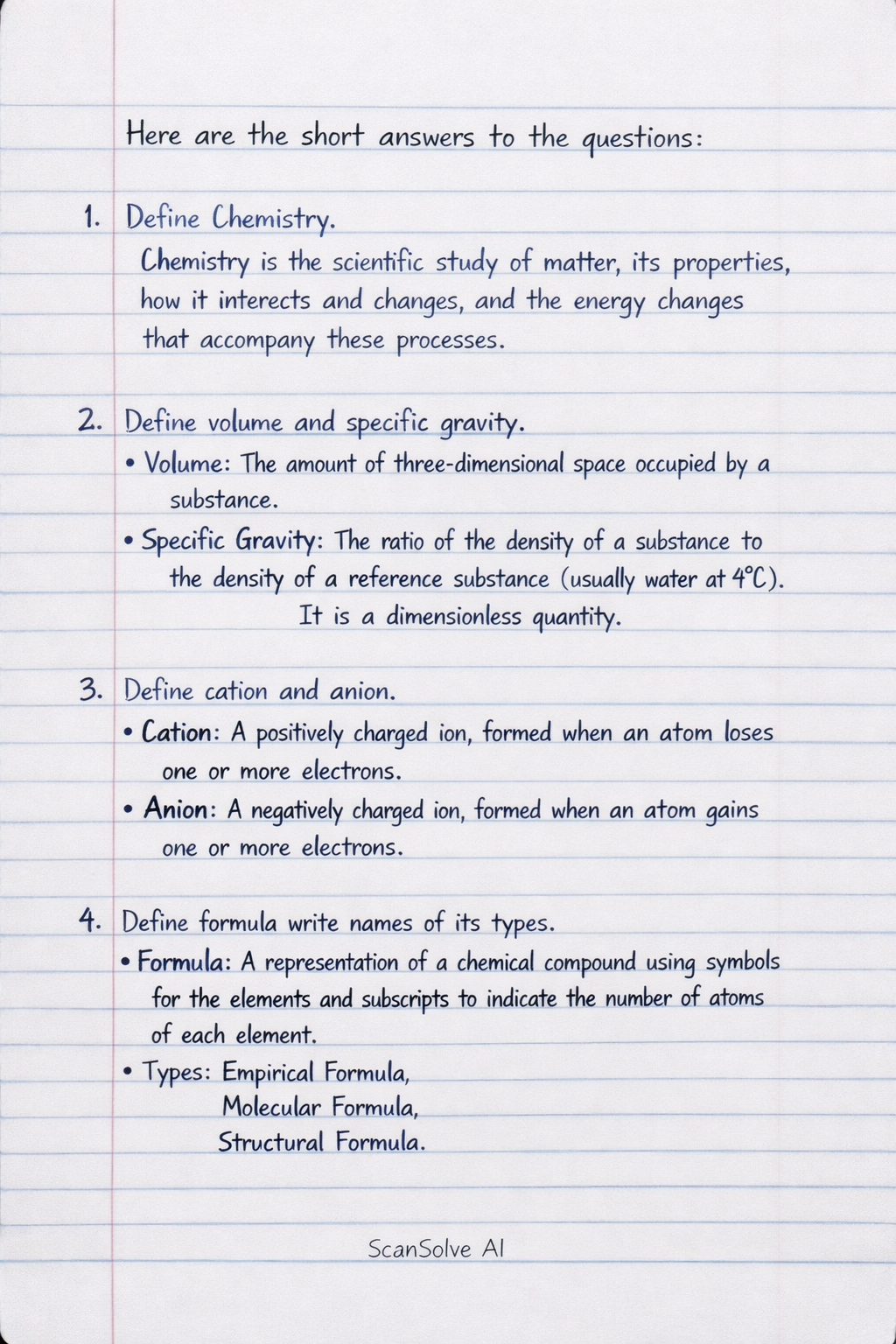
Here are the short answers to the questions:
-
Define Chemistry. Chemistry is the scientific study of matter, its properties, how it interacts and changes, and the energy changes that accompany these processes.
-
Define volume and specific gravity.
- Volume: The amount of three-dimensional space occupied by a substance.
- Specific Gravity: The ratio of the density of a substance to the density of a reference substance (usually water at ). It is a dimensionless quantity.
-
Define cation and anion.
- Cation: A positively charged ion, formed when an atom loses one or more electrons.
- Anion: A negatively charged ion, formed when an atom gains one or more electrons.
-
Define formula write names of its types.
- Formula: A representation of a chemical compound using symbols for the elements and subscripts to indicate the number of atoms of each element.
- Types: Empirical Formula, Molecular Formula, Structural Formula.
-
Define isotope. Give two examples.
- Isotope: Atoms of the same element that have the same number of protons but different numbers of neutrons, resulting in different mass numbers.
- Examples: Carbon-12 () and Carbon-14 (); Hydrogen-1 () and Hydrogen-2 ().
-
Define Octet rule. The Octet Rule states that atoms tend to gain, lose, or share electrons to achieve a full outer electron shell with eight electrons, similar to noble gases, which provides stability.
-
Define viscosity and write its unit.
- Viscosity: A measure of a fluid's resistance to flow, describing its internal friction.
- Unit: The SI unit is the pascal-second ().
-
What is chemical name of water. Which oxide is it.
- Chemical name of water: Dihydrogen monoxide.
- Type of oxide: It is a neutral oxide.
-
Write formula of sodium zeolite. A common formula for sodium zeolite (Zeolite A) is .
-
Write four physical properties of water.
-
- It is a colorless, odorless, and tasteless liquid.
-
- It has a high boiling point () and freezing point ().
-
- It has a high specific heat capacity.
-
- It is a universal solvent.
-
-
Define sub oxide and per oxide.
- Suboxide: A compound where the oxygen content is less than expected based on the usual valency of the other element (e.g., ).
- Peroxide: A compound containing an oxygen-oxygen single bond () where each oxygen atom has an oxidation state of -1 (e.g., ).
-
Write four uses of radio isotopes.
-
- Medical Diagnosis and Treatment: Used in PET scans and cancer therapy.
-
- Carbon Dating: Used to determine the age of ancient artifacts.
-
- Industrial Tracers: Used to detect leaks in pipes.
-
- Sterilization: Used to sterilize medical equipment and food.
-
-
Define Alloys. Give two examples.
- Alloy: A mixture of two or more elements, at least one of which is a metal, typically prepared by melting the components together.
- Examples: Brass (copper and zinc), Steel (iron and carbon).
-
Describe pitting corrosion. Pitting corrosion is a localized form of corrosion that creates small holes or "pits" in a metal surface. It often occurs in passive metals when their protective layer is locally damaged, leading to concentrated attack.
-
Define Electrode. An electrode is an electrical conductor used to make contact with a nonmetallic part of a circuit, such as an electrolyte. In electrochemistry, it is where oxidation or reduction reactions occur.
-
Define Dielectric. Give two examples.
- Dielectric: An electrical insulator that can be polarized by an applied electric field, causing charges to shift slightly without flowing.
- Examples: Glass, Plastic.
-
How many electrons are present in valence shell of oxygen. Oxygen has 6 electrons in its valence shell.
-
Write names of types of etching. The main types of etching are Wet Etching and Dry Etching.
Still stuck on this one?
Ask a follow-up, and the answer starts from this question.
Handwritten Step-by-Step Solution
Get this as a handwritten image on WhatsApp — like a tutor wrote it for you.
Try on WhatsApp