We read your photo as:

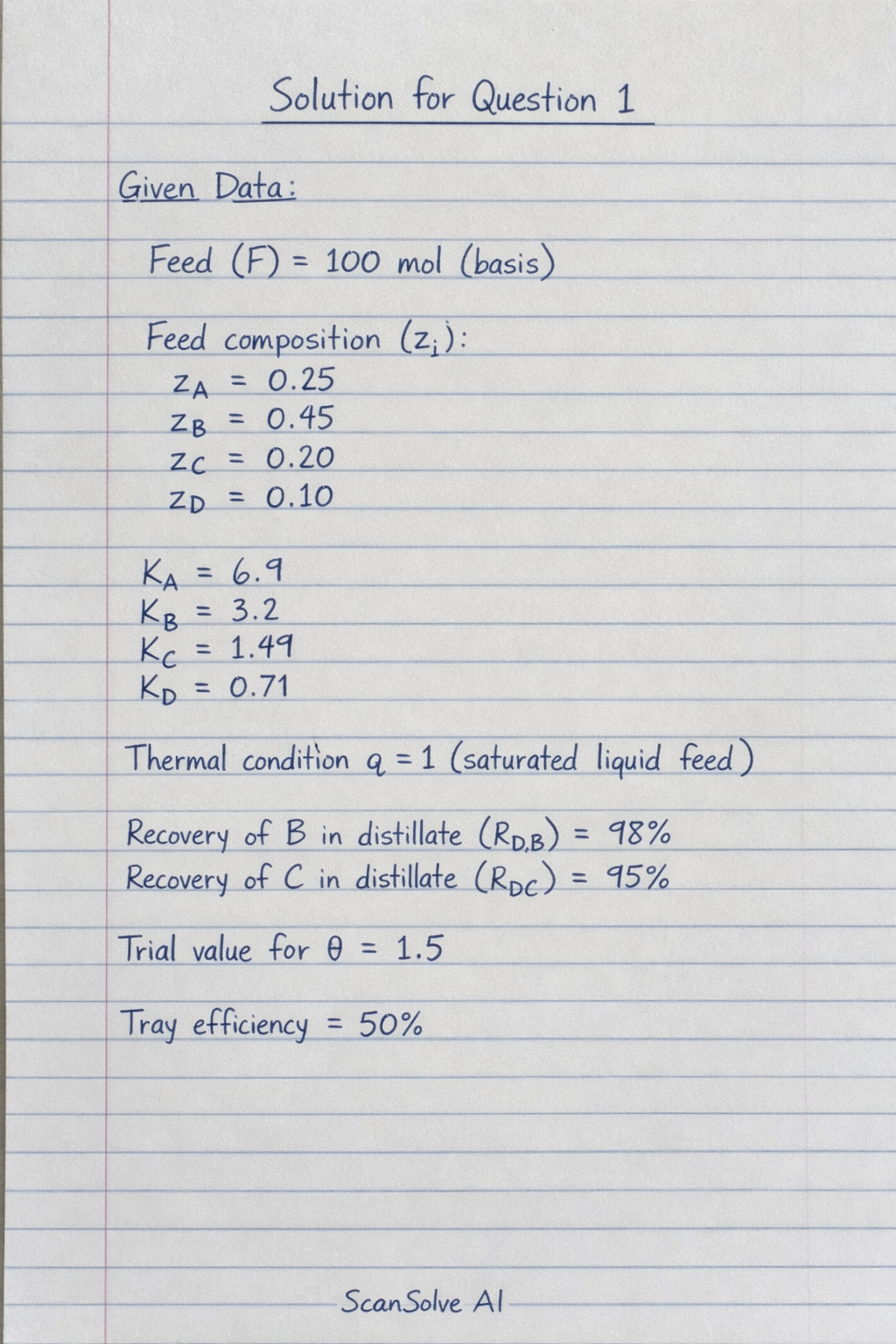
A feed mixture of thermal condition q = 1, consists of A (25 mol%), B (45 mol%), C (20 mol%) and D (10 mol%), respectively. The distillate contains 98 mol% B and 95 mol% C. The K-values are shown in Table 1.

Chemistry

ScanSolve AI Answer

Step-by-step solution

7 steps

Here's a step-by-step solution for Question 1, based on the most plausible interpretation of the problem statement. The phrasing "The distillate contains 98 mol% B and 95 mol% C" is ambiguous. I will assume it means that the recovery of component B in the distillate is 98% and the recovery of component C in the distillate is 95%. This implies that B and C are both light components, and the separation occurs between C (Light Key) and D (Heavy Key).

Given Data:
Feed (F) = 100 mol (basis)
Feed composition (ziz_i):

  • zA=0.25z_A = 0.25
  • zB=0.45z_B = 0.45
  • zC=0.20z_C = 0.20
  • zD=0.10z_D = 0.10 K-values: KA=6.9K_A = 6.9, KB=3.2K_B = 3.2, KC=1.49K_C = 1.49, KD=0.71K_D = 0.71 Thermal condition q=1q = 1 (saturated liquid feed) Recovery of B in distillate (RD,BR_{D,B}) = 98% Recovery of C in distillate (RD,CR_{D,C}) = 95% Trial and error value for θ=1.5\theta = 1.5 (for Underwood's method, this is unusual as θ\theta is usually solved for, but we will use it as given). Tray efficiency = 50%

  1. 1.1 Determine the light key and heavy key components.

    Based on the K-values, the components are ordered by volatility: A > B > C > D.
    If 98% of B and 95% of C go to the distillate, then B and C are primarily light components. A is even lighter. This means the separation occurs between C and D.

    • Light Key (LK): C
    • Heavy Key (HK): D
  2. 1.2 Calculate the relative volatility (α\alpha) of each component with respect to the heavy key component.

    The heavy key is D, so KHK=KD=0.71K_{HK} = K_D = 0.71.
    The relative volatility αi=Ki/KD\alpha_i = K_i / K_D.

    • αA=KA/KD=6.9/0.71=9.718\alpha_A = K_A / K_D = 6.9 / 0.71 = 9.718
    • αB=KB/KD=3.2/0.71=4.507\alpha_B = K_B / K_D = 3.2 / 0.71 = 4.507
    • αC=KC/KD=1.49/0.71=2.099\alpha_C = K_C / K_D = 1.49 / 0.71 = 2.099
    • αD=KD/KD=0.71/0.71=1.000\alpha_D = K_D / K_D = 0.71 / 0.71 = 1.000
  3. 1.3 Complete the material balance over the distillation column and the mole fractions of each component in the feed, distillate and the bottom streams.

    Basis: 100 mol of feed (F).
    Given recoveries:

    • Moles of B in distillate: DxD,B=0.98×FzB=0.98×100×0.45=44.1D x_{D,B} = 0.98 \times F z_B = 0.98 \times 100 \times 0.45 = 44.1 mol
    • Moles of C in distillate: DxD,C=0.95×FzC=0.95×100×0.20=19.0D x_{D,C} = 0.95 \times F z_C = 0.95 \times 100 \times 0.20 = 19.0 mol

    For non-key components:

    • Component A is much lighter than LK (C). Assume all A goes to distillate. Moles of A in distillate: DxD,A=FzA=100×0.25=25.0D x_{D,A} = F z_A = 100 \times 0.25 = 25.0 mol
    • Component D is the HK. Its recovery in distillate is not specified. We need to determine it.

    Total moles in distillate (D): D=DxD,A+DxD,B+DxD,C+DxD,DD = D x_{D,A} + D x_{D,B} + D x_{D,C} + D x_{D,D}
    We need to find DxD,DD x_{D,D}.
    Let's use the Fenske equation for the split of the heavy key (D) and light key (C) to determine the recovery of D in the distillate.
    This is a circular dependency, as Fenske requires NminN_{min}, which requires the split.
    A common approach for material balance in shortcut methods is to assume a small amount of HK in distillate and LK in bottom.
    Let's assume a typical separation for the heavy key D. For example, 99% of D goes to the bottom.
    So, recovery of D in bottom: BxB,D=0.99×FzD=0.99×100×0.10=9.9B x_{B,D} = 0.99 \times F z_D = 0.99 \times 100 \times 0.10 = 9.9 mol.
    Then moles of D in distillate: DxD,D=FzD−BxB,D=10−9.9=0.1D x_{D,D} = F z_D - B x_{B,D} = 10 - 9.9 = 0.1 mol.

    Now, sum the moles in the distillate:
    D=DxD,A+DxD,B+DxD,C+DxD,D=25.0+44.1+19.0+0.1=88.2D = D x_{D,A} + D x_{D,B} + D x_{D,C} + D x_{D,D} = 25.0 + 44.1 + 19.0 + 0.1 = 88.2 mol
    Total moles in bottom: B=F−D=100−88.2=11.8B = F - D = 100 - 88.2 = 11.8 mol

    Now calculate mole fractions in distillate (xD,ix_{D,i}) and bottom (xB,ix_{B,i}):
    Distillate (D = 88.2 mol):

    • xD,A=25.0/88.2=0.283x_{D,A} = 25.0 / 88.2 = 0.283
    • xD,B=44.1/88.2=0.500x_{D,B} = 44.1 / 88.2 = 0.500
    • xD,C=19.0/88.2=0.215x_{D,C} = 19.0 / 88.2 = 0.215
    • xD,D=0.1/88.2=0.001x_{D,D} = 0.1 / 88.2 = 0.001
    • Sum xD,i=0.283+0.500+0.215+0.001=0.999≈1.000x_{D,i} = 0.283 + 0.500 + 0.215 + 0.001 = 0.999 \approx 1.000

    Bottom (B = 11.8 mol):

    • Moles of A in bottom: BxB,A=FzA−DxD,A=25.0−25.0=0.0B x_{B,A} = F z_A - D x_{D,A} = 25.0 - 25.0 = 0.0 mol   ⟹  xB,A=0.000\implies x_{B,A} = 0.000
    • Moles of B in bottom: BxB,B=FzB−DxD,B=45.0−44.1=0.9B x_{B,B} = F z_B - D x_{D,B} = 45.0 - 44.1 = 0.9 mol   ⟹  xB,B=0.9/11.8=0.076\implies x_{B,B} = 0.9 / 11.8 = 0.076
    • Moles of C in bottom: BxB,C=FzC−DxD,C=20.0−19.0=1.0B x_{B,C} = F z_C - D x_{D,C} = 20.0 - 19.0 = 1.0 mol   ⟹  xB,C=1.0/11.8=0.085\implies x_{B,C} = 1.0 / 11.8 = 0.085
    • Moles of D in bottom: BxB,D=FzD−DxD,D=10.0−0.1=9.9B x_{B,D} = F z_D - D x_{D,D} = 10.0 - 0.1 = 9.9 mol   ⟹  xB,D=9.9/11.8=0.839\implies x_{B,D} = 9.9 / 11.8 = 0.839
    • Sum xB,i=0.000+0.076+0.085+0.839=1.000x_{B,i} = 0.000 + 0.076 + 0.085 + 0.839 = 1.000

    Summary of Mole Fractions:

    • Feed: zA=0.250z_A = 0.250, zB=0.450z_B = 0.450, zC=0.200z_C = 0.200, zD=0.100z_D = 0.100
    • Distillate: xD,A=0.283x_{D,A} = 0.283, xD,B=0.500x_{D,B} = 0.500, xD,C=0.215x_{D,C} = 0.215, xD,D=0.001x_{D,D} = 0.001
    • Bottom: xB,A=0.000x_{B,A} = 0.000, xB,B=0.076x_{B,B} = 0.076, xB,C=0.085x_{B,C} = 0.085, xB,D=0.839x_{B,D} = 0.839
  4. 1.4 Determine the minimum reflux ratio (RminR_{min}) (trial and error value of θ\theta is 1.5).

    For a saturated liquid feed (q=1q=1), the Underwood equation for θ\theta is:

    ∑i=1Ncαiziαi−θ=1−q=0\sum_{i=1}^{N_c} \frac{\alpha_i z_i}{\alpha_i - \theta} = 1-q = 0

    Using the given θ=1.5\theta = 1.5:

    αAzAαA−θ+αBzBαB−θ+αCzCαC−θ+αDzDαD−θ\frac{\alpha_A z_A}{\alpha_A - \theta} + \frac{\alpha_B z_B}{\alpha_B - \theta} + \frac{\alpha_C z_C}{\alpha_C - \theta} + \frac{\alpha_D z_D}{\alpha_D - \theta} =9.718×0.259.718−1.5+4.507×0.454.507−1.5+2.099×0.202.099−1.5+1.000×0.101.000−1.5= \frac{9.718 \times 0.25}{9.718 - 1.5} + \frac{4.507 \times 0.45}{4.507 - 1.5} + \frac{2.099 \times 0.20}{2.099 - 1.5} + \frac{1.000 \times 0.10}{1.000 - 1.5} =2.42958.218+2.028153.007+0.41980.599+0.10−0.5= \frac{2.4295}{8.218} + \frac{2.02815}{3.007} + \frac{0.4198}{0.599} + \frac{0.10}{-0.5} =0.2956+0.6744+0.7008−0.2000=1.4708= 0.2956 + 0.6744 + 0.7008 - 0.2000 = 1.4708

    This sum is not zero, which means θ=1.5\theta = 1.5 is not the correct root for q=1q=1. The problem states "trial and error value of θ\theta is 1.5", which implies we should use this value. This is a contradiction. If q=1q=1, the root θ\theta must be between αHK\alpha_{HK} and αLK\alpha_{LK} (i.e., between αD=1\alpha_D=1 and αC=2.099\alpha_C=2.099). Since θ=1.5\theta=1.5 is within this range, we will proceed with it, assuming the problem implies this value should be used despite the sum not being zero.

    The Underwood equation for minimum reflux ratio (RminR_{min}) is:

    Rmin+1=∑i=1NcαixD,iαi−θR_{min} + 1 = \sum_{i=1}^{N_c} \frac{\alpha_i x_{D,i}}{\alpha_i - \theta} Rmin+1=αAxD,AαA−θ+αBxD,BαB−θ+αCxD,CαC−θ+αDxD,DαD−θR_{min} + 1 = \frac{\alpha_A x_{D,A}}{\alpha_A - \theta} + \frac{\alpha_B x_{D,B}}{\alpha_B - \theta} + \frac{\alpha_C x_{D,C}}{\alpha_C - \theta} + \frac{\alpha_D x_{D,D}}{\alpha_D - \theta} =9.718×0.2839.718−1.5+4.507×0.5004.507−1.5+2.099×0.2152.099−1.5+1.000×0.0011.000−1.5= \frac{9.718 \times 0.283}{9.718 - 1.5} + \frac{4.507 \times 0.500}{4.507 - 1.5} + \frac{2.099 \times 0.215}{2.099 - 1.5} + \frac{1.000 \times 0.001}{1.000 - 1.5} =2.7498.218+2.25353.007+0.45130.599+0.001−0.5= \frac{2.749}{8.218} + \frac{2.2535}{3.007} + \frac{0.4513}{0.599} + \frac{0.001}{-0.5} =0.3345+0.7494+0.7534−0.0020=1.8353= 0.3345 + 0.7494 + 0.7534 - 0.0020 = 1.8353 Rmin=1.8353−1=0.8353R_{min} = 1.8353 - 1 = 0.8353

    Minimum reflux ratio (RminR_{min}): 0.835\boxed{0.835}

  5. 1.5 Determine the minimum number of stages required using the Fenske method.

    The Fenske equation for minimum stages (NminN_{min}) is:

    Nmin=ln⁡[(xD,LKxB,LK)(xB,HKxD,HK)]ln⁡αLK,HKN_{min} = \frac{\ln \left[ \left( \frac{x_{D,LK}}{x_{B,LK}} \right) \left( \frac{x_{B,HK}}{x_{D,HK}} \right) \right]}{\ln \alpha_{LK,HK}}

    Here, LK = C, HK = D. So αLK,HK=αC=2.099\alpha_{LK,HK} = \alpha_C = 2.099.

    Nmin=ln⁡[(xD,CxB,C)(xB,DxD,D)]ln⁡αCN_{min} = \frac{\ln \left[ \left( \frac{x_{D,C}}{x_{B,C}} \right) \left( \frac{x_{B,D}}{x_{D,D}} \right) \right]}{\ln \alpha_C} Nmin=ln⁡[(0.2150.085)(0.8390.001)]ln⁡2.099N_{min} = \frac{\ln \left[ \left( \frac{0.215}{0.085} \right) \left( \frac{0.839}{0.001} \right) \right]}{\ln 2.099} Nmin=ln⁡[(2.5294)×(839)]ln⁡2.099=ln⁡(2122.2366)ln⁡2.099N_{min} = \frac{\ln \left[ (2.5294) \times (839) \right]}{\ln 2.099} = \frac{\ln (2122.2366)}{\ln 2.099} Nmin=7.6600.741=10.337N_{min} = \frac{7.660}{0.741} = 10.337

    Minimum number of stages (NminN_{min}): 10.337\boxed{10.337}

  6. 1.6 Number of ideal stages at R=1.3RminR = 1.3 R_{min} by the Gilliland method.

    Use Figure 1 below to solve the number of stages.
    Actual reflux ratio R=1.3×Rmin=1.3×0.8353=1.08589R = 1.3 \times R_{min} = 1.3 \times 0.8353 = 1.08589.
    Calculate the Gilliland parameter:

    R−RminR+1=1.08589−0.83531.08589+1=0.250592.08589=0.1201\frac{R-R_{min}}{R+1} = \frac{1.08589 - 0.8353}{1.08589 + 1} = \frac{0.25059}{2.08589} = 0.1201

    From Figure 1 (Gilliland correlation), locate 0.1201 on the x-axis. Read the corresponding value on the y-axis, N−NminN+1\frac{N-N_{min}}{N+1}.
    Looking at the graph, for x=0.12x = 0.12, the y-value is approximately 0.58.

    N−NminN+1=0.58\frac{N-N_{min}}{N+1} = 0.58

    Substitute Nmin=10.337N_{min} = 10.337:

    N−10.337N+1=0.58\frac{N - 10.337}{N+1} = 0.58 N−10.337=0.58(N+1)N - 10.337 = 0.58(N+1) N−10.337=0.58N+0.58N - 10.337 = 0.58N + 0.58 N−0.58N=0.58+10.337N - 0.58N = 0.58 + 10.337 0.42N=10.9170.42N = 10.917 N=10.917/0.42=25.993N = 10.917 / 0.42 = 25.993

    Number of ideal stages (N): 25.993\boxed{25.993}

  7. 1.7 Use Kirkbride's method to determine the location of feed tray if the tray efficiency is 50%.

    First, calculate the actual number of stages:
    Nactual=N/efficiency=25.993/0.50=51.986N_{actual} = N / \text{efficiency} = 25.993 / 0.50 = 51.986 stages.
    Kirkbride's equation:

    log⁡(NpNs)=0.206log⁡[(BD)(xB,HKxD,LK)(FsFp)2]\log \left( \frac{N_p}{N_s} \right) = 0.206 \log \left[ \left( \frac{B}{D} \right) \left( \frac{x_{B,HK}}{x_{D,LK}} \right) \left( \frac{F_s}{F_p} \right)^2 \right]

    Where:

    • NpN_p: number of stages above the feed (rectifying section)
    • NsN_s: number of stages below the feed (stripping section)
    • B=11.8B = 11.8 mol, D=88.2D = 88.2
    log⁡(NpNs)=0.206log⁡[(BD)(xB,HKxD,LK)(FsFp)2]\log \left( \frac{N_p}{N_s} \right) = 0.206 \log \left[ \left( \frac{B}{D} \right) \left( \frac{x_{B,HK}}{x_{D,LK}} \right) \left( \frac{F_s}{F_p} \right)^2 \right]

    Where:

    • B=11.8B = 11.8 mol (total moles in bottom)
    • D=88.2D = 88.2 mol (total moles in distillate)
    • xB,HK=xB,D=0.839x_{B,HK} = x_{B,D} = 0.839 (mole fraction of heavy key D in bottom)
    • xD,LK=xD,C=0.215x_{D,LK} = x_{D,C} = 0.215 (mole fraction of light key C in distillate)
    • Fs=FzD=100×0.10=10F_s = F z_D = 100 \times 0.10 = 10 mol (moles of heavy key D in feed)
    • Fp=FzC=100×0.20=20F_p = F z_C = 100 \times 0.20 = 20 mol (moles of light key C in feed)

    Substitute the values into the equation:

    log⁡(NpNs)=0.206log⁡[(11.888.2)(0.8390.215)(1020)2]\log \left( \frac{N_p}{N_s} \right) = 0.206 \log \left[ \left( \frac{11.8}{88.2} \right) \left( \frac{0.839}{0.215} \right) \left( \frac{10}{20} \right)^2 \right] log⁡(NpNs)=0.206log⁡[(0.133787)×(3.902326)×(0.25)]\log \left( \frac{N_p}{N_s} \right) = 0.206 \log \left[ (0.133787) \times (3.902326) \times (0.25) \right] log⁡(NpNs)=0.206log⁡[0.13059]\log \left( \frac{N_p}{N_s} \right) = 0.206 \log \left[ 0.13059 \right] log⁡(NpNs)=0.206×(−0.8841)\log \left( \frac{N_p}{N_s} \right) = 0.206 \times (-0.8841) log⁡(NpNs)=−0.1821\log \left( \frac{N_p}{N_s} \right) = -0.1821 NpNs=10−0.1821=0.6575\frac{N_p}{N_s} = 10^{-0.1821} = 0.6575

    The total number of ideal stages is N=25.993N = 25.993. The number of ideal stages in the rectifying section (NpN_p) and stripping section (NsN_s) are related by Np+Ns=N−1N_p + N_s = N - 1 (excluding the feed stage itself).

    Np+Ns=25.993−1=24.993N_p + N_s = 25.993 - 1 = 24.993

    We have a system of two equations:

    1. Np=0.6575NsN_p = 0.6575 N_s
    2. Np+Ns=24.993N_p + N_s = 24.993 Substitute (1) into (2):
    0.6575Ns+Ns=24.9930.6575 N_s + N_s = 24.993 1.6575Ns=24.9931.6575 N_s = 24.993 Ns=24.9931.6575=15.079N_s = \frac{24.993}{1.6575} = 15.079 Np=0.6575×15.079=9.914N_p = 0.6575 \times 15.079 = 9.914

    The feed tray is the (Np+1)th(N_p+1)^{th} ideal stage from the top. Number of ideal stages from top to feed tray (inclusive) = Np+1=9.914+1=10.914N_p + 1 = 9.914 + 1 = 10.914. Given a tray efficiency of 50%, the number of actual trays from the top to the feed tray is:

    Nfeed,actual=Np+1efficiency=10.9140.50=21.828N_{feed,actual} = \frac{N_p + 1}{\text{efficiency}} = \frac{10.914}{0.50} = 21.828

    Rounding to the nearest whole number, the feed tray is the 22nd actual tray from the top.

    The location of the feed tray (actual trays): 22nd tray from the top\boxed{\text{22nd tray from the top}}

Was this helpful?

Still stuck on this one?

Ask a follow-up, and the answer starts from this question.
Got a different question?Ask your own question
Handwritten step-by-step solution preview

Handwritten Step-by-Step Solution

Get this as a handwritten image on WhatsApp — like a tutor wrote it for you.

Try on WhatsApp