
We read your photo as:
Bonding in organic chemistry.
ScanSolve AI Answer
Answers
4 partsStep-by-step solution
3 stepsBonding in organic chemistry.
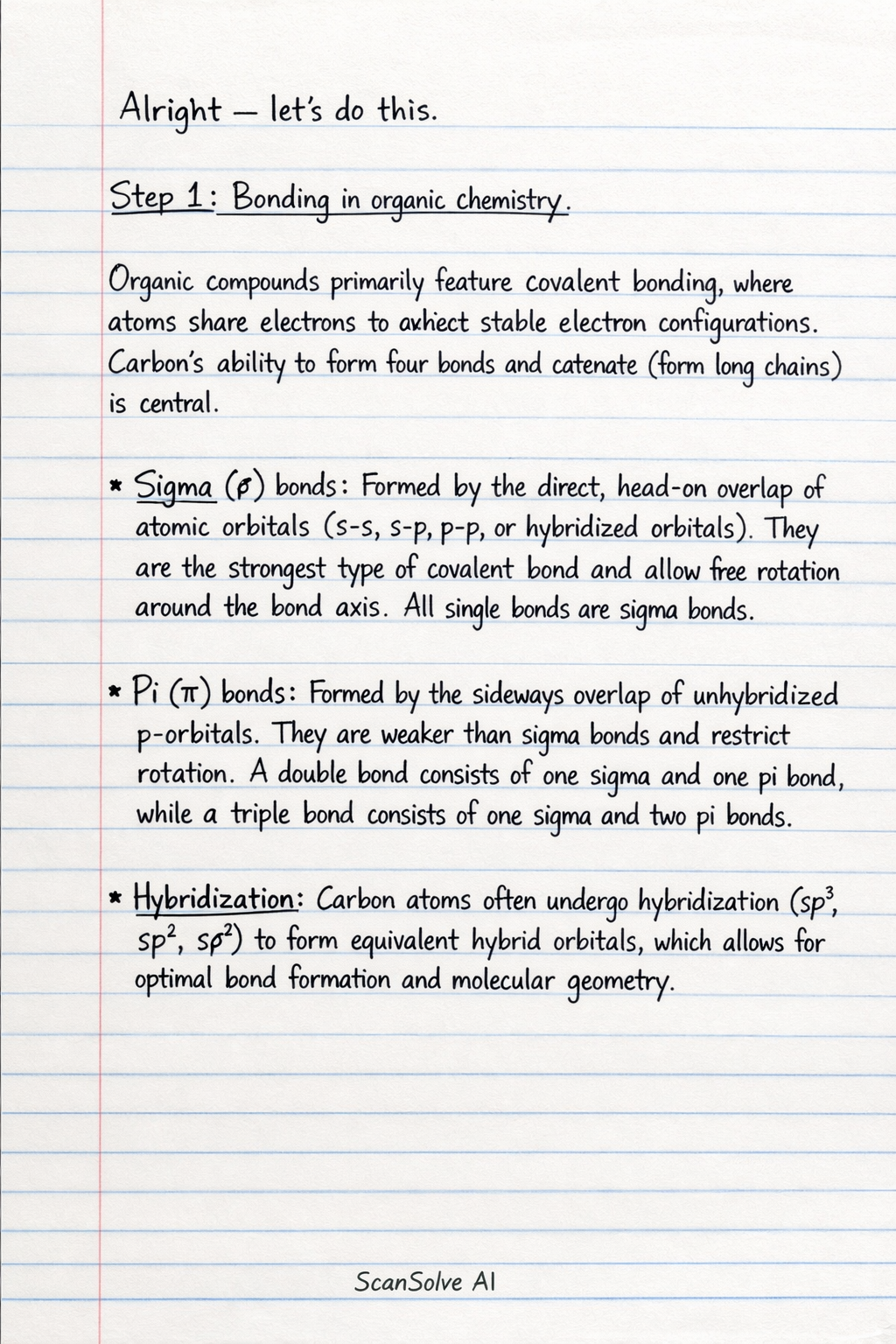
Organic compounds primarily feature covalent bonding, where atoms share electrons to achieve stable electron configurations. Carbon's ability to form four bonds and catenate (form long chains) is central.
- Sigma () bonds: Formed by the direct, head-on overlap of atomic orbitals (s-s, s-p, p-p, or hybridized orbitals). They are the strongest type of covalent bond and allow free rotation around the bond axis. All single bonds are sigma bonds.
- Pi () bonds: Formed by the sideways overlap of unhybridized p-orbitals. They are weaker than sigma bonds and restrict rotation. A double bond consists of one sigma and one pi bond, while a triple bond consists of one sigma and two pi bonds.
- Hybridization: Carbon atoms often undergo hybridization (, , ) to form equivalent hybrid orbitals, which allows for optimal bond formation and molecular geometry.
Difference between sigma and pi bonds.
- Sigma () bonds are formed by the direct, head-on overlap of atomic orbitals along the internuclear axis. They are stronger, allow free rotation, and are present in all single, double, and triple bonds.
- Pi () bonds are formed by the sideways overlap of unhybridized p-orbitals above and below the internuclear axis. They are weaker, restrict rotation, and are only present in double and triple bonds (in addition to a sigma bond).
Derivatives of benzene from reaction with the following.
These reactions typically involve electrophilic aromatic substitution, where an electrophile replaces a hydrogen atom on the benzene ring.
a) (Ethene)
Benzene reacts with ethene in the presence of a Lewis acid catalyst (e.g., ) via Friedel-Crafts alkylation.
The derivative formed is ethylbenzene.b) (Carboxylic acid group)
To introduce a carboxylic acid group to benzene, the derivative formed is benzoic acid. This can be achieved indirectly, for example, by oxidizing an alkylbenzene or by carboxylation of a phenylmagnesium halide.
The derivative formed is benzoic acid.c) (Hydroxyl group)
To introduce a hydroxyl group to benzene, the derivative formed is phenol. This is typically achieved through indirect methods, such as the hydrolysis of a diazonium salt or the cumene process.
The derivative formed is phenol.d) (Aldehyde group)
To introduce an aldehyde group to benzene, the derivative formed is benzaldehyde. This can be achieved via reactions like the Gattermann-Koch formylation (reaction with and in the presence of ).
The derivative formed is benzaldehyde.
Try one yourself
A new problem that tests the same skill.
Still stuck on this one?
Ask a follow-up, and the answer starts from this question.
More Chemistry Questions
Handwritten Step-by-Step Solution
Get this as a handwritten image on WhatsApp — like a tutor wrote it for you.
Try on WhatsApp