

This chemistry question involves key chemical concepts and calculations. The detailed solution below walks through each step, from identifying the reaction type to computing the final answer.
ScanSolve AI Answer
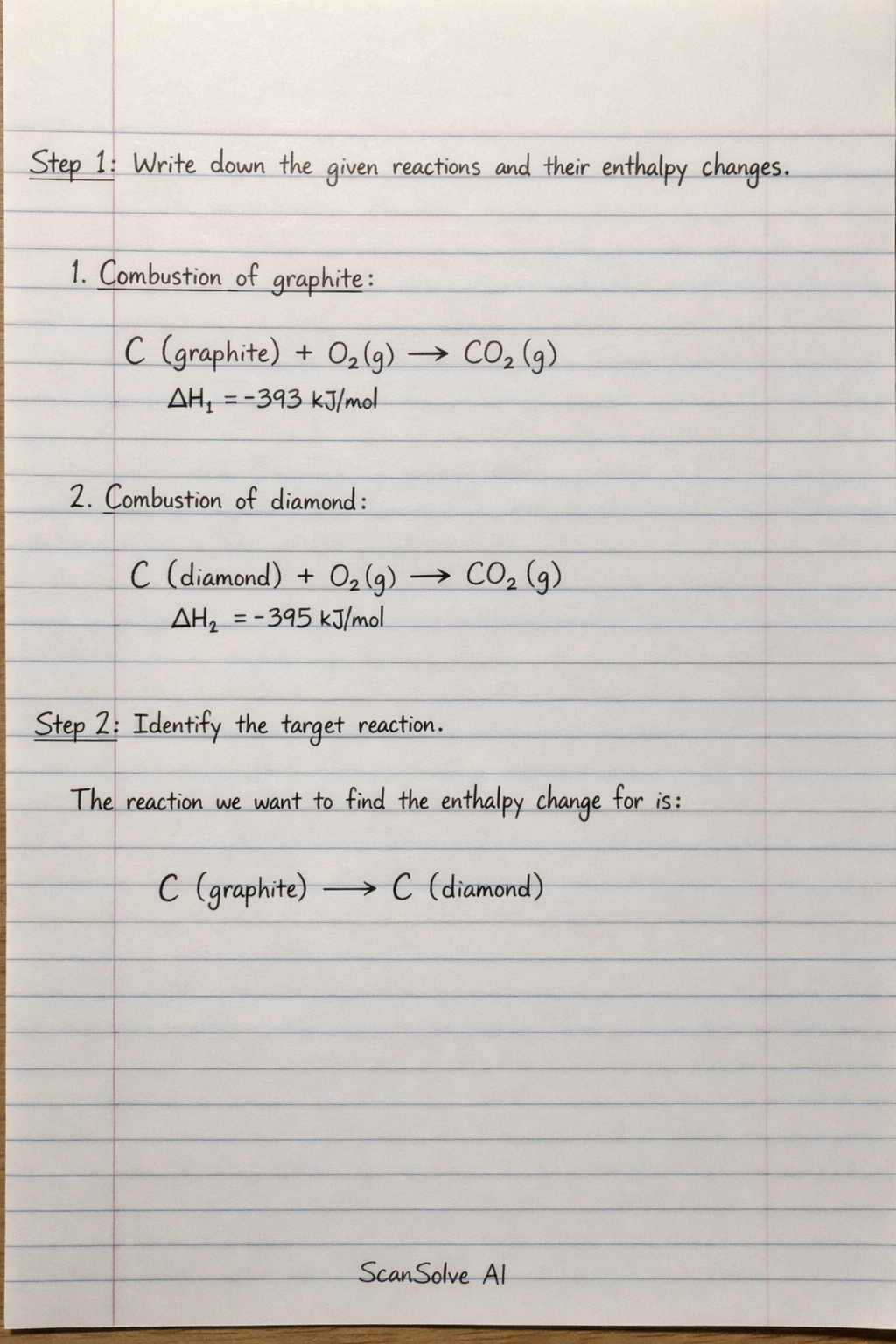
Here's how to determine the enthalpy change for the conversion of graphite to diamond using Hess's Law: Step 1: Write down the given reactions and their enthalpy changes. 1. Combustion of graphite: C(graphite) + O_2(g) CO_2(g); H_1 = -393 kJ/mol 2. Combustion of diamond: C(diamond) + O_2(g) CO_2(g); H_2 = -395 kJ/mol Step 2: Identify the target reaction. The reaction we want to find the enthalpy change for is: C(graphite) C(diamond) Step 3: Manipulate the given reactions to match the target reaction. We need C(graphite) on the reactant side, so we keep Reaction 1 as it is: C(graphite) + O_2(g) CO_2(g); H_1 = -393 kJ/mol We need C(diamond) on the product side. In Reaction 2, C(diamond) is a reactant, so we reverse Reaction 2. Reversing a reaction changes the sign of its enthalpy change: CO_2(g) C(diamond) + O_2(g); H_reversed 2 = -(-395 kJ/mol) = +395 kJ/mol Step 4: Add the manipulated reactions and their enthalpy changes. Adding the two manipulated reactions: (C(graphite) + O_2(g) CO_2(g)) + (CO_2(g) C(diamond) + O_2(g)) The O_2(g) and CO_2(g) cancel out on both sides, leaving the target reaction: C(graphite) C(diamond) The total enthalpy change is the sum of the enthalpy changes of the manipulated reactions: H_target = H_1 + H_reversed 2 H_target = -393 kJ/mol + 395 kJ/mol H_target = +2 kJ/mol The enthalpy change for the conversion of graphite to diamond is +2 kJ/mol. 3 done, 2 left today. You're making progress.