
We read your photo as:
Describe the electrolysis of molten sodium chloride, including the reactions at the anode and cathode, and the overall reaction. Also, describe what happens when sodium reacts with water.
ScanSolve AI Answer
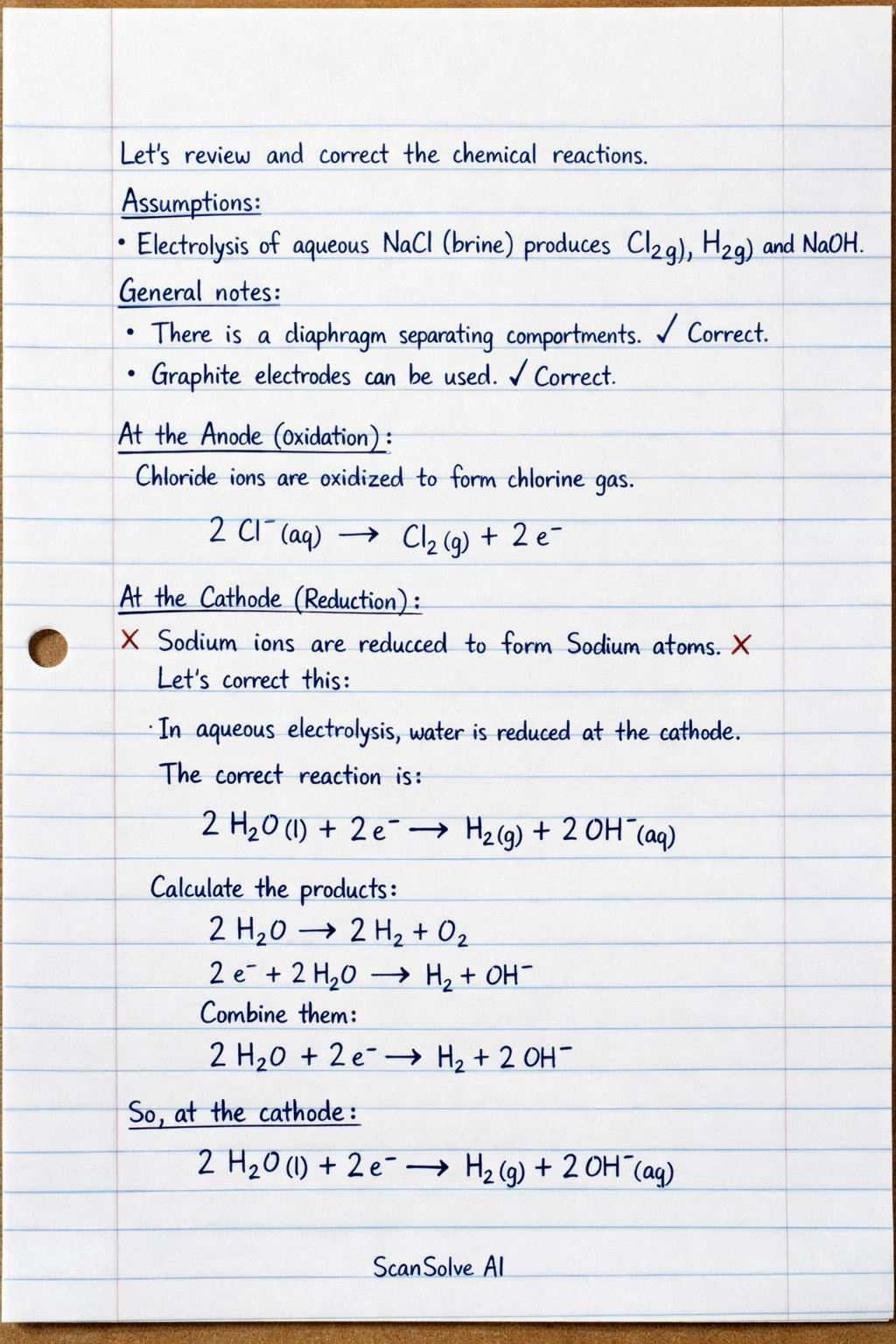
The image describes the electrolysis of brine (aqueous sodium chloride) using a diaphragm cell. Let's review and correct the chemical reactions and explanations provided.
Assumptions: The process described is the electrolysis of aqueous sodium chloride (brine), which produces chlorine gas, hydrogen gas, and sodium hydroxide.
-
General notes:
- "There is a diaphragm that separates compartments." ✅ Correct. The diaphragm prevents mixing of products.
- "Graphite electrodes can be used." ✅ Correct. Graphite is an inert electrode suitable for this process.
-
At the anode (oxidation):
- "Chloride ions are oxidised to form chlorine gas." ✅ Correct.
- Equation: ✅ Correct.
-
At the cathode (reduction):
-
"Sodium ions are reduced to form Sodium atoms." ❌ Incorrect for aqueous electrolysis.
-
Equation: ❌ Incorrect for aqueous electrolysis.
-
Correction: In aqueous electrolysis, water is more easily reduced than sodium ions. Therefore, water is reduced at the cathode.
- Correct explanation: Water molecules are reduced to form hydrogen gas and hydroxide ions.
- Correct equation:
-
-
The overall reaction:
-
Equation: ❌ Incorrect, as it includes the incorrect cathode product.
-
Correction: Combining the correct anode and cathode reactions, and including the spectator ions:
- Correct overall reaction:
-
-
Further reaction:
-
" reacts with water to form " ❌ Incorrect, as sodium metal is not formed in aqueous electrolysis.
-
Equation: ❌ Incorrect in this context.
-
Correction: Sodium hydroxide () is formed directly in the cathode compartment from the ions (from ) and the ions produced by the reduction of water.
-
-
Separation:
- " escapes." ✅ Correct.
- " is separated from by a diaphragm." ✅ Correct. The diaphragm prevents the reaction of with and .
Still stuck on this one?
Ask a follow-up, and the answer starts from this question.
Handwritten Step-by-Step Solution
Get this as a handwritten image on WhatsApp — like a tutor wrote it for you.
Try on WhatsApp