We read your photo as:

Calculate the empirical formula of organic compound containing C= 61.6% and H = 12.8%

Chemistry

ScanSolve AI Answer

Step-by-step solution

17 steps

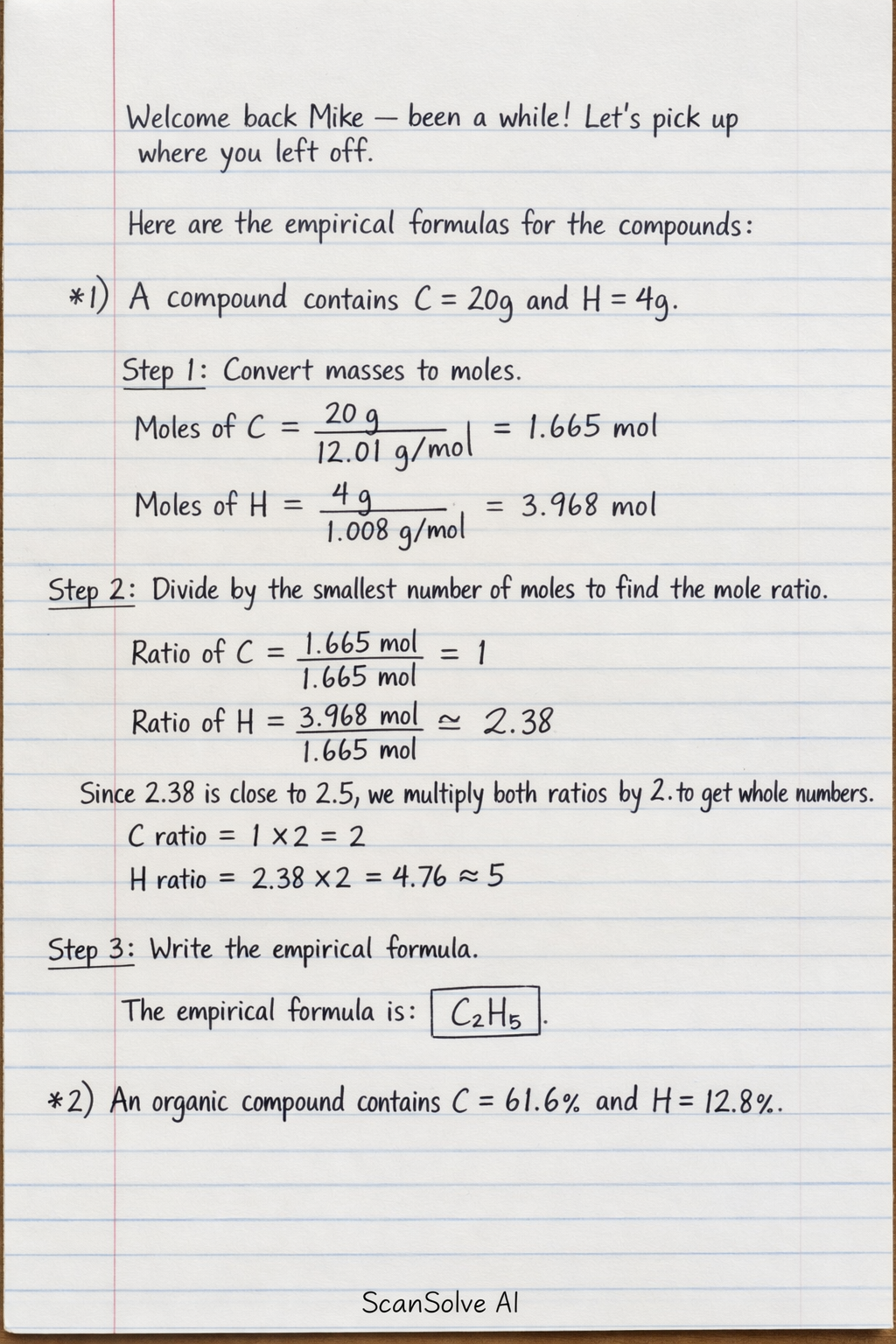
Here are the empirical formulas for the compounds:

1) A compound contains C = 20g and H = 4g.

  1. Convert masses to moles.

    Moles of C=20 g12.01 g/mol=1.665 mol\text{Moles of C} = \frac{20\, \text{g}}{12.01\, \text{g/mol}} = 1.665\, \text{mol} Moles of H=4 g1.008 g/mol=3.968 mol\text{Moles of H} = \frac{4\, \text{g}}{1.008\, \text{g/mol}} = 3.968\, \text{mol}
  2. Divide by the smallest number of moles to find the mole ratio.

    Ratio of C=1.665 mol1.665 mol=1\text{Ratio of C} = \frac{1.665\, \text{mol}}{1.665\, \text{mol}} = 1 Ratio of H=3.968 mol1.665 mol≈2.38\text{Ratio of H} = \frac{3.968\, \text{mol}}{1.665\, \text{mol}} \approx 2.38

    Since 2.38 is close to 2.5, we multiply both ratios by 2 to get whole numbers.

    C ratio=1×2=2\text{C ratio} = 1 \times 2 = 2 H ratio=2.38×2≈4.76≈5\text{H ratio} = 2.38 \times 2 \approx 4.76 \approx 5
  3. Write the empirical formula.

    The empirical formula is C2H5\boxed{\text{C}_2\text{H}_5}.

    2) An organic compound contains C = 61.6% and H = 12.8%.

  4. Assume a 100 g sample.

    The mass of C is 61.6 g and H is 12.8 g. The remaining percentage must be Oxygen.

    Mass of O=100%−61.6%−12.8%=25.6%\text{Mass of O} = 100\% - 61.6\% - 12.8\% = 25.6\%

    So, in a 100 g sample, C = 61.6 g, H = 12.8 g, O = 25.6 g.

  5. Convert masses to moles.

    Moles of C=61.6 g12.01 g/mol=5.129 mol\text{Moles of C} = \frac{61.6\, \text{g}}{12.01\, \text{g/mol}} = 5.129\, \text{mol} Moles of H=12.8 g1.008 g/mol=12.698 mol\text{Moles of H} = \frac{12.8\, \text{g}}{1.008\, \text{g/mol}} = 12.698\, \text{mol} Moles of O=25.6 g16.00 g/mol=1.600 mol\text{Moles of O} = \frac{25.6\, \text{g}}{16.00\, \text{g/mol}} = 1.600\, \text{mol}
  6. Divide by the smallest number of moles to find the mole ratio.

    Ratio of C=5.129 mol1.600 mol≈3.20\text{Ratio of C} = \frac{5.129\, \text{mol}}{1.600\, \text{mol}} \approx 3.20 Ratio of H=12.698 mol1.600 mol≈7.94\text{Ratio of H} = \frac{12.698\, \text{mol}}{1.600\, \text{mol}} \approx 7.94 Ratio of O=1.600 mol1.600 mol=1\text{Ratio of O} = \frac{1.600\, \text{mol}}{1.600\, \text{mol}} = 1

    Since 3.20 is close to 3.25 (or 3143 \frac{1}{4}) and 7.94 is close to 8, we can multiply by 4 to get whole numbers.

    C ratio=3.20×4=12.8≈13\text{C ratio} = 3.20 \times 4 = 12.8 \approx 13 H ratio=7.94×4=31.76≈32\text{H ratio} = 7.94 \times 4 = 31.76 \approx 32 O ratio=1×4=4\text{O ratio} = 1 \times 4 = 4
  7. Write the empirical formula.

    The empirical formula is C13H32O4\boxed{\text{C}_{13}\text{H}_{32}\text{O}_4}.

    3) A compound was found to contain C = 84.45% and N = 6.07%. (Assuming H is the remainder, as the given H percentage was too high).

  8. Calculate the percentage of H.

    Percentage of H=100%−84.45%−6.07%=9.48%\text{Percentage of H} = 100\% - 84.45\% - 6.07\% = 9.48\%

    So, in a 100 g sample, C = 84.45 g, H = 9.48 g, N = 6.07 g.

  9. Convert masses to moles.

    Moles of C=84.45 g12.01 g/mol=7.032 mol\text{Moles of C} = \frac{84.45\, \text{g}}{12.01\, \text{g/mol}} = 7.032\, \text{mol} Moles of H=9.48 g1.008 g/mol=9.405 mol\text{Moles of H} = \frac{9.48\, \text{g}}{1.008\, \text{g/mol}} = 9.405\, \text{mol} Moles of N=6.07 g14.01 g/mol=0.433 mol\text{Moles of N} = \frac{6.07\, \text{g}}{14.01\, \text{g/mol}} = 0.433\, \text{mol}
  10. Divide by the smallest number of moles to find the mole ratio.

    Ratio of C=7.032 mol0.433 mol≈16.24\text{Ratio of C} = \frac{7.032\, \text{mol}}{0.433\, \text{mol}} \approx 16.24 Ratio of H=9.405 mol0.433 mol≈21.72\text{Ratio of H} = \frac{9.405\, \text{mol}}{0.433\, \text{mol}} \approx 21.72 Ratio of N=0.433 mol0.433 mol=1\text{Ratio of N} = \frac{0.433\, \text{mol}}{0.433\, \text{mol}} = 1

    These ratios are close to whole numbers (16, 22, 1).

  11. Write the empirical formula.

    The empirical formula is C16H22N\boxed{\text{C}_{16}\text{H}_{22}\text{N}}.

    4) A compound contains C = 6.06g, H = 0.40g, and Oxygen = 6.73g.

  12. Convert masses to moles.

    Moles of C=6.06 g12.01 g/mol=0.5046 mol\text{Moles of C} = \frac{6.06\, \text{g}}{12.01\, \text{g/mol}} = 0.5046\, \text{mol} Moles of H=0.40 g1.008 g/mol=0.3968 mol\text{Moles of H} = \frac{0.40\, \text{g}}{1.008\, \text{g/mol}} = 0.3968\, \text{mol} Moles of O=6.73 g16.00 g/mol=0.4206 mol\text{Moles of O} = \frac{6.73\, \text{g}}{16.00\, \text{g/mol}} = 0.4206\, \text{mol}
  13. Divide by the smallest number of moles to find the mole ratio.

    Ratio of C=0.5046 mol0.3968 mol≈1.27\text{Ratio of C} = \frac{0.5046\, \text{mol}}{0.3968\, \text{mol}} \approx 1.27 Ratio of H=0.3968 mol0.3968 mol=1\text{Ratio of H} = \frac{0.3968\, \text{mol}}{0.3968\, \text{mol}} = 1 Ratio of O=0.4206 mol0.3968 mol≈1.06\text{Ratio of O} = \frac{0.4206\, \text{mol}}{0.3968\, \text{mol}} \approx 1.06

    Since 1.27 is close to 1.25 (or 1141 \frac{1}{4}), we multiply all ratios by 4 to get whole numbers.

    C ratio=1.27×4=5.08≈5\text{C ratio} = 1.27 \times 4 = 5.08 \approx 5 H ratio=1×4=4\text{H ratio} = 1 \times 4 = 4 O ratio=1.06×4=4.24≈4\text{O ratio} = 1.06 \times 4 = 4.24 \approx 4
  14. Write the empirical formula.

    The empirical formula is C5H4O4\boxed{\text{C}_5\text{H}_4\text{O}_4}.

    5) A compound contains C = 48g, H = 8g, and O = 12g.

  15. Convert masses to moles.

    Moles of C=48 g12.01 g/mol=3.997 mol\text{Moles of C} = \frac{48\, \text{g}}{12.01\, \text{g/mol}} = 3.997\, \text{mol} Moles of H=8 g1.008 g/mol=7.936 mol\text{Moles of H} = \frac{8\, \text{g}}{1.008\, \text{g/mol}} = 7.936\, \text{mol} Moles of O=12 g16.00 g/mol=0.750 mol\text{Moles of O} = \frac{12\, \text{g}}{16.00\, \text{g/mol}} = 0.750\, \text{mol}
  16. Divide by the smallest number of moles to find the mole ratio.

    Ratio of C=3.997 mol0.750 mol≈5.33\text{Ratio of C} = \frac{3.997\, \text{mol}}{0.750\, \text{mol}} \approx 5.33 Ratio of H=7.936 mol0.750 mol≈10.58\text{Ratio of H} = \frac{7.936\, \text{mol}}{0.750\, \text{mol}} \approx 10.58 Ratio of O=0.750 mol0.750 mol=1\text{Ratio of O} = \frac{0.750\, \text{mol}}{0.750\, \text{mol}} = 1

    Since 5.33 is close to 5135 \frac{1}{3} and 10.58 is close to 102310 \frac{2}{3}, we multiply all ratios by 3 to get whole numbers.

    C ratio=5.33×3=15.99≈16\text{C ratio} = 5.33 \times 3 = 15.99 \approx 16 H ratio=10.58×3=31.74≈32\text{H ratio} = 10.58 \times 3 = 31.74 \approx 32 O ratio=1×3=3\text{O ratio} = 1 \times 3 = 3
  17. Write the empirical formula.

    The empirical formula is C16H32O3\boxed{\text{C}_{16}\text{H}_{32}\text{O}_3}.

Was this helpful?

Still stuck on this one?

Ask a follow-up, and the answer starts from this question.
Got a different question?Ask your own question
Handwritten step-by-step solution preview

Handwritten Step-by-Step Solution

Get this as a handwritten image on WhatsApp — like a tutor wrote it for you.

Try on WhatsApp