
We read your photo as:
Identify X and Y. State the observation made at electrode X. In the absence of heat the set up did not work. Explain. Write an equation taking place at Y. State one application of the process above.
ScanSolve AI Answer
Step-by-step solution
9 stepsPart i· 2 steps
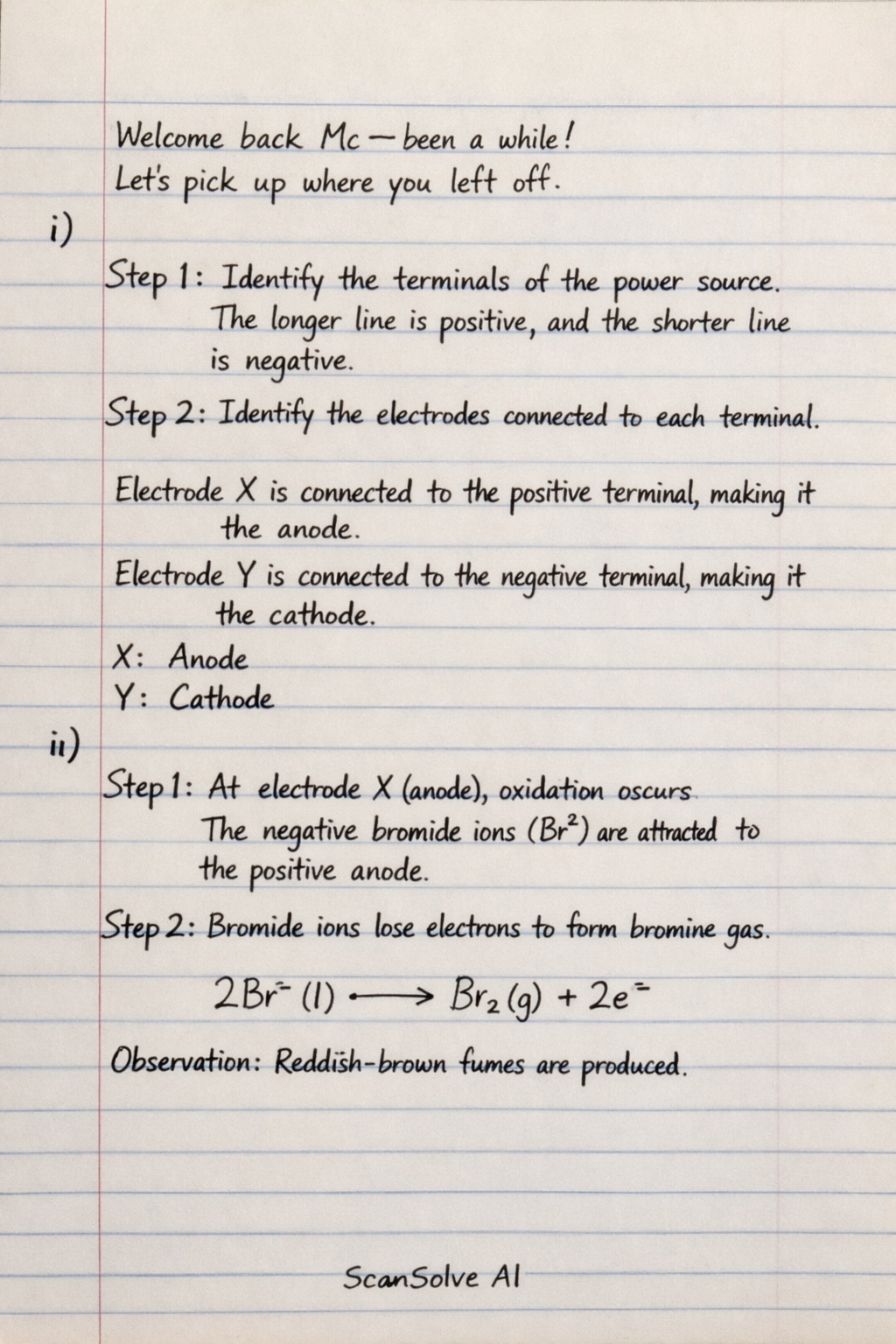
Identify the terminals of the power source.
The longer line is positive, and the shorter line is negative.
Identify the electrodes connected to each terminal.
Electrode X is connected to the positive terminal, making it the anode.
Electrode Y is connected to the negative terminal, making it the cathode.- X: Anode
- Y: Cathode
Part ii· 2 steps
At electrode X (anode), oxidation occurs.
The negative bromide ions () are attracted to the positive anode.
Bromide ions lose electrons to form bromine gas.
- Observation: Reddish-brown fumes are produced.
Part iii· 2 steps
In the solid state, ionic compounds like have their ions held in fixed positions within a crystal lattice.
For electrolysis to occur, ions must be mobile to carry electric charge.
Without heat, the remains solid, and its ions are immobile.
- Explanation: Solid does not conduct electricity because its ions are not free to move. Heating melts the , allowing the ions to become mobile and conduct electricity.
Part iv· 2 steps
At electrode Y (cathode), reduction occurs.
The positive lead ions () are attracted to the negative cathode.
Lead ions gain electrons to form lead metal.
- Equation:
Part v· 1 step
The process shown is the electrolysis of a molten ionic compound.
This method is used to extract reactive metals from their ores.
- Application: Extraction of reactive metals (e.g., aluminium, sodium, or lead).
Still stuck on this one?
Ask a follow-up, and the answer starts from this question.
Handwritten Step-by-Step Solution
Get this as a handwritten image on WhatsApp — like a tutor wrote it for you.
Try on WhatsApp