
We read your photo as:
State and explain the variation of electrical conductivity of Period (III) elements, Na to Ar.
ScanSolve AI Answer
Step-by-step solution
6 steps(II)
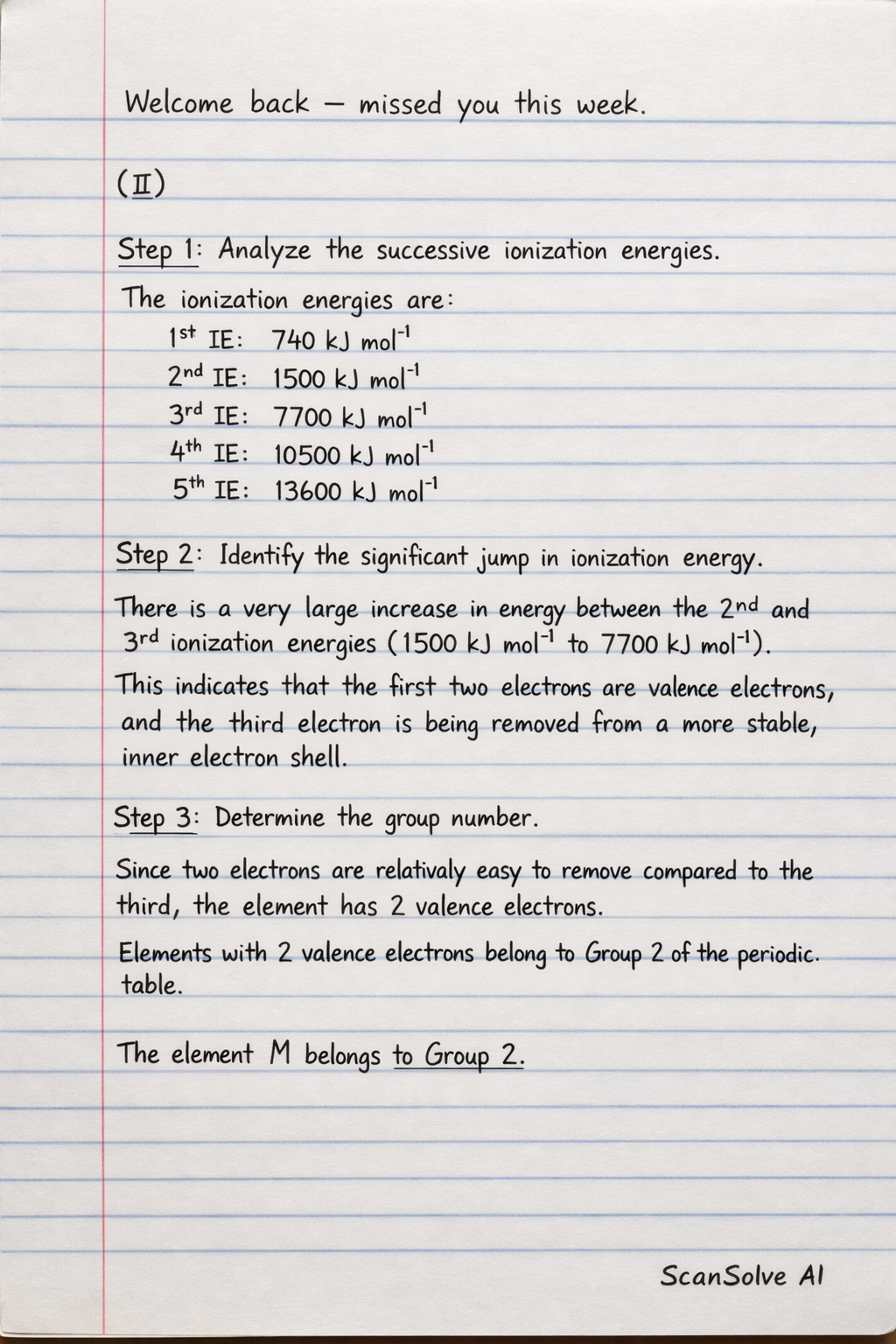
Analyze the successive ionization energies.
The ionization energies are:
1st IE:
2nd IE:
3rd IE:
4th IE:
5th IE:Identify the significant jump in ionization energy.
There is a very large increase in energy between the 2nd and 3rd ionization energies ( to ). This indicates that the first two electrons are valence electrons, and the third electron is being removed from a more stable, inner electron shell.
Determine the group number.
Since two electrons are relatively easy to remove compared to the third, the element has 2 valence electrons. Elements with 2 valence electrons belong to Group 2 of the periodic table.
The element M belongs to Group 2.
(c)
Describe the trend for metallic elements (Na, Mg, Al).
Electrical conductivity increases from sodium (Na) to aluminium (Al). This is because these are metals, and their conductivity depends on the number of delocalized electrons available to carry charge. Sodium has one delocalized electron per atom, magnesium has two, and aluminium has three. More delocalized electrons lead to higher conductivity.
Describe the conductivity of silicon (Si).
Silicon (Si) is a metalloid and a semiconductor. Its conductivity is significantly lower than that of aluminium but higher than that of non-metals. It has a giant covalent structure.
Describe the trend for non-metallic elements (P, S, Cl, Ar).
Phosphorus (P), sulfur (S), chlorine (Cl), and argon (Ar) are insulators (very poor conductors). These elements exist as simple molecular structures (P, S, Cl) or individual atoms (Ar) and do not have delocalized electrons or mobile ions to conduct electricity.
The variation of electrical conductivity across Period (III) elements from Na to Ar is:
- Conductivity increases from Na to Al (Na < Mg < Al) due to an increasing number of delocalized valence electrons.
- Conductivity decreases sharply at Si, which is a semiconductor.
- Conductivity becomes negligible for P, S, Cl, and Ar, as they are non-metals with no mobile charge carriers.
Still stuck on this one?
Ask a follow-up, and the answer starts from this question.
Handwritten Step-by-Step Solution
Get this as a handwritten image on WhatsApp — like a tutor wrote it for you.
Try on WhatsApp