
We read your photo as:
Solid E reacts with dilute hydrochloric acid to produce Solution F and a colourless gas G. Solution F is later shown to contain copper(II) ions. If Solid E is copper(II) carbonate, it reacts with hydr
ScanSolve AI Answer
Step-by-step solution
4 stepsHapa kuna majibu ya maswali yako:
I)
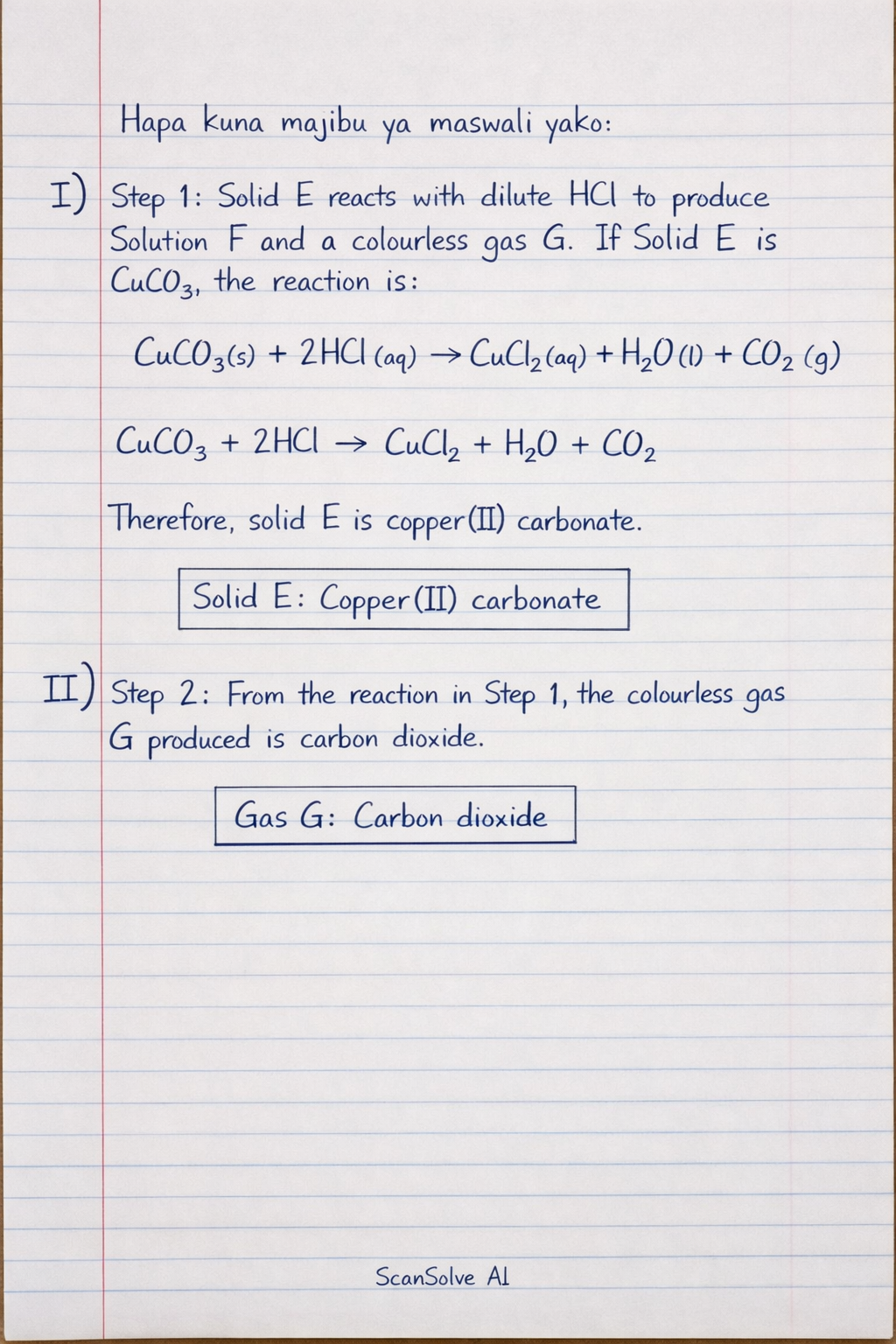
Solid E reacts with dilute hydrochloric acid to produce Solution F and a colourless gas G.
Solution F is later shown to contain copper(II) ions. If Solid E is copper(II) carbonate, it reacts with hydrochloric acid to form copper(II) chloride (Solution F), water, and carbon dioxide gas (colourless gas G).
Therefore, solid E is copper(II) carbonate.
- Solid E:
II)
From the reaction in Step 1, the colourless gas G produced is carbon dioxide.
- Gas G:
III)
Solution H is the deep blue solution formed when the blue precipitate (copper(II) hydroxide) reacts with excess aqueous ammonia.
This deep blue solution contains the tetraamminecopper(II) complex ion.
The formula of the compound (ion) in solution H is .
- Formula of the compound in solution H:
IV)
The reaction in Step II involves Solution F (containing ions) reacting with 3 drops of aqueous ammonia to form a blue precipitate, which is copper(II) hydroxide, .
Aqueous ammonia provides hydroxide ions.
- Ionic equation for the reaction in Step II:
Still stuck on this one?
Ask a follow-up, and the answer starts from this question.
More Chemistry Questions
Handwritten Step-by-Step Solution
Get this as a handwritten image on WhatsApp — like a tutor wrote it for you.
Try on WhatsApp