We read your photo as:

To answer questions (d) and (e) regarding calcium carbonate, I need the balanced chemical equation for the reaction with hydrochloric acid and the number of moles of hydrochloric acid that reacted. Th

Chemistry

ScanSolve AI Answer

Step-by-step solution

6 steps

To answer questions (d) and (e) regarding calcium carbonate, I need the balanced chemical equation for the reaction with hydrochloric acid and the number of moles of hydrochloric acid that reacted. This information is not provided in the current image. Please provide the preceding parts of the question or any relevant data.

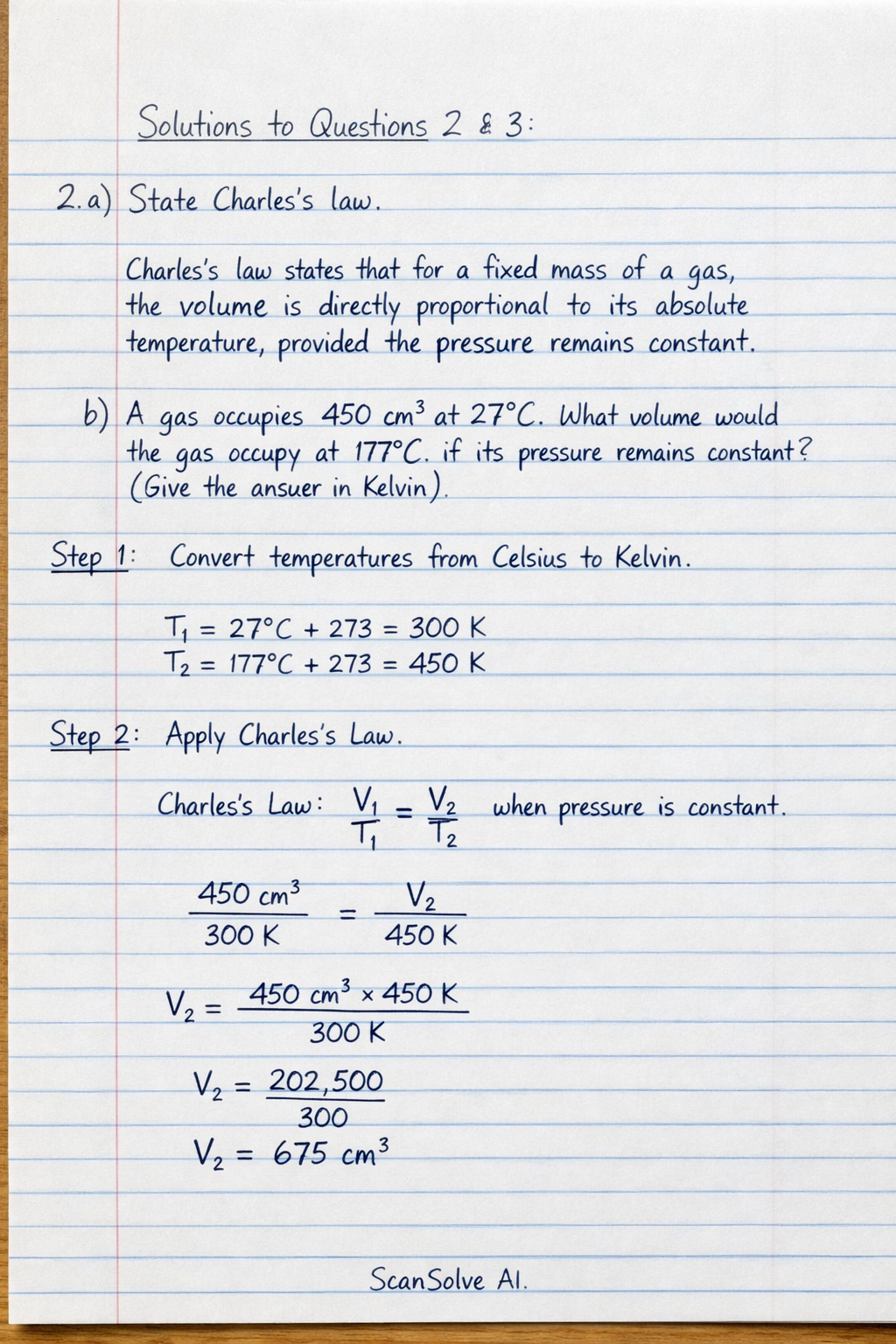
Here are the solutions for questions 2 and 3:

  1. a) State Charles's law. Charles's law states that for a fixed mass of a gas, the volume is directly proportional to its absolute temperature, provided the pressure remains constant.

b) A gas occupies 450 cm3450 \, \text{cm}^3 at 27∘C27^\circ C. What volume would the gas occupy at 177∘C177^\circ C? If its pressure remains constant? (Give the answer in Kelvin)

  1. Convert temperatures from Celsius to Kelvin.

    T1=27∘C+273=300 KT_1 = 27^\circ C + 273 = 300 \, \text{K} T2=177∘C+273=450 KT_2 = 177^\circ C + 273 = 450 \, \text{K}
  2. Apply Charles's Law.

    Charles's Law states that V1T1=V2T2\frac{V_1}{T_1} = \frac{V_2}{T_2} when pressure is constant.

    450 cm3300 K=V2450 K\frac{450 \, \text{cm}^3}{300 \, \text{K}} = \frac{V_2}{450 \, \text{K}}
  3. Solve for V2V_2.

    V2=450 cm3×450 K300 KV_2 = \frac{450 \, \text{cm}^3 \times 450 \, \text{K}}{300 \, \text{K}} V2=202500300 cm3V_2 = \frac{202500}{300} \, \text{cm}^3 V2=675 cm3V_2 = 675 \, \text{cm}^3

    The volume the gas would occupy is 675 cm3\boxed{\text{675 cm}^3}.

    1. A gas occupies 4 dm34 \, \text{dm}^3 at −23∘C-23^\circ C and 152 mmHg152 \, \text{mmHg}. At what pressure will its volume be halved, if the temperature then is 227∘C227^\circ C?
  4. List the initial and final conditions and convert temperatures to Kelvin.

    Initial conditions:
    V1=4 dm3V_1 = 4 \, \text{dm}^3
    T1=−23∘C+273=250 KT_1 = -23^\circ C + 273 = 250 \, \text{K}
    P1=152 mmHgP_1 = 152 \, \text{mmHg}

    Final conditions:
    V2=V12=4 dm32=2 dm3V_2 = \frac{V_1}{2} = \frac{4 \, \text{dm}^3}{2} = 2 \, \text{dm}^3
    T2=227∘C+273=500 KT_2 = 227^\circ C + 273 = 500 \, \text{K}
    P2=?P_2 = ?

  5. Apply the Combined Gas Law.

    The Combined Gas Law states that P1V1T1=P2V2T2\frac{P_1 V_1}{T_1} = \frac{P_2 V_2}{T_2}.

    152 mmHg×4 dm3250 K=P2×2 dm3500 K\frac{152 \, \text{mmHg} \times 4 \, \text{dm}^3}{250 \, \text{K}} = \frac{P_2 \times 2 \, \text{dm}^3}{500 \, \text{K}}
  6. Solve for P2P_2.

    P2=152 mmHg×4 dm3×500 K250 K×2 dm3P_2 = \frac{152 \, \text{mmHg} \times 4 \, \text{dm}^3 \times 500 \, \text{K}}{250 \, \text{K} \times 2 \, \text{dm}^3} P2=152×4×500250×2 mmHgP_2 = \frac{152 \times 4 \times 500}{250 \times 2} \, \text{mmHg} P2=152×4×22 mmHgP_2 = \frac{152 \times 4 \times 2}{2} \, \text{mmHg} P2=152×4 mmHgP_2 = 152 \times 4 \, \text{mmHg} P2=608 mmHgP_2 = 608 \, \text{mmHg}

    The pressure will be 608 mmHg\boxed{\text{608 mmHg}}.

Was this helpful?

Still stuck on this one?

Ask a follow-up, and the answer starts from this question.

Got a different question?Ask your own question
Handwritten step-by-step solution preview

Handwritten Step-by-Step Solution

Get this as a handwritten image on WhatsApp — like a tutor wrote it for you.

Try on WhatsApp