

This chemistry question involves key chemical concepts and calculations. The detailed solution below walks through each step, from identifying the reaction type to computing the final answer.
ScanSolve AI Answer
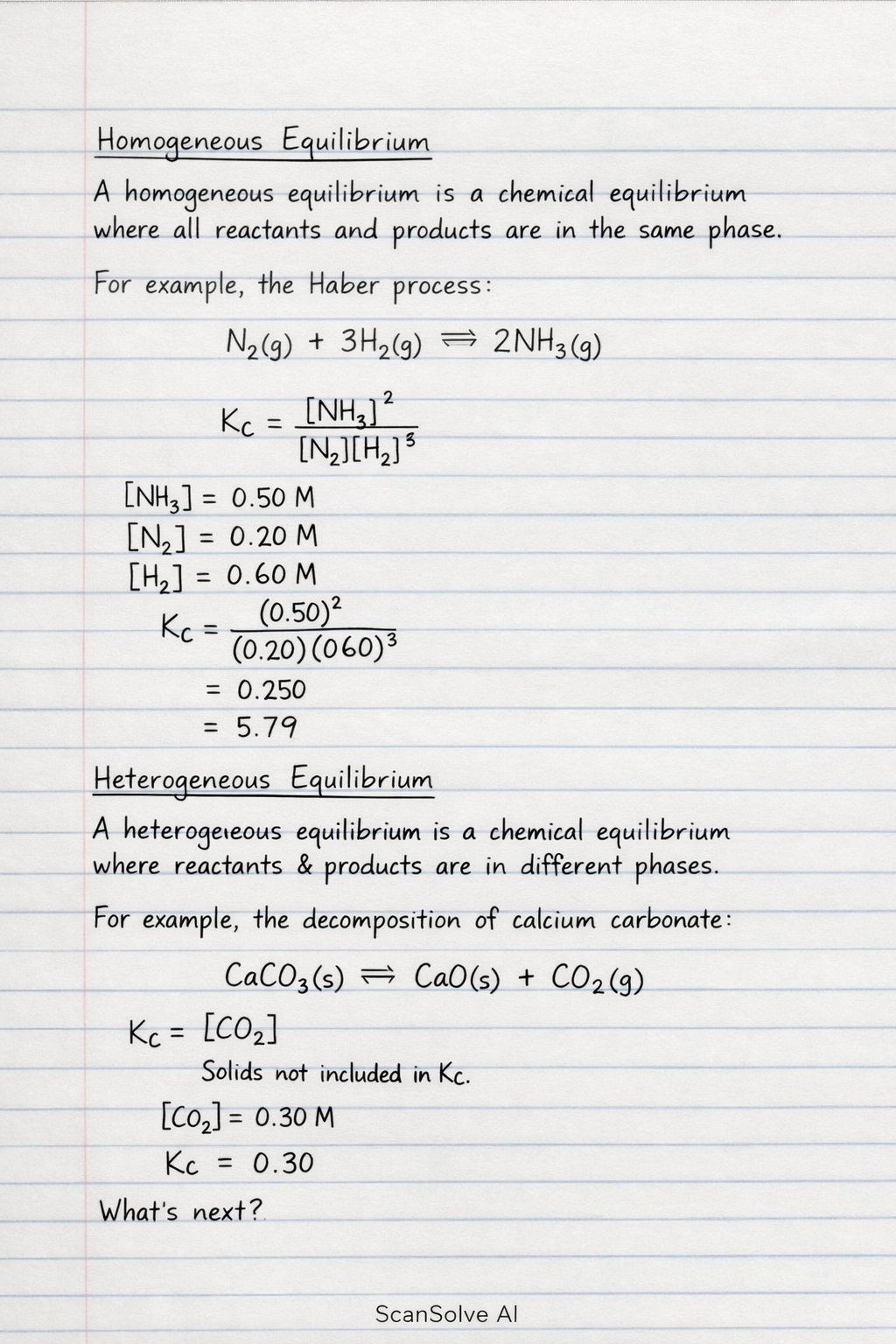
This image lists topics related to chemical equilibrium. Based on the previous discussion of equilibrium constants, here is an explanation of homogeneous and heterogeneous equilibria: Homogeneous Equilibrium A homogeneous equilibrium is a chemical equilibrium where all reactants and products are in the same physical state or phase. This typically means all species are gases or all are dissolved in a single liquid solution. For example, the Haber process for ammonia synthesis: N_2(g) + 3H_2(g) 2NH_3(g) Heterogeneous Equilibrium A heterogeneous equilibrium is a chemical equilibrium where reactants and products are present in more than one physical state or phase. In the equilibrium constant expression for heterogeneous equilibria, the concentrations of pure solids and pure liquids are considered constant and are therefore omitted. For example, the decomposition of calcium carbonate: CaCO_3(s) CaO(s) + CO_2(g) What's next?