
We read your photo as:
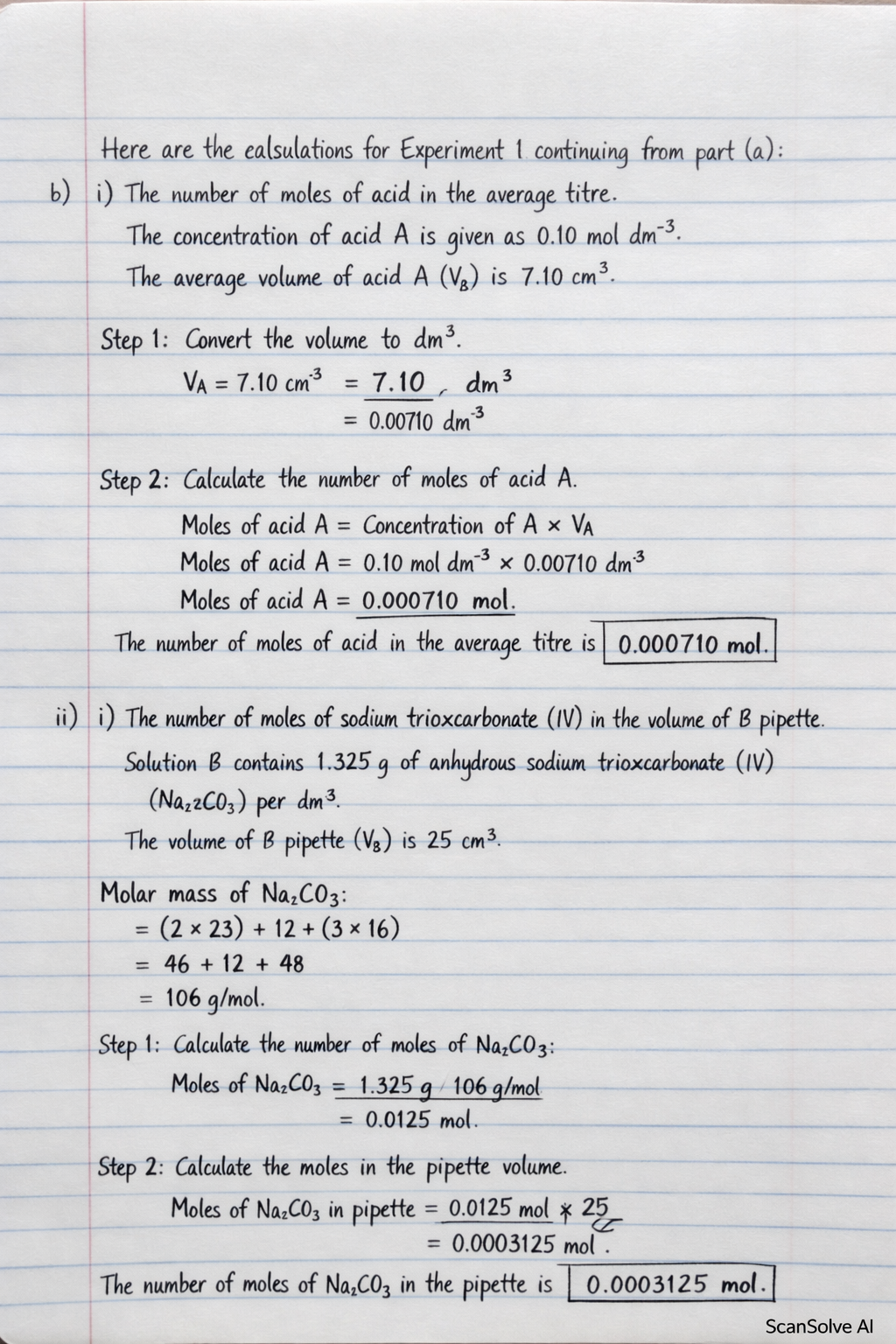
I) The number of moles of acid in the average titre.
ScanSolve AI Answer
Step-by-step solution
8 stepsHere are the calculations for Experiment 1, continuing from part (a):
Part b(i)· 2 steps
The number of moles of acid in the average titre.
The concentration of acid A is given as .
The average volume of acid A () is .
Convert the volume to .
Calculate the number of moles of acid A.
The number of moles of acid in the average titre is .
Part b(ii)· 4 steps
The number of moles of sodium trioxocarbonate (IV) in the volume of B pipette.
Solution B contains of anhydrous sodium trioxocarbonate (IV) () per .
The volume of B pipette () is .
Atomic masses: H = 1, C = 12, O = 16, Na = 23.
Calculate the molar mass of .
Calculate the concentration of in .
Convert the pipette volume to .
Calculate the number of moles of in the pipette volume.
The number of moles of sodium trioxocarbonate (IV) in the volume of B pipette is .
Part b(iii)· 2 steps
The mole ratio of acid to base in the reaction. Suggest what the acid in (a) could be, giving reasons for your answer.
Determine the mole ratio of acid to base.
To simplify the ratio, divide both sides by the smaller value (0.0003125):
This ratio is approximately .
Suggest the acid.
The base is sodium trioxocarbonate (IV) ().
A mole ratio of acid to base suggests that the acid is monoprotic (has one acidic hydrogen) and reacts with the carbonate, which is a diprotic base (can accept two protons).
The teacher's hint suggests . Hydrochloric acid () is a monoprotic mineral acid.
The reaction between and is:This equation shows that 2 moles of react with 1 mole of , which matches our calculated mole ratio of approximately .
Therefore, the mole ratio of acid to base is approximately .
The acid in (a) could be hydrochloric acid ().
Reason: The calculated mole ratio of acid to base is approximately , which is consistent with a monoprotic acid like reacting with a diprotic base like .
Part c
Hence, write the equation for the reaction.
Based on the identification of the acid as and the base as :
Still stuck on this one?
Ask a follow-up, and the answer starts from this question.
More Chemistry Questions
Handwritten Step-by-Step Solution
Get this as a handwritten image on WhatsApp — like a tutor wrote it for you.
Try on WhatsApp