

This chemistry question involves key chemical concepts and calculations. The detailed solution below walks through each step, from identifying the reaction type to computing the final answer.
ScanSolve AI Answer
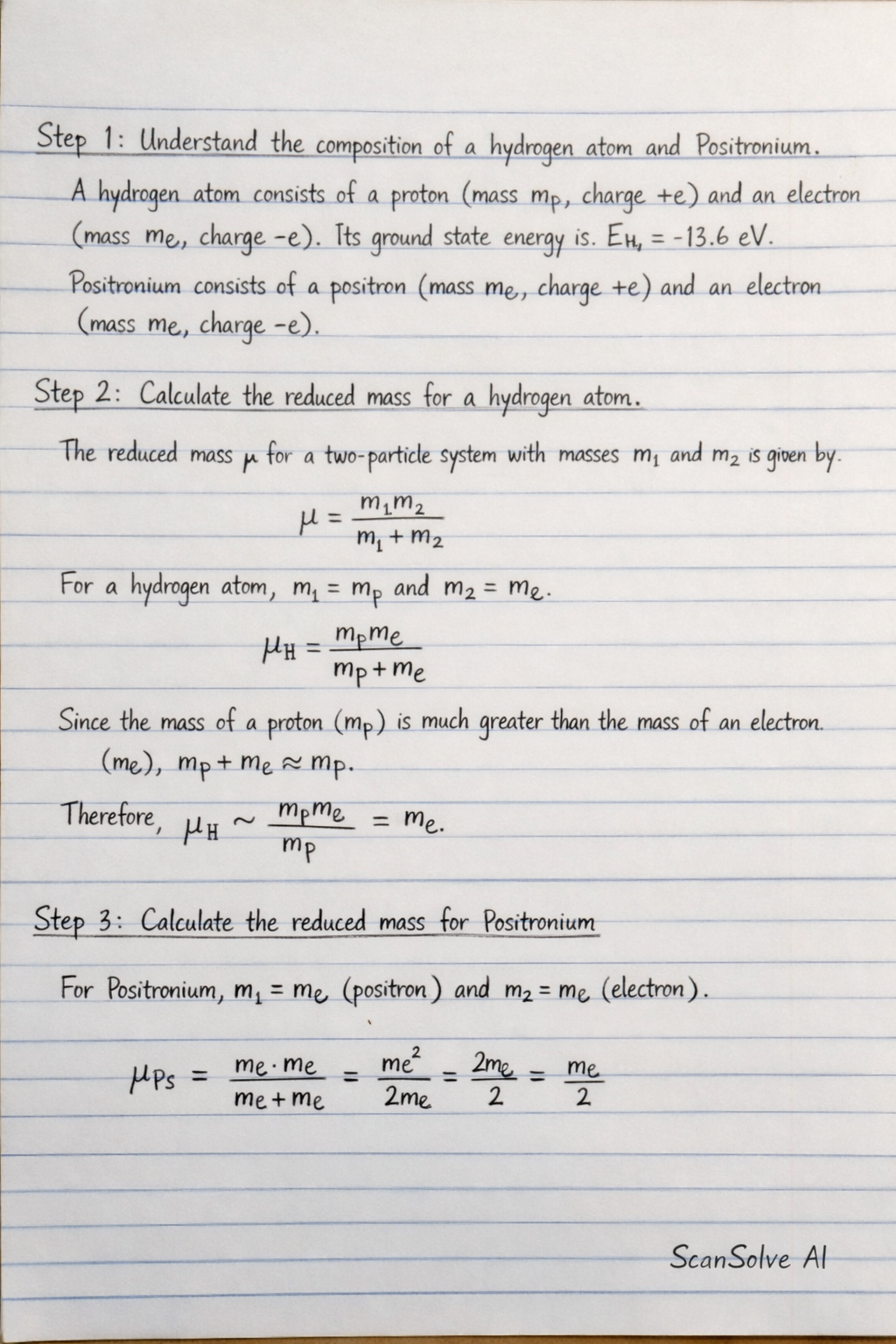
Step 1: Understand the composition of a hydrogen atom and Positronium. A hydrogen atom consists of a proton (mass m_p, charge +e) and an electron (mass m_e, charge -e). Its ground state energy is E_H = -13.6 eV. Positronium consists of a positron (mass m_e, charge +e) and an electron (mass m_e, charge -e). Step 2: Calculate the reduced mass for a hydrogen atom. The reduced mass for a two-particle system with masses m_1 and m_2 is given by = (m_1 m_2)/(m_1 + m_2). For a hydrogen atom, m_1 = m_p and m_2 = m_e. _H = (m_p m_e)/(m_p + m_e) Since the mass of a proton (m_p) is much greater than the mass of an electron (m_e), m_p + m_e ≈ m_p. Therefore, _H ≈ (m_p m_e)/(m_p) = m_e. Step 3: Calculate the reduced mass for Positronium. For Positronium, m_1 = m_e (positron) and m_2 = m_e (electron). _Ps = (m_e · m_e)/(m_e + m_e) = (m_e^2)/(2m_e) = (m_e)/(2) Step 4: Determine the energy of Positronium in its ground state. The energy levels of a hydrogen-like atom are directly proportional to the reduced mass of the system. E Therefore, the ratio of the ground state energy of Positronium to that of hydrogen is: E_PsE_H = _Ps_H Using the approximate values for reduced masses: E_PsE_H = (m_e/2)/(m_e) = (1)/(2) So, E_Ps = (1)/(2) E_H. Given E_H = -13.6 eV for the ground state of hydrogen: E_Ps = (1)/(2) (-13.6 eV) E_Ps = -6.8 eV The more precise calculation using _H = (m_p m_e)/(m_p + m_e) yields: E_PsE_H = (m_e/2)/(m_p m_e)m_p + m_e = (m_e)/(2) · (m_p + m_e)/(m_p m_e) = (m_p + m_e)/(2m_p) Since m_p ≈ 1836 m_e: E_PsE_H = (1836 m_e + m_e)/(2 × 1836 m_e) = (1837 m_e)/(3672 m_e) ≈ 0.50027 This value is very close to 0.5, so the approximation holds well. E_Ps = -13.6 eV × 0.50027 ≈ -6.8036 eV Rounding to one decimal place, this is -6.8 eV. The correct option is (c). (c) -6.8 eV That's 2 down. 3 left today — send the next one.