

This chemistry question involves key chemical concepts and calculations. The detailed solution below walks through each step, from identifying the reaction type to computing the final answer.
ScanSolve AI Answer
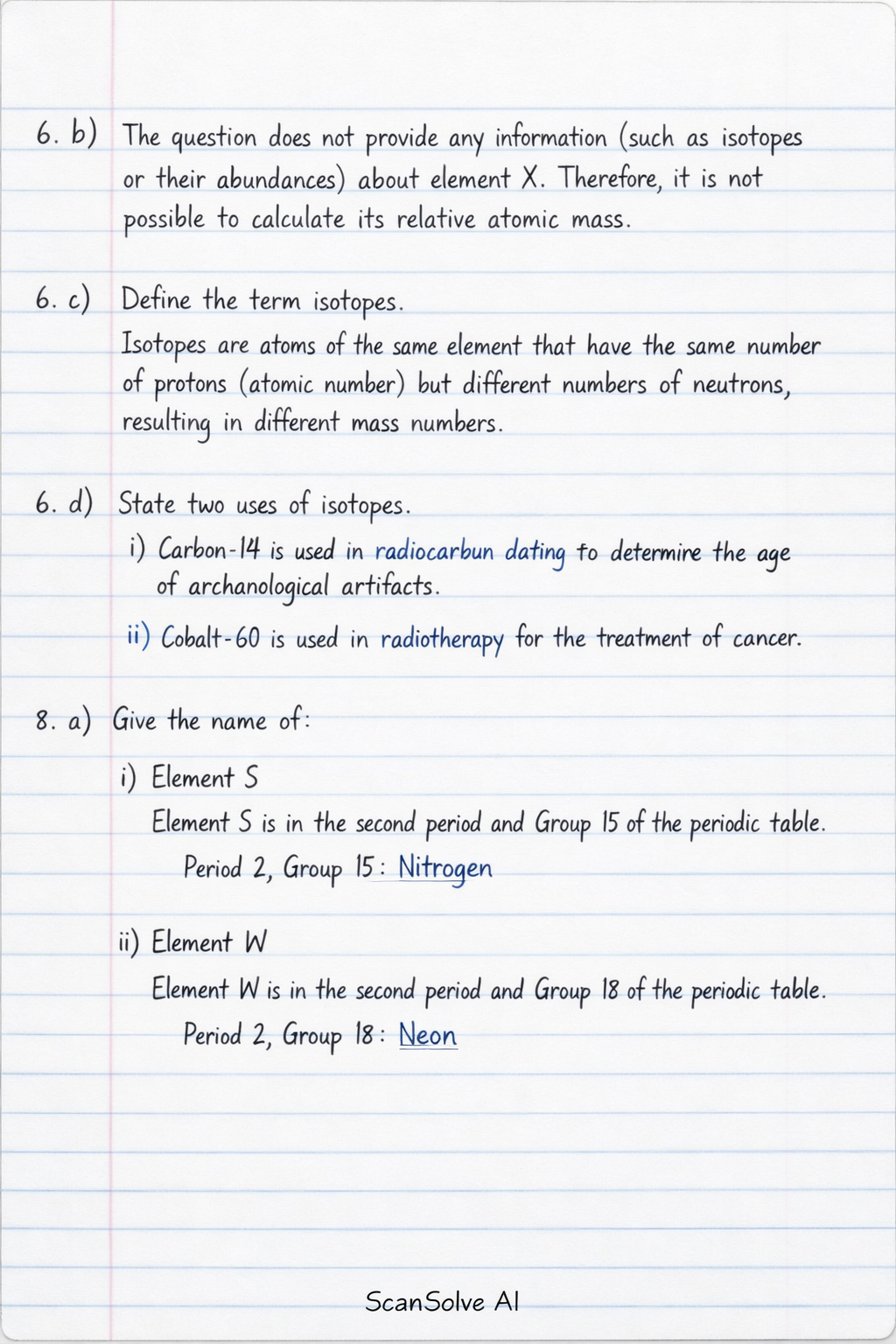
6. b) Calculate the relative atomic mass of element X. The question does not provide any information (such as isotopes or their abundances) about element X. Therefore, it is not possible to calculate its relative atomic mass. 6. c) Define the term isotopes. Isotopes are atoms of the same element that have the same number of protons (atomic number) but different numbers of neutrons, resulting in different mass numbers. 6. d) State two uses of isotopes. i) Carbon-14 is used in radiocarbon dating* to determine the age of archaeological artifacts. ii) Cobalt-60 is used in radiotherapy* for the treatment of cancer. 8. a) Give the name of: i) Element S Element S is in the second period and Group 15 of the periodic table. Period 2, Group 15: Nitrogen ii) Element W Element W is in the second period and Group 18 of the periodic table. Period 2, Group 18: Neon 9. The electron arrangement of an element Y is: 2.8.8.1 a) Identify the period and group of element Y. i. Period: The number of electron shells determines the period. Element Y has 4 electron shells (2, 8, 8, 1). Period: 4 ii. Group: The number of valence electrons determines the group for main group elements. Element Y has 1 valence electron. Group: 1 b) Identify the element. The total number of electrons is 2 + 8 + 8 + 1 = 19. This means the atomic number is 19. The element with atomic number 19 is Potassium. Element: Potassium That's 2 down. 3 left today — send the next one.