
We read your photo as:
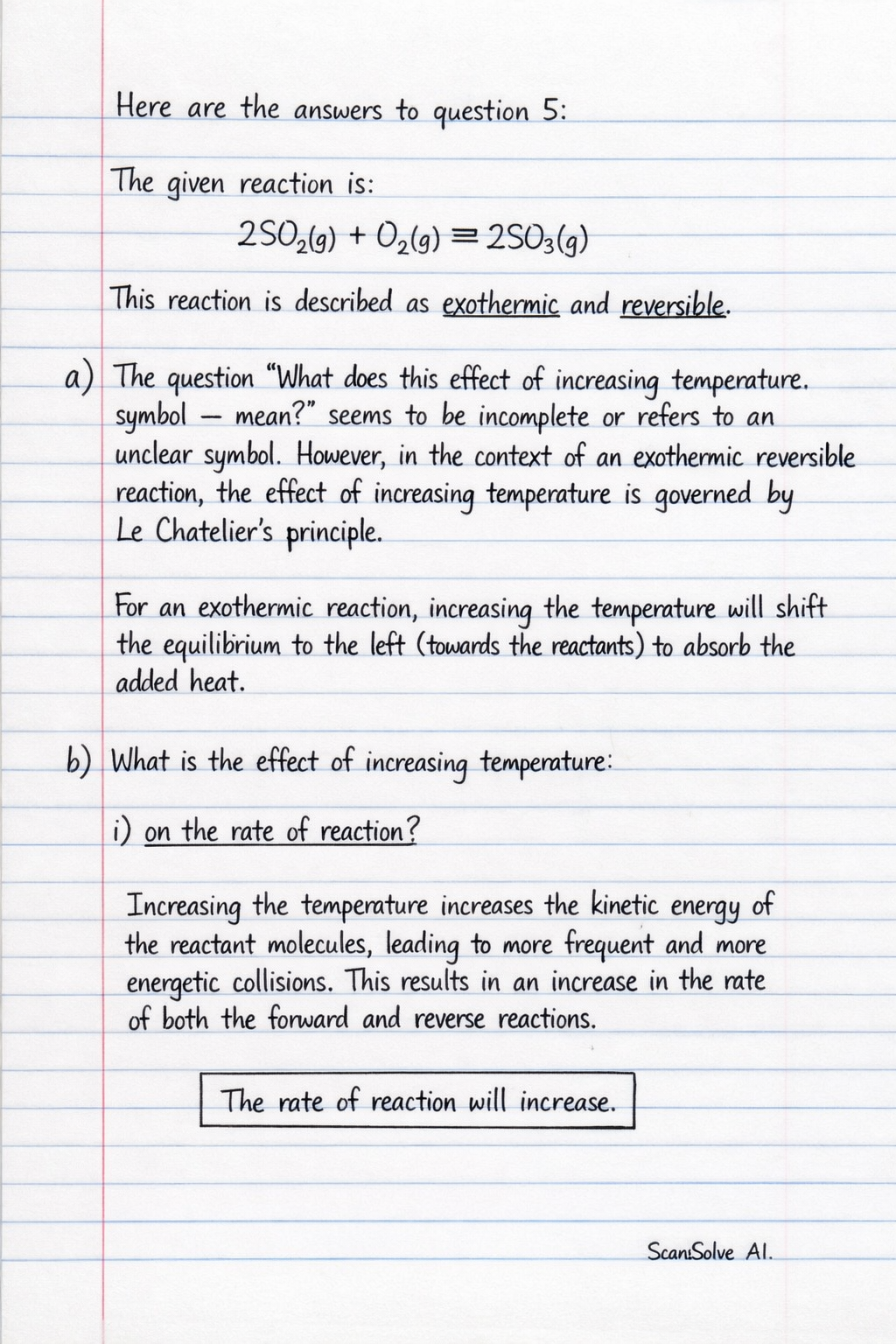
The given reaction is:
ScanSolve AI Answer
Here are the answers to question 5:
The given reaction is:
This reaction is described as exothermic and reversible.
a) The question "What does this effect of increasing temperature symbol - mean?" seems to be incomplete or refers to an unclear symbol. However, in the context of an exothermic reversible reaction, the effect of increasing temperature is governed by Le Chatelier's principle. For an exothermic reaction, increasing the temperature will shift the equilibrium to the left (towards the reactants) to absorb the added heat.
b) What is the effect of increasing temperature:
-
i) on the rate of reaction? Increasing the temperature increases the kinetic energy of the reactant molecules, leading to more frequent and more energetic collisions. This results in an increase in the rate of both the forward and reverse reactions.
-
ii) on the amount of sulphur trioxide present at equilibrium? Since the forward reaction () is exothermic, it releases heat. According to Le Chatelier's principle, if the temperature is increased, the equilibrium will shift in the direction that absorbs heat to counteract this change. The reverse reaction () is endothermic (absorbs heat). Therefore, increasing the temperature will favor the reverse reaction, shifting the equilibrium to the left. This will cause the amount of sulphur trioxide () to decrease.
Still stuck on this one?
Ask a follow-up, and the answer starts from this question.
More Chemistry Questions
Handwritten Step-by-Step Solution
Get this as a handwritten image on WhatsApp — like a tutor wrote it for you.
Try on WhatsApp