
Solve this question I have sent to u . Don't show me nonsense again.!!! The questions contains titration, energetics and organic chemistry rxns and experiments. Oya , solve am accurately as if u were answering the GCE directly.!!!!
ScanSolve AI Answer
Answers
3 partsStep-by-step solution
21 stepsHere is the solution to your question:
Part a· 3 steps
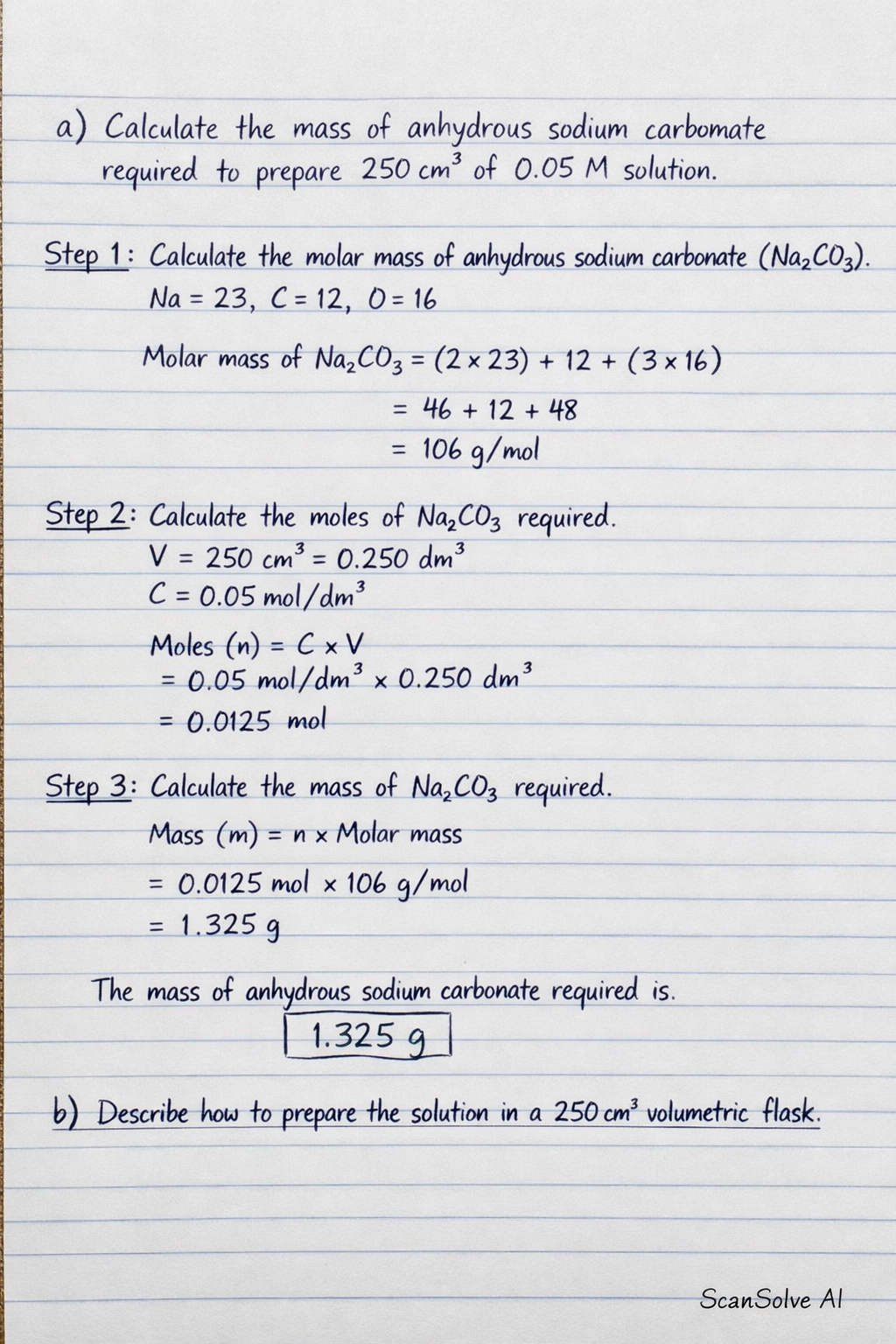
Calculate the mass of anhydrous sodium carbonate required to prepare 250 cm³ of 0.05 M solution.
Calculate the molar mass of anhydrous sodium carbonate (Na₂CO₃).
Given atomic masses: Na = 23, C = 12, O = 16.
Calculate the moles of Na₂CO₃ required.
Given volume () = 250 cm³ = 0.250 dm³.
Given concentration () = 0.05 mol dm⁻³.Calculate the mass of Na₂CO₃ required.
The mass of anhydrous sodium carbonate required is .
Part b· 5 steps
Describe how to prepare the solution in a 250 cm³ volumetric flask.
Weigh out 1.325 g of anhydrous sodium carbonate accurately using a weighing boat and an electronic balance.
Transfer the weighed solid into a clean 100 cm³ beaker.
Add about 50 cm³ of distilled water and stir with a glass rod until the solid completely dissolves.
Carefully transfer the solution from the beaker into a 250 cm³ volumetric flask using a funnel.
Rinse the beaker and the glass rod several times with small portions of distilled water, adding all washings to the volumetric flask.
Add distilled water to the volumetric flask until the bottom of the meniscus just touches the 250 cm³ mark, ensuring your eye is at the same level as the mark.
Stopper the volumetric flask and invert it several times to ensure the solution is thoroughly mixed and homogeneous.
Part c· 6 steps
Describe how to carry out the titration of 25.0 cm³ of the sodium carbonate solution with hydrochloric acid using methyl orange indicator.
Rinse a burette with the hydrochloric acid solution and then fill it with the acid, ensuring the jet is filled and reading the initial volume at the bottom of the meniscus.
Using a pipette, transfer 25.0 cm³ of the prepared sodium carbonate solution into a clean conical flask.
Add 2-3 drops of methyl orange indicator to the sodium carbonate solution in the conical flask.
The solution will turn yellow.
Titrate the sodium carbonate solution by slowly adding hydrochloric acid from the burette, swirling the conical flask continuously.
Add the acid drop by drop as you approach the endpoint.
Stop adding acid when the indicator changes color from yellow to a permanent orange/peach color.
Record the final burette reading.
Repeat the titration several times (at least two more times) until concordant results (titre values within of each other) are obtained.
Part d
Calculate the average volume of acid used.
Given titration results:
Titration 1: 24.80 cm³
Titration 2: 24.60 cm³
Titration 3: 24.65 cm³
Titration 4: 24.60 cm³
Identify concordant results.
Concordant results are those that are within of each other.
Titration 2 (24.60 cm³), Titration 3 (24.65 cm³), and Titration 4 (24.60 cm³) are concordant. Titration 1 (24.80 cm³) is not concordant with the others.Calculate the average volume using the concordant results.
Rounding to two decimal places, the average volume of acid used is .
Part e
Calculate the concentration of the hydrochloric acid.
Write the balanced chemical equation for the reaction.
Determine the mole ratio between Na₂CO₃ and HCl.
From the balanced equation, 1 mole of Na₂CO₃ reacts with 2 moles of HCl.
Mole ratio: .Calculate the moles of Na₂CO₃ used in the titration.
Concentration of Na₂CO₃ = 0.05 mol dm⁻³
Volume of Na₂CO₃ = 25.0 cm³ = 0.025 dm³Calculate the moles of HCl that reacted.
Using the mole ratio:
Calculate the concentration of HCl.
Average volume of HCl used = 24.62 cm³ = 0.02462 dm³
Rounding to three significant figures, the concentration of hydrochloric acid is .
Try one yourself
A new problem that tests the same skill.
Still stuck on this one?
Ask a follow-up, and the answer starts from this question.
More Chemistry Questions
Handwritten Step-by-Step Solution
Get this as a handwritten image on WhatsApp — like a tutor wrote it for you.
Try on WhatsApp