
We read your photo as:
State two different between physical and chemical change. Why is rusting considered as a chemical change? Is dissolving sugar in water chemical or physical change? Explain. State three signs that a chemical change has occured.
ScanSolve AI Answer
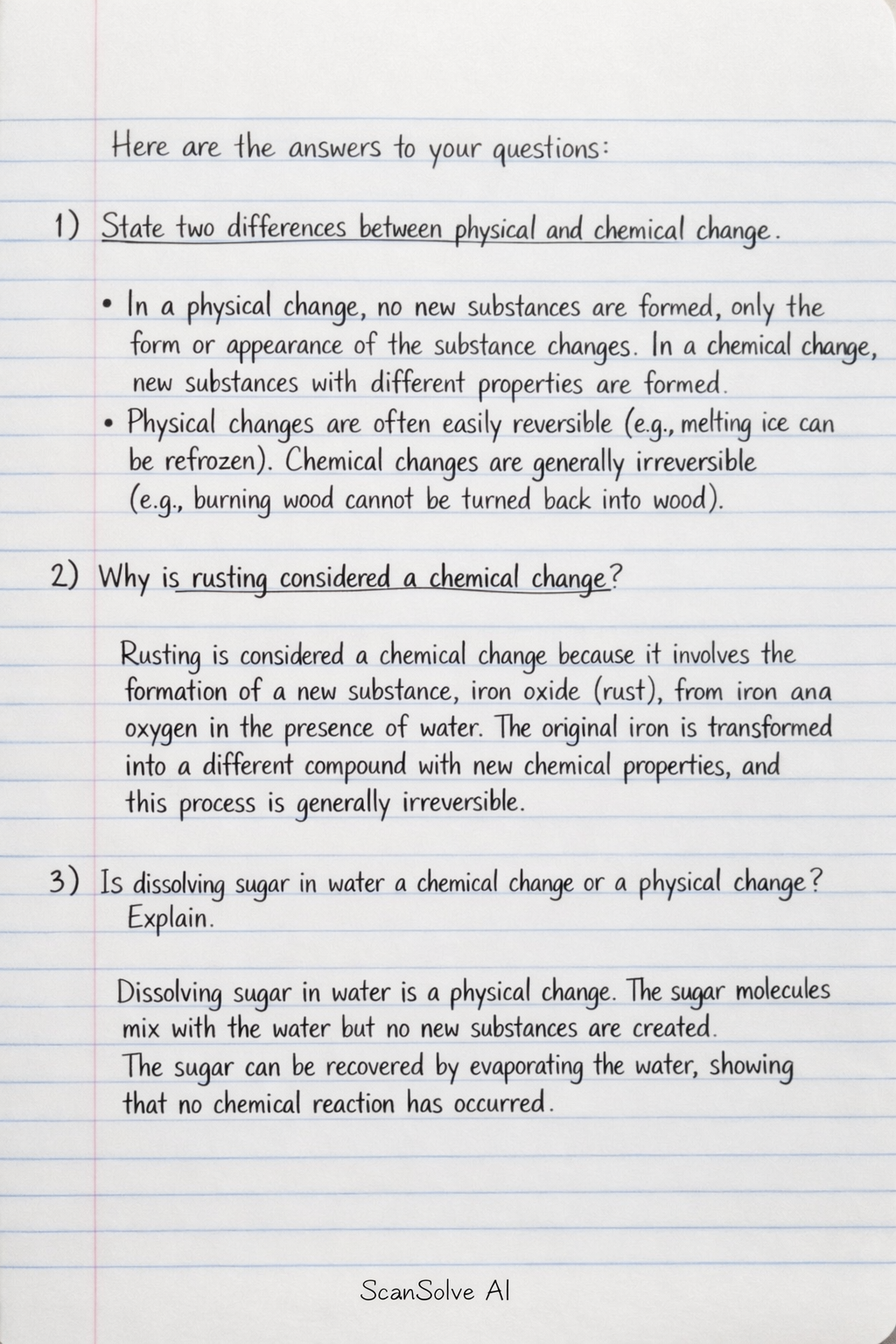
Here are the answers to your questions:
- State two differences between physical and chemical change.
- In a physical change, no new substances are formed, only the form or appearance of the substance changes. In a chemical change, new substances with different properties are formed.
- Physical changes are often easily reversible (e.g., melting ice can be refrozen). Chemical changes are generally irreversible (e.g., burning wood cannot be turned back into wood).
- Why is rusting considered a chemical change?
Rusting is considered a chemical change because it involves the formation of a new substance, iron oxide (rust), from iron and oxygen in the presence of water. The original iron is transformed into a different compound with new chemical properties, and this process is generally irreversible.
- Is dissolving sugar in water a chemical change or a physical change? Explain.
Dissolving sugar in water is a physical change. This is because the sugar molecules themselves do not change their chemical composition; they are simply dispersed throughout the water. No new substance is formed, and the sugar can be recovered by evaporating the water, demonstrating its reversibility.
- State THREE signs that a chemical change has occurred.
Three signs that a chemical change has occurred are:
- Change in color (e.g., fruit ripening).
- Formation of a gas (often seen as bubbles).
- Change in temperature (heat is either absorbed or released).
Still stuck on this one?
Ask a follow-up, and the answer starts from this question.
Handwritten Step-by-Step Solution
Get this as a handwritten image on WhatsApp — like a tutor wrote it for you.
Try on WhatsApp