

This computer science problem involves algorithmic thinking and programming concepts. The solution below explains the approach, logic, and implementation step by step.
ScanSolve AI Answer
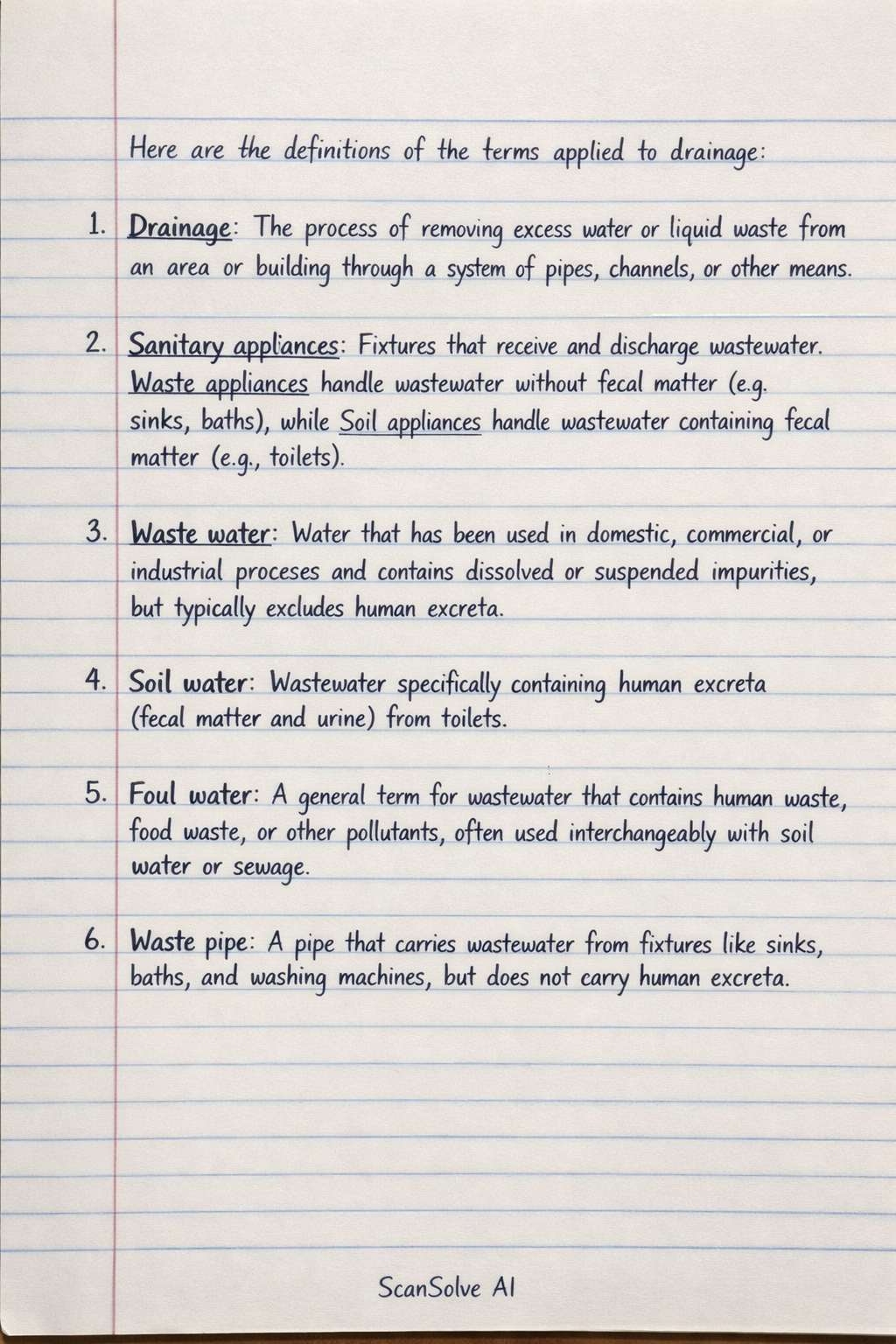
Here are the definitions of the terms applied to drainage: 1. Drainage: The process of removing excess water or liquid waste from an area or building through a system of pipes, channels, or other means. 2. Sanitary appliances: Fixtures that receive and discharge wastewater. Waste appliances handle wastewater without fecal matter (e.g., sinks, baths), while soil appliances handle wastewater containing fecal matter (e.g., toilets). 3. Waste water: Water that has been used in domestic, commercial, or industrial processes and contains dissolved or suspended impurities, but typically excludes human excreta. 4. Soil water: Wastewater specifically containing human excreta (fecal matter and urine) from toilets. 5. Foul water: A general term for wastewater that contains human waste, food waste, or other pollutants, often used interchangeably with soil water or sewage. 6. Waste pipe: A pipe that carries wastewater from fixtures like sinks, baths, and washing machines, but does not carry human excreta. 7. Soil pipe: A pipe that carries wastewater containing human excreta from toilets and may also carry waste water from other fixtures. 8. A drain: A pipe or channel that carries wastewater from a building or a limited area to a sewer or other disposal system. 9. A sewer: A larger underground pipe or conduit that collects and transports sewage and wastewater from multiple drains to a treatment plant or disposal site. 10. Private sewer: A sewer that serves a single property or a small group of properties and is owned and maintained by the property owner(s). 11. Public sewer: A sewer that serves a wider community, is part of the public sewerage system, and is owned and maintained by a local authority or utility company. 12. Sewage: The liquid waste containing human excreta, domestic wastewater, and sometimes industrial wastewater, transported through sewers. 13. Sewerage: The entire infrastructure system, including pipes, pumps, and treatment facilities, used for collecting, transporting, and treating sewage. 14. Stack: A vertical pipe that extends through one or more stories of a building, receiving discharge from horizontal branch pipes. It can be a soil stack or a waste stack. 15. Vent pipe: A pipe connected to a drainage system that allows air to enter and exit, preventing siphoning of traps and maintaining atmospheric pressure within the system. 16. Pavement drain: A drain designed to collect surface water runoff from paved areas like sidewalks and roads. 17. A trap: A U-shaped or S-shaped pipe fitting designed to hold a small amount of water, creating a seal that prevents sewer gases from entering a building. 18. A manhole: A covered opening in a sewer or drainage system that provides access for inspection, cleaning, and maintenance. 19. A septic tank: An underground watertight container that receives wastewater from a building, allowing solids to settle and partially decompose before the liquid effluent is discharged. 20. A soak-away pit: A pit or trench filled with permeable material (like gravel) that allows treated wastewater or surface water to gradually seep into the surrounding soil. Qualities of a good drainage system: A good drainage system must have adequate capacity to handle the maximum expected flow of wastewater without overflowing. It requires a proper gradient in all pipes to ensure a self-cleansing velocity, preventing the accumulation of solids. The system should be constructed from durable and corrosion-resistant materials to ensure a long lifespan and prevent leaks. All joints and connections must be watertight to prevent the leakage of sewage and the infiltration of groundwater. Accessibility for maintenance is crucial, with strategically placed manholes and cleanouts for easy inspection and blockage removal. Effective ventilation through vent pipes is necessary to prevent trap seal loss and safely release sewer gases. Traps must be installed at all fixture outlets to prevent foul air from entering the building. Finally, the system must ensure proper disposal of wastewater to a suitable treatment or disposal facility without causing environmental pollution.