
We read your photo as:
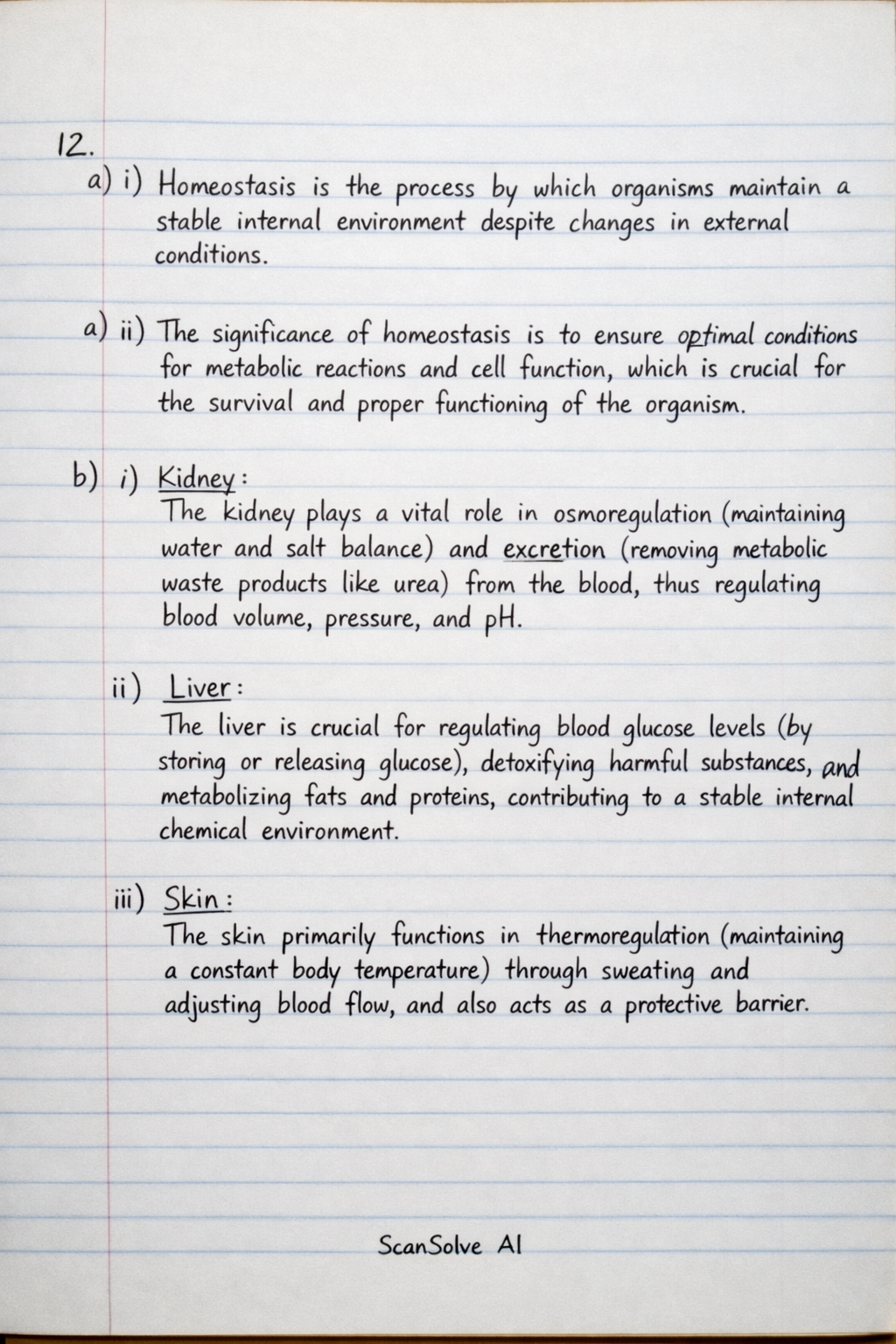
A) i) Homeostasis is the process by which organisms maintain a stable internal environment despite changes in external conditions.
ScanSolve AI Answer
- a) i) Homeostasis is the process by which organisms maintain a stable internal environment despite changes in external conditions.
ii) The significance of homeostasis is to ensure optimal conditions for metabolic reactions and cell function, which is crucial for the survival and proper functioning of the organism.
b) i) Kidney: The kidney plays a vital role in osmoregulation (maintaining water and salt balance) and excretion (removing metabolic waste products like urea) from the blood, thus regulating blood volume, pressure, and pH.
ii) Liver: The liver is crucial for regulating blood glucose levels (by storing or releasing glucose), detoxifying harmful substances, and metabolizing fats and proteins, contributing to a stable internal chemical environment.
iii) Skin: The skin primarily functions in thermoregulation (maintaining a constant body temperature) through sweating and adjusting blood flow, and also acts as a protective barrier.
- a) The liver: The liver maintains a constant internal environment by regulating blood glucose levels through the storage and release of glycogen, detoxifying harmful substances from the blood, and metabolizing nutrients, ensuring a stable supply of energy and removal of toxins for cells.
b) The skin: The skin contributes to a constant internal environment by regulating body temperature. It achieves this by releasing heat through sweating when the body is too warm and by constricting blood vessels to conserve heat when the body is cold.
c) The kidneys: The kidneys maintain a constant internal environment by filtering blood to remove metabolic waste products (like urea), regulating water balance, and controlling the levels of electrolytes (e.g., sodium, potassium) and blood pH, ensuring stable conditions for cellular processes.
Still stuck on this one?
Ask a follow-up, and the answer starts from this question.
More Computer Science Questions
Handwritten Step-by-Step Solution
Get this as a handwritten image on WhatsApp — like a tutor wrote it for you.
Try on WhatsApp